Advert

Showing posts with label Regional News. Show all posts

Tibet forges ahead as its people prosper


Local development has been given strong government support and will continue to receive it, Party chief says.


Tibet will give equal priority to growth, stability and ecology to ensure sustained socioeconomic improvements, Wu Yingjie, Party chief of the Tibet autonomous region said in an article published in the People’s Daily recently.

The Central Committee of the Communist Party of China and the central government have given strong support to Tibet’s development since the 18th National Congress of CPC convened in November 2012 in Beijing, he said.

Over the past five years the central authorities’ support has included starting many infrastructure projects, issuing preferential policies specifically for Tibet, making the region a higher priority in the national development strategy and offering guidance for the autonomous region’s growth, Mr Wu said.

Tibet is now in the best period of development in its history in terms of social stability, economic growth, ecology and people’s quality of life, Mr Wu said.

During the first half of this year, Tibet ranked first in the country in the growth of gross domestic product, industrial gross profit, retail sales of consumer goods and per capita incomes for rural and urban residents, he said. It ranked third in the growth of fixed-asset investment.


The government will invest 73.7 billion yuan (£8.48 billion) this year in 32 key projects for improving residents’ living conditions.


Tibet will make further efforts to help increase growth, ensure social stability and improve people’s lives, he said. The government will invest 73.7 billion yuan (£8.48 billion) this year in 32 key projects for improving residents’ living conditions.

The spending and other efforts will ensure that 130,000 people in Tibet can be lifted above the poverty line by the end of this year. About 20 counties will be removed from the list of impoverished areas, he said.

Tibet is highlighting the role of industrial development in eradicating poverty, both in cities and the countryside.

Farmers, herders and local businesses are joining efforts to extend industrial chains of local produce such as highland barley and yak dairy products, which are playing an increasingly important role in raising locals’ incomes, he said.

Various measures will be taken to promote employment, especially for new graduates from colleges and universities, he said.

Graduates are encouraged to start their own businesses, and the government has set aside 2 billion yuan for an entrepreneurship fund for graduates. About 3,000 new graduates from universities have opened their own businesses this year in the region, Mr Wu said.

Medical care is crucial for improving local people’s lives, so authorities will adopt preferential policies to attract medical professionals from the rest of the country, to encourage medical workers to work in rural communities and improve education for rural medical professionals, he said.

Mr Wu highlighted the role of religious affairs in maintaining social stability in Tibet.

The Party’s and the government’s management of religious affairs should be enhanced, he said, adding that efforts should be made to ensure freedom of belief and improve the lives of Buddhists and other believers.

On the other hand, the Tibetan people oppose all kinds of separatist activities and violence in the disguise of religions, he said.

Mr Wu said Tibet should strengthen collaboration with other regions of the country. He said Tibet will have more preferential policies to encourage talented people from the rest of China to come to Tibet to work or start businesses — and Tibetans are encouraged to work outside Tibet to learn more skills for working or doing business.

Mr Wu said good ecology plays an important role in Tibet’s development and the well-being of its people.

To protect the local environment, Tibet should take stricter measures to control pollution and restore plateau ecology by minimising the impact of human activities, he said.

Pakistan army chief makes historic visit to Iran

Image result for Pakistan army chief makes historic visit to Iran

ATTA KENARE/AFP/Getty ImagesPakistan army chief Gen. Qamar Javed Bajwa (L) meets with Iranian President Hassan Rouhani during a trip to Tehran, Iran, Nov. 6, 2017.


In a visit to Iran to boost military relations, Pakistan’s chief of army staff, Gen. Qamar Javed Bajwa, expressed interest in learning from Iran’s Basij Organization. The meeting between the two countries at the military level was hailed in Iranian media as a new era in Iran-Pakistan military relations.


Speaking to Maj. Gen. Mohammad Ali Jafari, the head of Iran’s Islamic Revolutionary Guard Corps (IRGC), Bajwa said, “We believe the most important factor in your success against enemies is the support of the people, and I hope this trip will be the basis for transferring to Pakistan the experience of the Basij and the example of the Iranian people’s forces.”


The Basij Organization, which formally operates under the IRGC, was created after the 1979 Islamic Revolution on the orders of Ayatollah Ruhollah Khomeini, the founder of the Islamic Republic of Iran and former supreme leader. It was not until after the Iraqi invasion of Iran in 1980 that the Basij took on a life of its own and became a popular force for its role on the front lines. Basij popularity took a hit after the 2009 presidential election, in which its forces played a significant role in quelling protests. Iranian officials have claimed that Basij membership is in the millions, which may be technically accurate. However, full-time, active membership is likely 100,000.


Despite some differences on regional issues, the two military leaders heaped praise on each other’s countries and promised greater military cooperation. “The mutual cultural and linguistic similarities of a part of Pakistan and Iran shows the depth of this relationship,” said Jafari. He added, “With the existence of conspiracies and treachery of the enemies against Islam and regional countries, with respect to the past, Iran and Pakistan’s relationship will become deeper.”


In reference to the experiences of Iran’s armed forces during the Iran-Iraq War, Jafari said, “The presence of the people in defending the Islamic Revolution and the homeland resulted in changing the fate of the war.” The United States, Western European countries and nearly all of the Arab countries supported former Iraqi President Saddam Hussein’s invasion of Iran, which was under sanctions and was forced to rely on volunteer forces such as the Basij. Jafari called the people’s forces such as the Basij the “most important component of the Sacred Defense,” which is what the Iran-Iraq War is called in Iran.


To what degree Iran’s wartime experiences, especially the evolution and formation of the Basij, can be transferred to Pakistan remains to be seen. Iran does, however, have experience in building up and supporting forces in Iraq and Syria. Of Iran’s efforts in helping the Iraqi and Syrian governments to build up a people’s force, Jafari said, “Today, this example has been transferred to other countries. And in Syria and Iraq — when the decision was made for the entrance of the people into the war — their presence was organized, and the defense of the people alongside the army turned the page against Daesh [the Islamic State] and marked the defeat of takfiris.”


During his three-day visit, Bajwa also met with President Hassan Rouhani, Foreign Minister Mohammad Javad Zarif and the chief of staff of Iran’s armed forces, Maj. Gen. Mohammad Hossein Bagheri.


Courtesy Al-Monitor

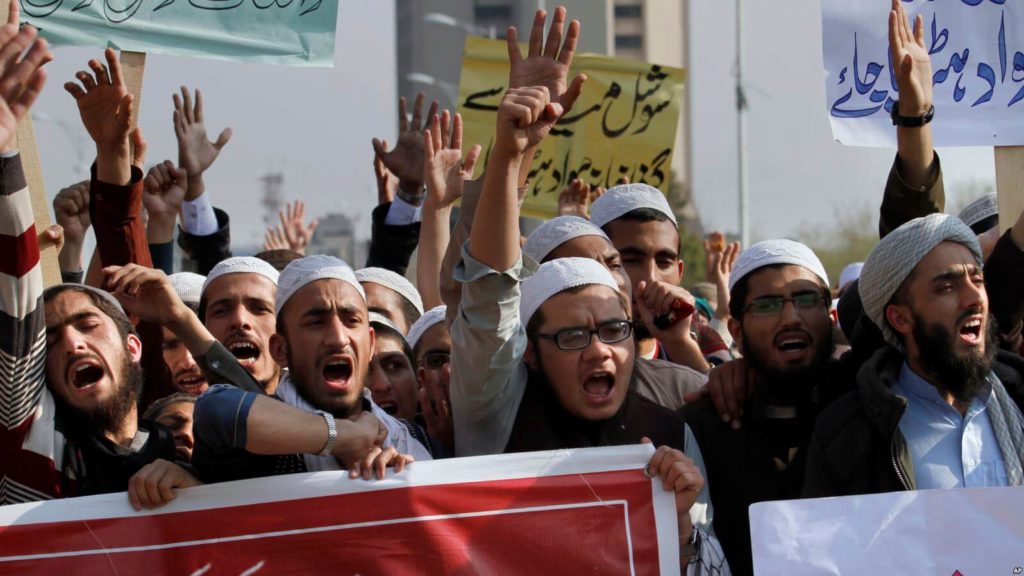
Pakistan’s capital Islamabad shut down by Islamists

 Pakistani Law and Enforcement Agencies   helpless as capital #Islamabad shut down by Islamists.


Several thousand Islamists in Pakistan have effectively blocked a main crossing near the national capital, Islamabad, crippling the daily life of millions of people and underscoring challenges facing the country’s counter extremism efforts.


The rally began with a few hundred members of the small radical Tehreek-i-Labaik Ya Rasool Allah party who had gathered earlier this week at the main Faizabad crossing outside Islamabad.


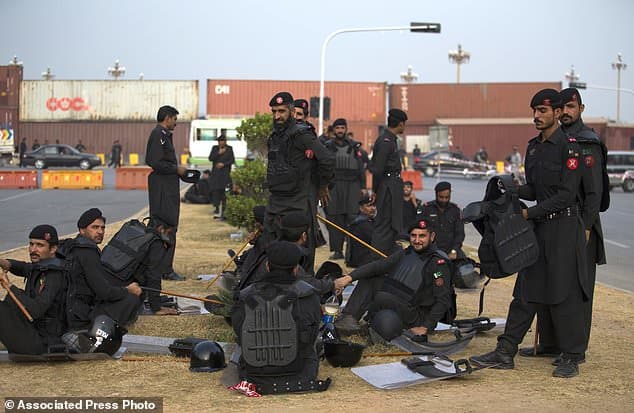
By Friday afternoon, the gathering grew to over 3,000, disrupting public life and prompting police to set up shipping containers on the throughway to prevent the protesters from entering the city. The demonstrators sought the removal of Zahid Hamid, although he has apologized and said the omission of the reference how Muhammad is the last prophet in Islam was a clerical mistake that was later corrected by the parliament.


But demonstrators claim Hamid made the omission purposefully to appease the minority Ahmadis sect.


Addressing emotionally charged demonstrators, Khadim Hussain Rizvi, the head of the Tehreek-i-Labaik Ya Rasool Allah party, said they will not end their protest until the government has sacked Hamid.


“We will not allow anyone to change Islamic laws,” he said, as people chanted: “We will die to protect the honor of the Prophet.”


The rally drew criticism from residents and rights activists when an infant died Thursday on the way to a hospital due to the road blockades in Islamabad. Police say they have charged the rally’s organizer, Rizvi, with manslaughter following complaints from the child’s parents who claim his life could have been saved had they reached the hospital in time.


The government has said it wants the protesters to peacefully disperse and authorities are in communication with Rizvi — who has not yet been detained over the charge — to end the sit-in along with the other clerics in attendance.


Pakistani Interior Minister Ahsan Iqbal told media that the government has rejected the protesters’ demand for the law minister to be removed, saying there is no charge against him.


“There is a small group of certain demonstrators who are sitting on one road. We are trying to talk to them through dialogue to persuade them that this is an illegal action to make a sit-down on the road because there is a restriction on such an assembly under the law. However, if they indulge in any violent activity the law will take its course,” Iqbal said.


The rally has also caused inconvenience to commuters as authorities have suspended the only bus service linking the nearby garrison city of Rawalpindi with Islamabad.


Islamabad’s administration has placed scores of shipping containers and deployed up to 4,000 policemen to prevent protesters from entering Islamabad’s key areas, particularly the “Red Zone” housing foreign diplomatic missions, government offices and the parliament.


Authorities have hinted at using force over the weekend if their talks with Rizvi fail.


On Friday evening, authorities started cordoning the rally amid rumors of imminent action against the demonstrators, who have virtually sieged an important entry gateway into the capital.


Pakistan has also stepped up security at places of worship for Ahmadis, as the protesters are accusing Hamid of transgressing to appease the small sect.


Ahmadis are declared non-Muslims under the Pakistani constitution and considered apostates by the clergy. Members of the community in Pakistan are barred from calling themselves Muslims or referring to their worship places as mosques.


Ahmadis’ interpretation of Islam differs from traditional orthodox positions, and community leaders insist their faith has been misinterpreted by mainstream Muslims, encouraging fundamentalists to persecute and preach violence against them.


Courtesy Rabwah

Exclusive: 'We will kill you all' - Rohingya villagers in Myanmar beg for safe passage

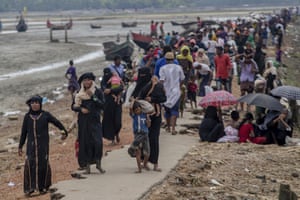
 Rohingya Muslims, who crossed over from Myanmar into Bangladesh, walk towards the nearest refugee camp at Teknaf, Bangladesh


SITTWE, Myanmar (Reuters) - Thousands of Rohingya Muslims in violence-racked northwest Myanmar are pleading with authorities for safe passage from two remote villages that are cut off by hostile Buddhists and running short of food.


“We’re terrified,” Maung Maung, a Rohingya official at Ah Nauk Pyin village, told Reuters by telephone. “We’ll starve soon and they’re threatening to burn down our houses.”


Another Rohingya contacted by Reuters, who asked not to be named, said ethnic Rakhine Buddhists came to the same village and shouted, “Leave, or we will kill you all.”


Fragile relations between Ah Nauk Pyin and its Rakhine neighbors were shattered on Aug. 25, when deadly attacks by Rohingya militants in Rakhine State prompted a ferocious response from Myanmar’s security forces.


At least 430,000 Rohingya have since fled into neighboring Bangladesh to evade what the United Nations has called a “textbook example of ethnic cleansing”.


About a million Rohingya lived in Rakhine State until the recent violence. Most face draconian travel restrictions and are denied citizenship in a country where many Buddhists regard them as illegal immigrants from Bangladesh.


Tin Maung Swe, secretary of the Rakhine State government, told Reuters he was working closely with the Rathedaung authorities, and had received no information about the Rohingya villagers’ plea for safe passage.


“There is nothing to be concerned about,” he said when asked about local tensions. “Southern Rathedaung is completely safe.”


National police spokesman Myo Thu Soe said he also had no information about the Rohingya villages but that he would look into the matter.


Asked to comment, a spokeswoman for the U.S. State Department’s East Asia Bureau made no reference to the situation in the villages, but said the United States was calling “urgently” for Myanmar’s security forces “to act in accordance with the rule of law and to stop the violence and displacement suffered by individuals from all communities.”


“Tens of thousands of people reportedly lack adequate food, water, and shelter in northern Rakhine State,” spokeswoman Katina Adams said. “The government should act immediately to assist them.”


Adams said Patrick Murphy, the U.S. deputy assistant secretary of state for East Asia, would reiterate grave U.S. concern about the situation in Rakhine when he meets senior officials in Myanmar this week.


Britain is to host a ministerial meeting on Monday on the sidelines of the annual U.N. General Assembly in New York to discuss the situation in Rakhine.


NO BOATS


Ah Nauk Pyin sits on a mangrove-fringed peninsula in Rathedaung, one of three townships in northern Rakhine State. The villagers say they have no boats.

Until three weeks ago, there were 21 Muslim villages in Rathedaung, along with three camps for Muslims displaced by previous bouts of religious violence. Sixteen of those villages and all three camps have since been emptied and in many cases burnt, forcing an estimated 28,000 Rohingya to flee.


Rathedaung’s five surviving Rohingya villages and their 8,000 or so inhabitants are encircled by Rakhine Buddhists and acutely vulnerable, say human rights monitors.


The situation is particularly dire in Ah Nauk Pyin and nearby Naung Pin Gyi, where any escape route to Bangladesh is long, arduous, and sometimes blocked by hostile Rakhine neighbors.


Maung Maung, the Rohingya official, said the villagers were resigned to leaving but the authorities had not responded to their requests for security. At night, he said, villagers had heard distant gunfire.


“It’s better they go somewhere else,” said Thein Aung, a Rathedaung official, who dismissed Rohingya allegations that Rakhines were threatening them.


Only two of the Aug. 25 attacks by the Arakan Rohingya Salvation Army (ARSA) took place in Rathedaung. But the township was already a tinderbox of religious tension, with ARSA citing the mistreatment of Rohingya there as one justification for its offensive.


In late July, Rakhine residents of a large, mixed village in northern Rathedaung corraled hundreds of Rohingya inside their neighborhood, blocking access to food and water.


A Rohingya refugee carries a sick infant in Cox's Bazar, Bangladesh, September 17, 2017. REUTERS/Cathal McNaughton


A similar pattern is repeating itself in southern Rathedaung, with local Rakhine citing possible ARSA infiltration as a reason for ejecting the last remaining Rohingya.


‘ANOTHER PLACE’


Maung Maung said he had called the police at least 30 times to report threats against his village.


On Sept. 13, he said, he got a call from a Rakhine villager he knew. “Leave tomorrow or we’ll come and burn down all your houses,” said the man, according to a recording Maung Maung gave to Reuters.


When Maung Maung protested that they had no means to escape, the man replied: “That’s not our problem.”


On Aug. 31, the police convened a roadside meeting between two villages, attended by seven Rohingya from Ah Nauk Pyin and 14 Rakhine officials from the surrounding villages.


Instead of addressing the Rohingya complaints, said Maung Maung and two other Rohingya who attended the meeting, the Rakhine officials delivered an ultimatum.


Slideshow (8 Images)


“They said they didn’t want any Muslims in the region and we should leave immediately,” said the Rohingya resident of Ah Nauk Pyin who requested anonymity.


The Rohingya agreed, said Maung Maung, but only if the authorities provided security.


He showed Reuters a letter that the village elders had sent to the Rathedaung authorities on Sept. 7, asking to be moved to “another place”. They had yet to receive a response, he said.


VIOLENT HISTORY


Relations between the two communities deteriorated in 2012, when religious unrest in Rakhine State killed nearly 200 people and made 140,000 homeless, most of them Rohingya. Scores of houses in Ah Nauk Pyin were torched.


Since then, said villagers, Rohingya have been too scared to leave the village or till their land, surviving mainly on monthly deliveries from the World Food Programme (WFP). The recent violence halted those deliveries.


The WFP pulled out most staff and suspended operations in the region after Aug. 25.


Residents in the area’s two Rohingya villages said they could no longer venture out to fish or buy food from Rakhine traders, and were running low on food and medicines.


Maung Maung said the local police told the Rohingya to stay in their villages and not to worry because “nothing would happen,” he said.


But the nearest police station had only half a dozen or so officers, he said, and could not do much if Ah Nauk Pyin was attacked.


A few minutes’ walk away, at the Rakhine village of Shwe Long Tin, residents were also on edge, said its leader, Khin Tun Aye.


They had also heard gunfire at night, he said, and were guarding the village around the clock with machetes and slingshots in case the Rohingya attacked with ARSA’s help.


“We’re also terrified,” he said.


He said he told his fellow Rakhine to stay calm, but the situation remained so tense that he feared for the safety of his Rohingya neighbors.


“If there is violence, all of them will be killed,” he said.


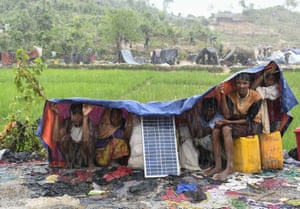
Rohingya refugees protect themself from the rain in Bangladesh’s Balukhali refugee camp

Courtesy


Reporting by Wa Lone and Andrew R.C. Marshall; Additional reporting by David Brunnstrom in Washington; Editing by Ian Geoghegan and Peter Cooney

Our Standards:The Thomson Reuters Trust Principles.

The future leaders of Central Asia


Students from the University of Central Asia’s inaugural class during the inauguration ceremony in Naryn, Kyrgyzstan. Photo by: Michael Igoe / Devex

Naryn, Kyrgyzstan — In the 15th century, a grandson of the Central Asian conqueror Timur — or Tamerlane — sought to turn the city of Samarkand into an intellectual capital of the Persian Empire. His name was Ulugh Beg, and he ruled over the territory now referred to somewhat dismissively as “the Stans.” Ulugh Beg built one of the largest astronomical observatories in the world, with an 11-meter sextant, and he used it to calculate the timing of eclipses.


“Central Asia, a thousand years ago, led the world in trade and investment, in urban development, in cultural and intellectual achievement. This was the place that leading thinkers from around the known world would look to for leadership,” said Prince Karim Aga Khan IV, at the inauguration of the University of Central Asia in Naryn, Kyrgyzstan, in October.


The Aga Khan Development Network, a multi-disciplinary development organization founded and led by the Islamic royal billionaire, is trying to rebuild Central Asia’s educational and intellectual infrastructure. The University of Central Asia will operate in three countries — Kyrgyzstan, Tajikistan and Kazakhstan — and draw students from across the region. Its aim is to create the next generation of Central Asian thinkers, scientists and leaders.


The university, however, has taken a big risk and faces an uphill battle. UCA’s graduates will have the language skills and educational training that would propel many young job seekers to higher-paying opportunities abroad. The Aga Khan’s vision is that these students find opportunities for leadership in their own region. Whether that vision comes to fruition will depend on whether UCA can tailor the education students receive to the specific practical challenges facing their own communities — and whether the university can establish a network of graduates and researchers who will become Central Asia’s job creators.


There are only 71 students in UCA’s inaugural class, but when it reaches full capacity, the university’s three international campuses in remote, underdeveloped mountain towns will educate 3,000 plus students and employ more than 300 faculty. The Aga Khan Development Network has placed a big bet on these students: that, if equipped with a world-class education tailored to their own countries and mountain environments, they can help drive economic, scientific and political progress across Central Asia.


Today, Central Asia is better known for its past than its present. World heritage sites shelter in cities whose names resonate through history — Samarkand, Bukhara, Herat — while the future remains an uncertain place. Since the days of the fabled silk road trading routes, Central Asian states have found themselves caught between spheres of influence, absorbed into political empires, and cast out into the wilds of global capitalism. Five of these countries are still known best by what they used to be — “the former Soviet Union.” Most have struggled with war and autocracy.


According to the Aga Khan, the quality that enabled the region’s intellectual life to flourish a thousand years ago was “openness.”


“Openness to new ideas, openness to change, and openness to people from many backgrounds and with a variety of gifts ... That kind of openness can again be the key that unlocks the doors to the future,” he said at the inauguration.


The spiritual leader of 15 million Ismaili muslims has staked a big share of his legacy and fortune on the University of Central Asia — and the international cohort of students he hopes will help redefine leadership for a region that has struggled to recapture its spirit of openness.


Will this society reward them?


Zarastin Kholbash is a member of UCA’s inaugural class, currently pushing through the intensive one-year preparatory curriculum designed to help incoming students master English and critical thinking skills before moving on to the four-year international degree program.


Kholbash, who is from Khorog, Tajikistan, an isolated mountain town near the Afghan border, already speaks English with near-fluency. She plans to study communications so she can work as a journalist like her uncle and her mother, who have both been targeted by Tajikistan’s government for their opposition to a regime the Economist Intelligence Unit dubs “authoritarian.”


“The government were looking for us. They did a lot of bad stuff to my family. My mom, they don’t let her work. And my uncle, he had to leave the country … I had a lot of problems too in school,” Kholbash said, seated at a table in UCA’s bustling cafeteria.


If UCA lives up to its billing, the education students receive will be on par with world-class universities in Europe and the United States. In its first admissions cycle UCA already attracted some of the most competitive applicants in the region, many of whom saw the Central Asian startup as an alternative to leaving for universities in Russia, Turkey, Europe or the United States. But whether UCA fulfills its mission as an institution focused on regional economic development depends on more than just the quality of the education it delivers. UCA’s regional impact hinges on what students decide to use that education for — and where.


“I can assure you that it would be a heck of a lot cheaper to take these 70 students and send them off on scholarships to the U.S. and Canada … than it is to build this university and keep them here,” said Valerie Lopes, director of teaching and learning at Seneca College in Toronto, who led the development of UCA’s preparatory year curriculum.


The Aga Khan has chosen to undertake a massive institution-building project in rural, mountainous areas. After this first preparatory year, UCA’s students will have the English-language proficiency to pass university entrance exams and the academic credentials to stand out among international applicants. But UCA’s basic mission is to promote socio-economic development in the region, not send qualified job-seekers abroad.


“That’s without question a risk they’ve taken… They’re gambling here,” Lopes said.


The students’ own preferences are not the only factor that will determine whether they can apply their UCA education at home. With a few exceptions, such as oil-wealthy Kazakhstan, Central Asia’s economies are small and struggling. More than 80 percent of Kyrgyzstan’s population lives on less than five dollars a day, and with many of the former Soviet states still heavily dependent on remittances from Russia, Moscow’s economic troubles have been a liability for the region. The countries may not have the capacity to employ the more than 1,000 graduates who will eventually emerge from UCA every year.


Lake Chatyr-Kol, seen from a mountain pass in Kyrgyzstan. Photo by: Michael Igoe


“The question will be, will this society reward them for that level of knowledge,” said Shamsh Kassim-Lakha, chairman of UCA’s board of trustees.


It may take some time, Kassim-Lakha admits, before a steady stream of UCA graduates are meeting a steady supply of job opportunities in the countries where their expertise and talents are so badly needed.


But he hopes UCA’s graduates will eventually become job creators and look to the network of fellow graduates to help build Central Asia’s businesses and institutions. Some of them will no doubt be drawn away from the region, to countries where salaries are higher and jobs are more plentiful. But Kassim-Lakha predicts that many will come back.


“You work on Wall Street — who knows you there? Who are you? You are another number, or maybe another brilliant financial analyst. You come here and people say, ‘my god, look at this man,’” Kassim-Lakha said.


“The way we are educating them is to have that sense about ‘my people.’ Where do I belong? Where are my roots?” Kassim-Lakha said.


Kholbash, who traveled to the United States under the State Department’s Future Leaders Exchange Program, and who has seen family members suffer for expressing political views, says her goal is to apply what she learns at UCA at home, not to use it as a springboard for job opportunities abroad.


“I grew up in Tajikistan, and yeah, I had a bad experience with government. I had a bad experience with people, but I don’t think it’s their fault. They just don’t know another way of doing things. If more people get educated, it’s going to change, but we need more time,” she said.


“I don’t want to just leave them and say, ‘oh it’s Tajikistan. It’s just the way it is.’ I want to change something. Because nobody needs me in Europe or America. They need me here, because it’s my home town,” she said.


18,000 lawyers and 8 geologists


Kyrgyzstan is richly endowed with natural resources, including gold and rare earth metals such as beryllium, but also hydropower; its reservoirs fed by the massive rivers that drain the country’s glaciated peaks. Less abundant are local people with the scientific and environmental knowledge to harness those resources for the country’s own development.


Deep in Kyrgyzstan’s Tien Shan mountains and 14,000 feet above sea level, the open-pit gold mine “Kumtor” churns out mineral resources worth nearly 10 percent of the country’s gross domestic product. The mine can produce more than half a billion dollars worth of gold per year in a country where the GDP per capita barely tops $1,000.


But suitable expertise is simply lacking inside a country that looks to the mining sector to power a significant portion of its economy.


“You have a country with an educational system that produces 5,000 lawyers a year and three or four people that are geologists, whereas the extractive industries is a high priority,” said Bohdan Krawchenko, UCA’s director general and dean of graduate studies.


Between 2008 and 2012, Kyrgyzstan’s universities graduated eight geologists and 60 exploration technicians — and 18,018 lawyers, according to UCA.


“The disconnect between declarations and actually mobilizing society and building capacity in society for these declarations — there is a yawning gap in between,” Krawchenko said.


The University of Central Asia’s campus in Naryn, Kyrgyzstan. Photo by: Michael Igoe / Devex


A key component of UCA’s strategy is to educate students in areas relevant to the socio-economic development of the mountain regions where the three campuses are located. Beyond the undergraduate curriculum, UCA aims to host graduate research programs and create new knowledge of practical use to mountainous Central Asian societies.


The Mountain Societies Research Institute, a multidisciplinary research center “dedicated to addressing the challenges and opportunities within Central Asian mountain communities and environments,” is already active. In November MSRI announced a partnership with three snow leopard conservation programs aimed at securing vital ecosystems for the endangered cats. MSRI-affiliated researchers have studied sustainable land management, tourism development, glacial retreat due to climate change, and a range of other issues affecting Central Asia’s mountain communities and ecosystems.


“To find the smallest particle of matter is very important, but we don’t have the means [nor] the ability to compete in that area,” Kassim-Lakha said. “If our researchers can come up with ideas — whether it’s on disaster mitigation, or in the area of agriculture, or improving the understanding of how one valley works with another one without fighting — that improve the quality of life for people, [then] we have then made this university relevant to the society in which it functions.”


Eventually, UCA’s leaders aim to develop graduate programs that will train experts in areas critical to socio-economic development in the mountains.


“We’re going to try to move the graduate schools ahead even more quickly than the undergraduate schools. It will give us a quicker impact. It will give us mid-career support for mid-career people in this region,” the Aga Khan said in response to a question from Devex.


What is ‘Central Asia’?


UCA’s students, currently drawn from five countries, live in two-person rooms with wooden dividers that separate one from the other. Each student is matched with a roommate from a different country.


Kholbash, from Tajikistan, lives with a student from Bishkek, Kyrgyzstan’s capital. “She talks about Kyrgyzstan. I tell her about Tajikistan,” Kholbash said.


The two countries share a border and a history as former Soviet republics and about 50,000 Tajiks live in Kyrgyzstan. But the two landlocked nations are also culturally distinct. Tajik is a Persian language, while Kyrgyz is related to Turkish. The rivers and canals they share have been points of conflict. Regional cooperation has been difficult to forge, despite — and in part because of — the Soviet effort to construct a post-national, integrated union.


“Today, Central Asia is just known as Central Asia to you and me. People here call themselves Kyrgyz, or Kazakhs, or Tajik. It is not an identity of Central Asia ... They don’t get to see themselves as Central Asians,” Kassim-Lakha said.


Part of UCA’s potential, according to the university’s leaders, is to contribute to a sense of regional identity — and to enable better regional cooperation among the political, business and scientific leaders who will eventually comprise the university’s network of graduates.


“One hopes that in the next 20 to 25 years, some of the kids we saw there will be the best physician, a very powerful civil servant, or a minister or a lawyer — and I need to just pick up the phone and ask my friend in Astana, ‘listen, we’ve got this issue, and why are we fighting between ourselves?’ Just multiply the number of cohorts by about 50, and you can see that this is a possible catalyst for cooperation,” Kassim-Lakha said.


For now, UCA’s inaugural class of students are focused on the next assignment — and feeling the weight of expectations that has followed them from home.


“In my home town, when I was leaving, they were telling me that I can change the situation in the country … I have a lot of pressure.” said Kholbash.


“I think it’s fine, because it makes me more powerful,” she said.


Michael Igoe /Devex

EIGHT YEARS OF AWAMI LEAGUE RULE Bangladesh at a Political Crossroads

Mir Aftabuddin Ahmed


People protesting on the streets during the anti-Ershad movement. Photo: Dinu Alam

Bangladesh will be observing the eighth consecutive year of the present Awami League Government on January 5, 2017. In the last eight years, the country has witnessed impressive socio-economic development. Prime Minister Sheikh Hasina and her cabinet have successfully enhanced the scope of the Bangladeshi economy whilst restoring Bangladesh's soft-power image internationally. The statistics and data support this. Nevertheless, uncomfortable questions have arisen regarding the state of democracy in Bangladesh. If Bangladesh is to continue in its path towards becoming a middle-income economy, the values of democracy that have diminished over the past few years, requires a major revamp in the current year.


Begum Khaleda Zia may have flaws. But nobody can question her role in the anti Ershad struggle or her defiant character. In a public rant against the Awami League regime and state organisations, the erstwhile Leader of the Opposition questioned the audacity of the law-enforcement agencies in surrounding her residence without a warrant in December 2013. When Begum Zia strode out of her car and expressed her anger towards the Government, many believed she had the sympathy, if not support, of the public. The facts remain that the Awami League Government had harassed her, cordoned her house off with the notorious sand-trucks and arrested many senior leaders of her party, prior to the January elections.


And yet how the tables have turned! Does the Awami League Government enjoy nationwide support? Surveys give indifferent responses. Who knows, maybe people do not care anymore. But then does the public have an overarching support for the BNP? The answer is no. Neither the BNP nor the Awami League enjoy the levels of popularity that they had in the past. Social media and an ever-aware population do not succumb to the rhetoric of politicians.


To judge the January 5 election of 2014 as a simple matter of right versus wrong, is in itself erroneous. The Awami League is right when it says that the election was a constitutional requirement. The BNP is right when it suggests that the day was a dent to democracy. And General Ershad's flip flopping on whether he would participate in the election or not, was in all honesty, a comical charade for the public. But what Sheikh Hasina, Begum Zia and General Ershad fail to realise is that this entire episode and its long term effects were consequences of a purely internal political issue. The public had nothing to do with it. We did not demand a scrapping of the caretaker government system neither have we been vociferously demanding its restoration. Our media did not promote a crisis. Our businessmen did not advise the leadership to go for destructive politics. Our political parties created and enhanced a crisis which had absolutely nothing to do with the average Bangladeshi, and this lack of realisation, is the biggest dent to our democratic values.


Going back to the confinement of Khaleda Zia, the former Prime Minister might have expected the public to storm into the streets of Dhaka in her support. But the backdrop of this day was mired by the paralysing hartals and violent agitations of the BNP and its allies. Mind you, it was not the BNP that invented the practice of violent agitations. Again, this was a trend set forth during the Ershad-era and carried on to the post 1991 period, a trend adopted by the Awami League and the BNP collectively. The means of violence may have changed from Logi Boithas to arson, but it is a trend whose architects are our two major political parties.


Analysing BNP's brand of politics and its mistakes during the last nine years explains why the BNP is where it is today. Why should people support a party which continues to ally, for whatever reason, to a political entity, which as an organisation had opposed the very birth of our nation? Why should the public approve of a party which is seemingly losing its identity? Why should people support a party whose leader, a courageous woman and a former Prime Minister, celebrates her birthday on the death anniversary of her adversary's father, the country's founder? What democratic values have BNP adhered to in the last four years for us to support them in their quest towards restoring democracy? Yet almost paradoxically, we need democracy to be respected again.


The Awami League, on the other hand, has consolidated its supremacy during the course of its tenure in office. It has established an ever-growing political network throughout the country. The Awami League led the political struggle which led to the formation of independent Bangladesh. This notion has been well-established. Their political progress has been assisted by the good performance of Bangladesh on the socio-economic frontier. But at the same time, many of the Awami League's actions have been detrimental to Bangladesh's democracy. For one, the harassment of Khaleda Zia and her party leaders through legal instruments and not allowing any democratic space, have not only diminished the BNP but also the AL and at the same time diminished the possibilities of inter-party collaboration. The nature of the January 5 elections was largely undemocratic. An election for the sake of holding an election, that too where no opposition or the mass public participated, did more to hurt democracy than to protect it. The country is increasingly becoming divided into ideological groups. We call these groups secularists, populists, radicals etc. The moment these groups become powerful, Bangladesh will lose the hard-earned unity we have. The killings of bloggers, the increasing growth of radicalised youth and the international growth of right-wing nationalists, serve as a warning to our political establishment.


Those, like many in the Awami League leadership, who believe in the concept of development first, then democracy, are surely mistaken. Political scientists cite examples of Mahathir Mohammad's Malaysia or Lee Kwan Yew of Singapore, as being classic examples of how autocracies can work for developing economies. Yet we forget the cases of Hosni Mubarak's Egypt, Bashar Al-Assad's Syria or Robert Mugabe's Zimbabwe, all of whom had also adhered to the notion of prioritising development over democracy. Sadly, short term economic growth was outweighed by abuse of power, over concentration of power in a few hands leading corruption, inequality and conflict. A weak, dysfunctional and depleted opposition such as the BNP, whose sole purpose is to get back to power, does not help either.


A systematic misuse of power over the last 25 years has resulted in the current state of Bangladeshi politics. It is no one party's fault. We have seen our democratic values diminish even before they could be firmly established. We have observed silently as the Awami League and BNP selfishly took each other on for mere personal gains, ignoring the plight of the common man. Bangladesh is at the height of its economic progress, a process for which both the Awami League and BNP deserve credit. More than ever before, Bangladesh needs its political leadership to rise to the occasion. The initiation of electoral-related dialogue by President Abdul Hamid is a positive sign. Let us celebrate democracy, and the values it represents. If we do not, then Bangladesh's developmental achievements may very well be overshadowed by the ever-increasing internal socio-political concerns, concerns which, if history is correct, will have grave, long term consequences.


The writer is a student of Economics and International Relations at the University of Toronto.


Courtesy Daily Star

Central Asia in 2016: The More Things Change…?

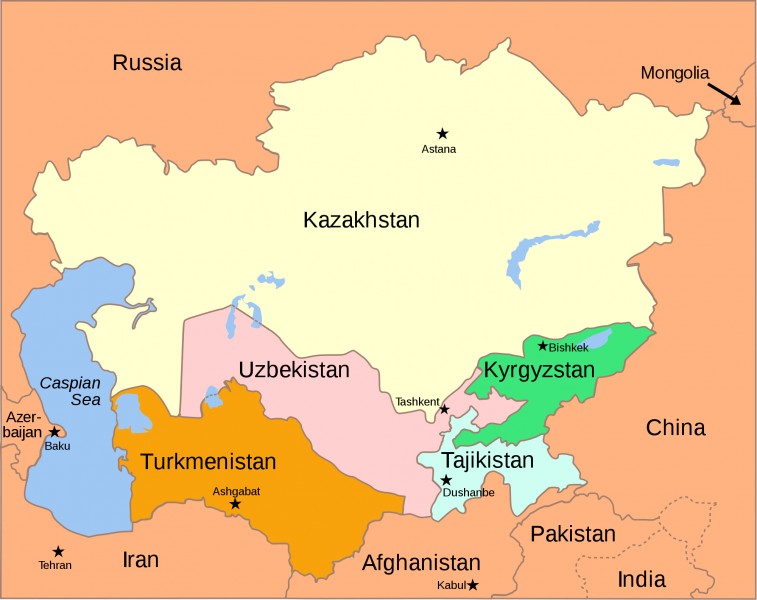
[caption id="" align="alignnone" width="508"]Map of Central Asia. Creative commons. Map of Central Asia[/caption]

Despite occasional whiffs of volatility, Central Asia has remained remarkably resistant to real change, either the type that could see it deteriorate into a hotbed of violence and chaos as some have predicted, or the kind that might inch it in the direction of democratic rule and socio-economic wellbeing, which almost no-one suspects will happen.


Consequently, while a lot of things happened in the region this year, none of it will necessarily look meaningful when (or if) historians look back on Central Asia's 2016 in 50 years time.


Long live the kings


As in 2015, Central Asia's rulers are still really, really powerful men aged over 55-years-old. The region's oldest and arguably most powerful ruler, Uzbekistan's Islam Karimov, got so old, that he actually died. Ignoring Kyrgyzstan, which has seen two revolutions in just over a decade and boasts fairly competitive elections, death is the only surefire way of removing a Central Asian president from office (see ‘comment of the year’).


Moreover, even if a standing Central Asian president does die, there is no promise his successor will be any better. In Uzbekistan, Karimov's successor, his prime minister of over 13 years, Shavkat Mirziyoyev, was elected this month with around 90% of the vote facing nobody in particular, including two of the very same nobodies that Karimov beat in a presidential vote last year. In Turkmenistan, President Gurbanguly Berdymukhamedov has swapped his predecessor's cult of personality for his own and forced through constitutional changes that will enable him to rule for life. Emomali Rakhmon, whose Tajikistan is the former Soviet Union's poorest descendant, did something very similar, adding a new legal provision lowering the age limit for presidential candidates in the country. That is a change that will potentially benefit his son, who is the subject of a persistent if not fully substantiated rumour that he shot his own uncle in the neck in a struggle over a local bank.


Because mortality is the main source of opposition in local politics, all of these leaders are surrounded by constant speculation about their health. Shortly after Karimov's death, which likely occurred earlier than the government said it did, Kyrgyzstan's President Almazbek Atambayev was rushed to hospital with chest pains while abroad in Turkey. Few citizens took this at face value and the range of conspiracy theories surrounding the incident provides an insight into how little local populations in these parts trust official statements. The now recovered Atambayev has promised he won't be a “dragon” and seek further political office after 2017, when his presidential term expires. But after his impromptu appearance as a character in a textbook used in state schools, there are fears he might be getting ideas from his neighbours.


Things are slightly more horrid


Other things that seem to be news might just be the intensification of existing trends. Turkmenistan's regime has been health-mad for quite a long time, but a particularly vicious assault on cigarettes this year earned it international infamy. Tajikistan is still cracking down on Muslims and their political representatives, but has done so more harshly and is increasingly extending the repression to their lawyers and relatives. This is state-driven Islamophobia in a country where over 90% of the population is Muslim. Then again, none of the other secular governments in the region are that fond of Islam.


Central Asia is still a really bad place for the media. In Kyrgyzstan, the president is kind enough to sue you in person if you write nasty articles about him. In Tajikistan, Turkmenistan and Uzbekistan, doing the same thing would probably mean either jail or disappearance, while in Kazakhstan, even insulting a foreign leader can can earn you a stint behind bars. The vacuum created by a lack of independent media in the region leaves people wondering whether diva-cum-businesswoman Gulnara Karimova has been murdered by her late father's government, as one news website claimed, or just kept under house arrest as most believe to be the case. Less crucially, it is also a real struggle to know whether or not Kazakhstan's capital Astana has really reached a million residents as President Nursultan Nazarbayev claimed it had earlier this year.


As for the honours:


Central Asia's Achievement of the Year


Tajik hammer-thrower Dilshod Nazarov won his country's first Olympic gold and sent his compatriots into raptures in the process.


Central Asia's Fail of the Year


A Scottish miner made an ill-considered and inaccurate joke on Facebook about Kyrgyz people eating horse penis, lost his well-paid job in the country and got himself deported.


Central Asia's Comment of the Year


Anonymous commenter on Turkmenistan media outlet-in-exile Chrono-TM.orgregarding Central Asia's long-reigning presidents:

Felling of trees continues unabated in Gilgit Baltistan region

Image result for cutting of trees in gilgit

GILGIT: The illegal felling of trees in the Gilgit-Baltistan (G-B) region continues unabated, causing irreplaceable and devastating damage to the ecosystem of the area.

According to latest reports from Khan Muhammad Qureshi, a local activist in Chilas, some illegal felling has been reported in Diamer valley.

Image result for cutting of trees in gilgit

About 200 trees in the Babusar top area have been felled this month. “Unfortunately a strong group of illegal loggers is behind this onslaught,” Qureshi said on Wednesday. “This isn’t the first time 200 trees have been cut, they have done it in the past as well,” Qureshi toldThe Express Tribune on Wednesday.

According to available statistics, approximately 295,000 from 640,000 hectares of forest has been denuded in the last 20 years due to callous cutting of trees and illegal transportation down-country.


The current onslaught has further shrunk the forest cover – causing deeply impacting the ecosystem which is resulting in climate change that has caused widespread rains and landslides in the region over the years.

“This year trees in other valleys have also been cut by the loggers and we brought this to notice of public representatives,” said Qureshi.

The deforestation of woodland in Diamer also echoed in the G-B assembly this week, where opposition leader Shah Baig accused successive governments of tampering with official timber figures for a decade to benefit the loggers. “Timber in Diamer actually totals 14,000 feet, but it is being shown as 40,000 feet to benefit the loggers,” Baig said in the assembly on Tuesday. On this, Forests Minister Imran Wakil assured the house that action would be taken against the responsible officials if lawmakers can support such allegations with evidence.

Logging; G-B stripped of more than 50% forest cover


G-B government spokesman Faizullah Faraq confirmed fresh felling had been reported and said a team has been sent to the area to collect firsthand information.

Courtesy The Express Tribune 

Kargil Town Residents Expressed resentment against Electricity Crisis

Kargil Town Residents Expressed resentment against Electricity Crisis

We  will Protest and the responsibility will be either on the concerned departments or Ladakh Autonomous Hill Development Council (LAHDC) Kargil after two days if the power curtailment time wouldn’t  reduce in Kargil town”. This was stated by Mohammad Sadiq Zaman during briefing to the media at LAHDC Complex in Kargil on Tuesday.


He was leading the delegation of Youths of kargil town who were protesting against the electricity crisis.  The residents of Kargil town rush on the council complex to express resentment against five hours electricity curtailment. Meanwhile Power development department (PDD) and NHPC authorities were also been invited by the executive councilor Syed Hassan Arman and Mohmammad Hussain .

The protesters were also demanding sort of relaxation for the town. The Protesters led by PDP youth leader Mohammad Sadiq Zaman Said, “ There must be little difference between Town areas and Urban areas ,Though we are not against Urban areas but most of the people from Urban areas too are settled here and now there must be some relaxation”.

The protesters also accused PDD that they have included Sankoo and Khangral areas with the Chutuk Hydel project due to political influence.

While responding to media The Executive Councilor LAHDC Kargil, Aga Syed Hassan Arman Said that they will discuss and find out a solution. When media asked him that many areas have been connected with DG sets, Solar Light and NHPC can he manage to balance these things , He replied , “ The Kargil Revenuable Energy Development Agency (KREDA) and PDD should sit together and they should sought out the matter and if there is any possibility they must look that option too”.

The protesters also threatened PDD and Ladakh Autonomus Hill Development Council for strong protest if their grievances wouldn’t be redressed in two days.

Its’ pertinent to mention here that in Kargil during winter due to freezing temperature water get down and power generation also get very low . Due to which electricity crisis also becomes a challenge for the people in chilling cold. However, this year the power load also increased after two major areas Sankoo and Khangral were also linked with the Chutuk Hydel power Project.

On pattern of ‘Kargil House’, People demand ‘Chenab Valley Ghar’ in Srinagar, Jammu

Scores of residents of twin districts of Chenab region including Kishtwar and Doda said that government should build temporary residential accommodation for the people of Chenab Valley like it has established "Kargil House" for the people of Kargil and Ladakh, in Srinagar and Jammu.

On pattern of ‘Kargil House’, People demand ‘Chenab Valley Ghar’ in Srinagar, Jammu

On pattern of ‘Kargil House’, People demand ‘Chenab Valley Ghar’ in Srinagar, Jammu

People across the Chenab Valley today demanded the 'Chenab Valley Ghar' in capital cities of Jammu and Srinagar for them.

Scores of residents of twin districts of Chenab region including Kishtwar and Doda said that government should build temporary residential accommodation for the people of Chenab Valley like it has established "Kargil House" for the people of Kargil and Ladakh, in Srinagar and Jammu.


They said that Chenab Valley is very far flung and the people from this region regularly move to Jammu or Srinagar for several assignments where in absence of any government accommodation for them, they have no option but to stay in hotels.

They said that Chenab Valley have more than 8 legislators including one minister in the present government. “These legislators and the minister should have submitted proposal to Chief Minister, Mehbooba Mufti, for the allotment of residential accommodation for Chenab Valley people.”

They demanded that the government residential building exclusively for the Chenab Valley people should be made available in both capital cities of the state so that the poor people from the region could live there during their visit to these cities.

Courtesy Greater Kashmir

Draining a Glacial Lake in Nepal

Draining a Glacial Lake in Nepal

In a difficult operation, Nepali workers lower the water level in a dangerous glacial lake.


By Deepak Adhikari and Nabin Baral


Early on November 23, a group of eight Buddhist monks in maroon robes sat cross-legged on the banks of a glacial lake located at 5,010 meters above sea level. They offered Buddhist prayers as dignitaries from Kathmandu descended on a military helicopter. A group of Sherpa women in traditional dresses offered silken scarves to the delegates.

This was the culmination of months of painstaking work to lower the water level of one of the most dangerous glacial lakes in the Himalayas. In summer this year, Bharat Lal Shrestha, a lieutenant colonel at Nepal Army’s Engineering Department, led a group of 40 army soldiers and 100 high altitude workers, including Sherpas, to drain the waters of Imja Tsho, one of six most dangerous glacial lakes of Nepal, home to 1,466 such lakes.

Experts have warned that Imja Tsho, which lies just south of Everest, poses a danger to tens of thousands of people living downstream and threatens to damage the teahouses, settlements, and trekking trails that are key to attracting tourists. Until 1960, the lake, one of 21 lakes in the Nepali Himalayas at risk of bursting, was small in size, but since then, it has expanded rapidly: now it covers an area of 1.28 square kilometers and is 150 meters deep. Three major events of Glacial Lake Outburst Floods (GLOF) in the Everest region between the late 1970s and late 1990s, along with last year’s devastating earthquake, prompted Nepal’s government and United Nations Development Program (UNDP) to carry out the mammoth task of draining Imja Tsho.

The team drained almost 4 million cubic meters of water, lowering the lake’s water level by 3.4 meters. “This was very challenging because of high altitude. We had to be motivated to keep going in such harsh environment,” Shrestha told The Diplomat. His team faced a host of challenges, including transporting heavy equipment for the construction of an outlet and a 45 meter cement and concrete canal. “We worked in two shifts from seven in the morning to five in the evening. People needed a lot of rest and we constantly supplied hot water and coffee to the workers,” he said. The team members were served dry food, which was carried to the site using yak, a large, shaggy-haired animal domesticated in the Himalayas. “Whenever a worker suffered from altitude sickness, we arranged for a trip to lower altitude. We also had medical doctors, who regularly carried out check-ups,” Shrestha said.

This was not the first draining of a glacial lake in the Nepali Himalayas. In 2000, Nepal’s Department of Hydrology and Meteorology lowered Tsho Rolpa, a glacial lake in northeast Nepal’s Dolakha district, by three meters. The lowering of water in Imja Tsho averts the bursting of the lake and could help save the lives of the 87,782 people living downstream, according to the UNDP. If the Imja Tsho bursts, it would incur an estimated loss of $11 billion, according to a 2009 study by International Center for Integrated Mountain Development, a regional knowledge center based in Kathmandu. But for now, such risk has been significantly reduced.

Deepak Adhikari is a Kathmandu-based freelance journalist, who covers Nepal for international publications.

Nabin Baral is a Kathmandu-based freelance photojournalist specializing in social and environmental issues

Courtesy The Diplomat

109th National Day of Bhutan: the Story of Bhutan

Image result for bhutan  map and flag Image result for bhutan  national day

The Trongsa valley, steeped in rich spiritual and political history, has been home to momentous events as Bhutan emerged from a mythological past, overcame an era of medieval intrigue, and evolved into a modern nation state. But the spirit of the 109th National Day of Bhutan is magical even by the standards of the Kingdom’s enchanted past.

This is a moment of pure tendryil. Never has there been such a culmination of history and legend, of the presence of figures of destiny, of spirituality in its most sacred form, and the almost unbelievable coincidences that prophesises the best for the future.

From the confines of his hermitage, a former Lam Neten of Trongsa who lived 60 years in Trongsa Dzong and then entered into meditation, explains that this is an extraordinary converging of the outer and inner blessings. The inner blessings are bestowed by the Kingdom’s guardian deities housed in the sacred lhakhangs of Trongsa Dzong which is also home to the second largest monastic body in the country. The outer blessings are personified by the physical presence of His Majesty The King, His Majesty Drukgyal Zhipa, and His Royal Highness The Gyalsey.

All this is taking place during the birth year of none other than Guru Rinpoche, the fourth century after Zhabdrung Ngawang Namgyel’s arrival in Bhutan, and the birth of Gyalsey Jigme Namgyel Wangchuck. It cannot be just coincidence that it is also the 10th year of His Majesty The King’s reign and the 12th year of His Majesty’s investiture ceremony as the Trongsa Penlop.

The celebration is taking place in this valley that is a massive natural cradle created by the sheer imposing ridges all around. Thousands of people of the Mangdue Tshozhi, acutely conscious of the spiritual and historical significance of their valley, are gathered in eager anticipation to greet three generations of the Royal lineage. Theirs is a land blessed by Longchhen Rabjam and Pema Lingpa and they are descendants of Trongsa’s Nyagoes and the country’s most famous singers.

Nestled on the natural contours of a strategic ridge in the centre of the valley sits the majestic Druk Minjur Chhoekhor Rabtentse Dzong, popularly called Trongsa Dzong. This edifice is a testimony of Bhutan’s architectural heritage and ancient Bhutanese cultural traditions.

But, beyond the physical magnificence, Trongsa Dzong stands as a tribute to Bhutan’s spiritual and political history. Crafted from a vision of Pelden Lhamo, this ancient monument is home to the heroes and legends – past and present – who built Bhutan. The dzong’s corridors, wide stone stairs, beautiful flagstone courtyards, and sacred temples have been witness to many significant events that have shaped Bhutanese history since the 16th century.

In 1543, Yongzin Ngagi Wangchuk first saw a vision of Pelden Lhamo and constructed the Chorten Lhakhang, the oldest of the lhakhangs. In 1652, Zhabdrung Ngawang Namgyel appointed, as the first Trongsa Penlop, Chhoeje Minjur Tenpa who constructed the first monastic fort as the Druk Minjur Choekhor Rabtentse, translated as “the Dzong of the never changing country of Druk where the dharma is everlasting”. Desi Tenzin Rabgye further enlarged the Dzong and consecrated the goenkhang of Pelden Lhamo and Yeshey Goembo in 1667. In 1715, Penlop Druk Dendrup built the Chenreyzig Lhakhang and, in 1765, the Trongsa Penlop, Zhidar, established the Trongsa Rabdey dratshang with 50 monks.

In 1853 Jigme Namgyel, the 10th Trongsa Penlop, built the Dechhog Lhakhang in the central section of the Dzong. According to legend two disciples of Lam Jangchu Tsindup came from Tibet with the sacred self created (rangjung) image of Dorji Phagmo, one of the 21 Rangjur Khartsa Pani, a religious relic formed miraculously from the spinal bone of Tshangpa Jarey, the patriarch of the Drukpa Kargyue sect. The scared rangjung was offered to Trongsa Penlop Jigme Namgyel and is today housed in a Gaw (amulet) placed at the centre of a life size silver image of the Dorji Phagmo in the Dechhog Lhakhang.

Trongsa Dzong is the cradle where the Wangchuck Dynasty was born. It is in this Dzong that the investiture ceremonies for Bhutan’s Crown Princes as the Trongsa Penlop are performed before they ascend the Golden Throne.

High above the valley, at a strategic vantage point over Trongsa Dzong, rises its watchtower, the Ta Dzong.  This “tower of Trongsa” now tells the stories of the Dzong and the valley that it has watched over for centuries. His Majesty The King inaugurated the Ta Dzong in 2008 as a museum dedicated to the Wangchuck Dynasty, representing a tasteful blend of tradition and modernity. It houses ceremonial and personal belongings of the Kings and Queens of Bhutan including the Raven Crown and robes worn by Gongsar Ugyen Wangchuck, King Jigme Namgyel’s sword, King Jigme Dorji Wangchuck’s wine flask and radio, and a full dress set of the Fourth Druk Gyalpo Jigme Singye Wangchuck.

By celebrating National Day in Trongsa this year, His Majesty The King brings together the past, present, and future that His Majesty Himself personifies. This is where His Majesty held the last public discussion on the Constitution. It is a continuity of the history, legend, and mythology that is the basis of the Bhutanese identity.

Jigme Namgyel (1825 – 1881) is a Bhutanese hero who has not been much written about but whose life and achievements speak volumes. A descendant of the line of Dungkar Chhoejey, he came to Trongsa around 1843, in search of a dream that was already destined. He began his service of the nation as a common retainer for Penlop Ugyen Phuntsho and eventually drew Bhutan out of chaos, confusion and civil strife. A natural commander with diplomatic skills and long term vision, Jigme Namgyel overcame all challenges, conquered all adversaries and built a unified national polity to establish a new era of peace and stability.

Jigme Namgyel paved the way for absolute ascendency and established the foundations for the Wangchuck lineage. The era of peace and prosperity that is written as Bhutan’s recent history is not rhetoric. It was won with sharp vision, with conviction and strength, with bloodshed, and above all, with statecraft.

Thus His Royal Highness the Gyalsey – Prince Jigme Namgyel Wangchuck – comes to Trongsa today from the past – from Bhutanese history. He personifies the return of destiny.


Why is all this a prophecy? When the Bhutanese people heard the name of the Gyalsey, we were taken back into the past. Yet we know that Gyalsey Jigme Namgyel Wangchuck will carry with him the sacred mandate of guiding Bhutan in his time. In essence the mandate has not changed.  Jigme Namgyel of the past established the polity that came to be the shared consciousness of the Bhutanese identity. Jigme Namgyel of the future has the formidable task of strengthening this shared consciousness for Bhutan to survive and thrive for times to come.

This is the national consciousness that His Majesty The King continues to strengthen today as “One Nation One Vision”.

courtesy  KUENSEL

Sikkim threat to Bengal vehicles


Rango in East Sikkim. File picture


Gangtok/Calcutta, Dec. 5: Tourist vehicle operators across Sikkim have threatened they would not allow any taxis bearing Bengal registration numbers to enter the hill state unless the permit issue is resolved within a few days even as the government in Bengal is trying to seal a reciprocal transport agreement.

Bengal and Sikkim had struck a reciprocal transport agreement on April 9, 2007, wherein vehicles from Bengal could enter only three Sikkim towns - Gangtok in East, Pelling in West and Namchi in the South. Vehicles from Sikkim though could move all over Bengal.

According to the agreement, sources in the Bengal's transport department said, all vehicles that have been included in the agreement could enter Bengal with a permit issued to them.

After entering Bengal, these permits had to be countersigned at different entry points. The vehicles included under the agreement are buses, goods vehicles as well as contract carriages.

This agreement was cancelled on August 30 as tourist vehicle operators in Bengal have been long complaining to chief minister Mamata Banerjee about how several thousands of operators were taking a beating because of the truncated movement of vehicles to Sikkim.

"We had repeatedly drawn the attention of the chief minister about how tourists planning to visit Sikkim from New Jalpaiguri were facing problems. If someone had to reach Gangtok, he would have to get off a vehicle bearing Bengal's registration number, hire a vehicle of Sikkim and then reach the hotel," said Samrat Sanyal of the Eastern Himalaya Travel and Tour Operators' Association.

"It's time that both the states agreed to sea-mless connectivity."

In September 2015, Bengal chief minister Mamata Banerjee had written to her counterpart in Sikkim, Pawan Chamling, requesting that all tourist vehicles entering the Himalayan state be given access to all points in the hill state. Over the next few months with no response reaching Nabanna, Bengal decided to terminate the agreement in August after nearly a decade.

"Since then we have sent several letters asking for a mutual agreement. But there was no response," a transport department official in Bengal said.

In October, the department sent a senior officer to Siliguri and Sikkim for a thorough understanding of the situation. A report to the government submitted later that month identified key problems, including how jeeps, taxis and other vehicles were entering Bengal without bothering for any counter-signature of the permits.

Sikkim was running few buses and more small vehicles, including jeeps and taxis, resulting in congestion on its hilly roads. Most of these vehicles belonged to the category, which were not included in the mutual agreement.

Operators in Sikkim today rose in protest after the regional transport authorities started slapping fines on each vehicle that didn't have its permit countersigned.

"They are imposing on us a fine of Rs 4,000 for one vehicle for not having a countersigned permit. This is too much. The passengers are getting harassed and those vehicles that don't have permits are being asked to return," said Dawa Tamang, a driver in Gantok.

Around 3,000 taxis including trucks from Sikkim enter Bengal everyday. In contrast, only 1,500 tourist vehicles reach Sikkim everyday.

The members of different driver and vehicle associations also highlighted how vehicles of Sikkim have to get two different permits for Darjeeling and Jalpaiguri districts. On the contrary, vehicles from Bengal plying to Sikkim need to have only one permit for travel.

Operators today met transport secretary SBS Bhaduria to voice their grievances.

A meeting has been scheduled on December 7 between the transport secretaries of the two states to address the issue. "Hopefully we will arrive at a solution," said a transport official in Calcutta.


Courtesy Calcutta Telegraph

The Gilgit-Baltistan government has tasked the Frontier Works Organisation (FWO) to build the much-awaited Skardu-Jaglot road

Paving the way: FWO bags tender to build Skardu-Jaglote road


Image result for skardu road

GILGIT: The Gilgit-Baltistan government has tasked the Frontier Works Organisation (FWO) to build the much-awaited Skardu-Jaglot road, officials said on Monday.

The road, which is expected to be completed at a cost of Rs46 billion, is the only route connecting Baltistan to the rest of G-B and the country. The road is also significant for defence standpoint as the Kargil, Siachin, Batalik and the Chourbat borders fall in this region. Thousands of security forces are deployed in these areas.

“The tender bid was held in Islamabad recently and awarded to FWO,” G-B government spokesman Faizullah Faraq said on Monday.

The existing 250-kilometre road, passing through the towering the Himalayan mountain range, is narrow and dilapidated, causing immense problems for travellers. There are accidents aplenty on this road which was initially built in the late 1960s and early 1970s. Over the years, landslides triggered by rains and earthquakes have left the route extremely precarious.

“This was one of the promises [made by the government] and we are happy things are moving in the right direction,” Faraq told The Express Tribune. He was referring to Prime Minister Nawaz Sharif’s announcement which was made soon after elections in G-B last year.

According to officials, no other local company bid for the project as most of them are too small to complete this mega project.

“FWO is an expert at completing road networks through mountains and local contractors are only good at making small roads in the city,” said an official of the FWO. The organisation was created in 1966 to tackle the virtually impossible task of constructing the Karakoram Highway (KKH).

The KKH, also called the eighth wonder of the world, was said to be unprecedented as it required various technical skills. These included a geological survey, while concrete, masonry and design works were also involved in addition to use of explosives, and developing drilling and blasting techniques. Over 15,000 personnel spread over a harsh terrain of more than 800 kilometres to build the road.

Back in Baltistan, the news of the Skardu-Jaglote road’s construction was met positively by locals.

It is believed that the previous government of Mehdi Shah lost out in the 2015 election because it could do nothing about the vital road.

Pakistan Muslim League-Nawaz upstaged him by sweeping the elections after it promised to construct the road.

G-B Chief minister Hafeezur Rehman, during his visit to Skadu last month, announced the construction of five bridges on the road. These bridges include the main Alam bridge, Sassi Nullah bridge, Brumdoor Nullah bridge, Tungush Nullah bridge and Sapper Shaheed Bridge

Kargil's remote Drass finally gets its double lane bridge

Image result for Kargil

Commuting just became easier in district thanks to the construction of a double lane bride that would now connect various villages and small towns.

For long considered a backward area, Drass has served as an important between the Kashmir valley and Ladakh.


Kachoo Hussain Khan, Deputy Commissioner of told ANI, "When it was single lane bridge, it was difficult to commute. This double lane bridge will make travelling on the highway much easier for the people of Drass."

"This new bridge will help trade to flourish as well," he added.

Muhammad Iqbal, a commuter, recalled the chaotic commuting of the past, especially during the six months when the route was closed for six months due to winter. Others like Farooq Ahmad Sai and he said that the double lane bride has taken three years to construct.

The construction of the double lane bridge or 'Project Vijayak' as referred to by the has been much appreciated by local residents.

Manipur’s line of fire

Sudeep Chakravarti

As with so many things with Manipur and the Naga peace process, insecurities and intrigue plague this chessboard at the bleeding edge of India’s so-called Act East policy

Image result for Manipur’s line of fire

Who would want to shoot at Okram Ibobi Singh, the Congress chief minister of Manipur? The answer might fill a large black book.


For now, the government of Manipur has pointed the finger at National Socialist Council of Nagalim (Isak-Muivah), or NSCN(I-M), the largest Naga rebel group, and currently in peace talks with the government of India. As with so many things with Manipur and the Naga peace process, insecurities and intrigue plague this chessboard at the bleeding edge of India’s so-called Act East policy. Complicating matters is elections to Manipur’s assembly next February, which is a Congress-versus-Bharatiya Janata Party (BJP)-versus-spoilers contest. Spoilers include smaller political parties, rebel groups and specific ethnic interests.


On 24 October morning, Ibobi and his colleagues choppered up to the district headquarter town of Ukhrul. He was to inaugurate an unfinished hospital here, a local development office and two electricity sub-stations. Shots were fired—it isn’t clear by whom—after he arrived. Two police vehicles were set on fire by protesters, two Manipur policemen injured. Ibobi left without fulfilling any agenda except that of reconfirming the enormous divide between the plains and hills of Manipur.


Ukhrul was already locked down on account of a boycott called by the Tangkhul Naga Long (TNL), the apex body of Tangkhuls for whom Ukhrul district is the tribal homeland. Tangkhuls have long complained about the majority Meitei community, to which Ibobi belongs, being biased against them, other Naga tribes, and the Kuki and Zomi people who inhabit the hill districts of Manipur—which account for 40% of the population but more than four-fifths of the area.


They accuse the government of stacking job opportunities against tribals, of skewing development projects in the interest of the plains, such as a major dam to bring water to Imphal and irrigate the surrounding valley that has submerged tribal villages. TNL had warned against Ibobi’s visit; the projects were seen as being politically motivated. The protests certainly were.


Such animosity isn’t new. For several years United Naga Council, the apex body of Naga tribes in Manipur, has boycotted Imphal and entered into negotiations with the central government for administrative independence of Naga areas in Manipur.


Last year, Churachandpur district erupted when Zomis protested a legislation they felt would question their eligibility to reside in Manipur, and own land and establishments. Several protesters were killed by police.


To be fair to Ibobi, his reign of error and terror since 2002 has been ethno-agnostic: it has also impacted the Meitei. His government and Manipur’s police have been censured by the Supreme Court for human rights violations in Imphal Valley. Manipur is impoverished. Infrastructure is in shambles. The government is so corrupt that the Comptroller and Auditor General’s reports about Manipur carry a despondent tone.


Equally, anti-Ibobi and anti-Meitei narratives aren’t the only twists.


Several leaders of NSCN(I-M), including its general secretary Thuingaleng Muivah, chief of its army, and a large proportion of armed cadres are Tangkhul. Nothing moves in Ukhrul, from development projects to the death of a political target, without the say-so of NSCN(I-M), a ruthless organization with a long reach, which is pushing for the integration of Naga homelands in Manipur, Arunachal Pradesh and Assam with Nagaland. Both TNL and the Council are influenced by NSCN(I-M).


As in Nagaland, NSCN(I-M) imposes tax on individuals and businesses (including those for prospecting for hydrocarbons, for instance), skims off development funds for public projects, and attempts to influence electoral outcomes. Indeed, several dozen rebel groups and factions active in Manipur—Naga, Meitei, Kuki and Zomi—do exactly the same in their areas of influence.


Since a framework agreement for peace was signed between the government of India and NSCN(I-M) in August 2015, the organization has had a freer run. Major functionaries, including a key arms procurer, and cadres, have been released from custody. The central government has used it as a bulwark against other groups, especially NSCN’s Khaplang faction that ditched a ceasefire early last year. Central government forces, especially Assam Rifles, omnipresent and heavy-handed in Manipur, and with a major presence in Ukhrul, laid low during the fracas earlier this week. Local politics played out with local players and local police.


The BJP’s strategy is to aggressively stitch together a broad spectrum alliance for elections, and balance the Naga peace process at the same time. It’s an incendiary, high-stakes game. Few in Manipur will cry for Ibobi, but Manipur isn’t yet done with tears.


Sudeep Chakravarti’s books include Clear.Hold.Build: Hard Lessons of Business and Human Rights in India, Red Sun: Travels in Naxalite Country and Highway 39: Journeys through a Fractured Land. This column, which focuses on conflict situations and the convergence of businesses and human rights in India and South Asia, will now run on Thursdays.

Congress, BJP gear up for Assam by-election

Image result for assam by election

GUWAHATI: The Congress on Friday announced the names of candidates for the November 19 by-election to Lakhimpur Lok Sabha     constituency and Boithalangshu Assembly constituency even as the rival BJP has gone overboard in the campaign trail with the chief minister Sarbananda Sonowal and his second in command Dr Himanta Bishwa Sarma leading from the front.
The Congress has fielded Dr Hem Hari Prassana Pegu as its candidate from Lakhimpur Lok Sabah constituency and Rupan Sing Ronghang from Baithalangshu Assembly constituency. They are pitted against BJP’s Pradan Baruah and Mansing Rongpi respectively.
Pradan Baruah is a sitting BJP MLA from Jonai Assembly constituency while former Congress MLA Mansing Rongpi shifted allegiance to the BJP after the last Assembly election held in April this year even though he had won from Baithalangshu as a Congress candidate.
Meanwhile, BJP’s key ally AGP is not going to field any candidate of its won in these two constituencies going for by-election.
A senior BJP leader Dilip Moran on Friday resigned from the BJP in protest against not being given the party ticket to contest from Lakhimpur Lok Sabha seat. He alleged that there was no democracy within the BJP in Assam and the party was now run by one `Hitler’.
Image result for assam by election

Pakistan Atomic Energy Commission (PAEC) is establishing two more cancer hospitals in Gilgit and Mardan.


PAEC establishing two cancer hospitals in Gilgit, Mardan

Pakistan Atomic Energy Commission (PAEC) is establishing two more cancer hospitals in Gilgit and Mardan.

PAEC Chairman Muhammad Naeem while addressing an awareness seminar on breast cancer in Islamabad today stated this.


The Chairman said eighteen medical centers are already operating under the aegis of atomic energy commission in all provinces.

He said all possible resources will be mobilized to meet the requirements of cancer hospitals.

Speaking on the occasion, Foreign Secretary Aizaz Ahmad Chaudhary emphasized the need for creating awareness among people about all types of cancers including breast cancer.

The Cost of Political Instability in Nepal


Last week, Nepal’s Parliament elected Pushpa Kamal Dahal as prime minister, in the country’s 25th change in leadership in 26 years. Mr. Dahal’s predecessor, K. P. Sharma Oli, resigned last month after only nine months in office.


Political instability is harming Nepal’s struggling economy, which is expected to grow only 1.5 percent this year, and threatens to stall further relief for victims of last year’s devastating earthquake.


Unfortunately, there is little hope for stable governance in the near future. Mr. Dahal, under a power-sharing agreement between his Communist Party of Nepal (Maoist-Center) and the Nepali Congress party, will serve as prime minister for nine months, after which power will pass to Sher Bahadur Deuba, chairman of the Nepali Congress party, for nine months. That transition could well add to the political turmoil involving disputes over Nepal’s new Constitution, which was approved by the Parliament last September, and jockeying between Nepal’s powerful neighbors, India andChina.


Photo


Nepal earthquake victims in a displacement camp in Kathmandu. CreditTom Van Cakenberghe/Getty Images


Nepal’s southern plains bordering India were gripped by violent protestslast fall after the Madhesis, who have strong cultural ties to India, and other ethnic groups objected to the federal districts in the new Constitution, which they say do not adequately represent them. Many Nepalese blamed India for a subsequent trade halt — including vital fuel deliveries — across the border. India claimed the protests made cross-border trade impossible.


Mr. Oli, who was elected prime minister last October during a period of public anger toward India over the trade issue, maintained a hard line toward India, and made building relations with China a priority. On Sunday, he warned India against “unnatural meddling” in Nepal’s affairs, and said his party, the Communist Party of Nepal (Unified Marxist-Leninist), would fight any attempts to reverse agreements he had signed with China, including a transit and trade pact. So far, both India and China have expressed support for Mr. Dahal’s new government.


Mr. Dahal, a former Maoist rebel leader who was prime minister from August 2008 to May 2009, has promised to address Madhesi demands, though he hailed the passage of the Constitution in its current form last fall as “a victory of the dreams of the thousands of martyrs and disappeared fighters” of the Maoist insurgency. He will have to move quickly to organize local elections, paving the way for national and provincial elections under Mr. Deuba’s watch, and preparing the ground for constitutional changes to accommodate Madhesi demands.


Meanwhile, $4.1 billion in foreign grants and soft loans have yet to be disbursed to victims of last year’s earthquake. Some 770,000 Nepalese households will most likely have to go through another winter in temporary structures. While Nepal’s political leaders are embroiled in interminable fights, the country’s needs are going unaddressed.


courtesy The NewYork Times

Tension in Assam district after militant attack


Guwahati: Tension gripped Tinsukia district in eastern Assam on Saturday after five to six militants belonging to the Ulfa faction opposed to talks shot dead two people and injured seven.

The attack took place on Friday night at a house in Bamungaon village. The dead were identified as Kishori Shah (65) and his son Rajesh Shah (35), the police said.

Hundreds of people in Philobari area came out to the streets to condemn the attack on “Hindi speaking” community and blamed police for their failure to protect the lives of innocent civilians.

“The Hindi speaking community in Assam has been facing attacks since 2000. However, the state government has not done anything to protect the lives of the people living in Tinsukia and other districts for generations and assimilated with the locals,” a demonstrator said.

The locals demanded federal Home Minister Rajnath Singh and state Chief Minister Sarbananda Sonowal to visit Philobari and ensure security of the people.

They have also complained that the police were aware of a probable attack by the militants in the area but did not deploy adequate forces.

Tinsukia Superintendent of Police Mugdhajyoti Dev Mahanta said operations were launched against the militants and that security in the districts was intensified.