Advert

Popular Posts

Start online business with zero Investment


By Naveed Ahmed


The newly launched e-Commerce based website name Abcooz.com helps many individuals to display their products online for free , the business model of Abcooz is (C2C) means customer to customer, The platform providing free listing of products there are no any other charges on sales ,it also helps to reach and connect with millions of buyers across the globe for free. The core aim of this platform is to create million of business opportunities for the young entrepreneurs who got big dreams.


The good thing about this platform is that anyone can start online business with no money. You don’t need to be adding credit card or to pay any additional fees for registration. What you have to do is to display good pictures of products, write some details on products and mention price in dollar. You can easily add your own shop on this website, the user friendly interface helps many customers as well as many sellers to connect with each other in just a click like a social networking sites. You can add list of many customers and sellers in your contact list and sending request for adding in your contact list. This is quite amazing for new startups that have big dreams and want to start their own onlinebusiness with zero investment.

The platform is performing as a search engine for the products so there are two options for buyers whether they are searching for worldwide products or searching for just nearby products. When they search for worldwide products they will get all the data across the globe on the same search results keyword and those shops will find on the first page of Abcooz which have quality content and have good quality services for customers. When the buyers will search for nearby products they will get results for nearby products in the range of 500 meters around them, in this case they will get results for those shops which are nearby to them, and mostly customers search for nearby products because of rapid growth of consumers and their urgent needs. They want to receive products within an hour so this is advantage for both consumers and sellers ends.

There is no any limitation to extend the business; the young entrepreneurs have a great advantage to make their own scalable business model by listing more products. This platform is hundred times better than other big e-Commerce business marketplaces like Amazon, eBay and Alibaba which always ask for premium memberships and to pay seller accounts, you cannot sell any products on these platforms until you pay them, but on Abcooz you can sell and make many regular customers.

As you know the big e-Commerce giants never let you to find customers details even email address and contact numbers, they just provide you shipping address, in this case you have only option to run a business with limited scale because you don’t have option to find a customer’s details the customers are not yours these customers are only for the big e-Commerce giants. So the beautiful thing about Abcooz is providing you all the data of customers their location, contact, email so you can build a massive business community and you can involve with many people in your circle to extend your business within a months.

Naveed Ahmed is Founder and Ceo of Abcooz and e-marketing expert

10 Surprising Health Benefits of Himalayan Salt You Must Know

Himalayan salt is by far the purest salt available on earth, as it is free from toxins and pollutants. This salt is mainly extracted from the Himalayan belt, where it is also popularly known as “white gold”.

A uniqueness of Himalayan salt is its pink color, which is mainly due to the presence of iron oxide. Because of this, it is also often called “pink salt”.

It predominantly consists of sodium chloride, but it also contains about 80 naturally occurring trace elements including sulfate, magnesium, calcium, potassium, phosphorus, copper, zinc, selenium, iodine, and fluoride.


Additionally, as most of the minerals in this salt exist in a colloidal form, they are easily absorbed by human cells.

Due to its rich mineral content, Himalayan salt provides an array of healing and amazingly therapeutic uses for both your body and soul.

himalayan sal health benefits

Here are the 10 surprising health benefits of Himalayan salt.

1. Maintains Fluid Balance


Himalayan pink salt contains several electrolytes that regulate hydration in the body. Proper hydration is essential for all the body’s cells to function effectively.

The major electrolytes in this salt are sodium, potassium, calcium, magnesium and chloride. All these electrolytes are quickly absorbed by the body as compared to water. In simple terms, this means faster hydration.

Drink this brine solution, also known as “sole”, as part of your daily diet to ensure a proper fluid balance in the body.


  1. Place 1 inch of Himalayan crystal salt in a glass jar, preferably one with a lid.

  2. Add 2 to 3 inches of spring or filtered water, until the salt crystals are completely covered with water.

  3. Let the water sit overnight.

  4. Add 1 teaspoon of this solution to a glass of filtered water and drink it first thing each morning.


Note: When making the sole, make sure you do not use metal lids and spoons.

2. Detoxifies the Body


Adding Himalayan salt to your bath water creates a rejuvenating and detoxifying bath.

The electrical charge of the salt as well as its various minerals get transferred into the water. So when you take a bath in this water, it helps draw toxins out of healthy cells and into your bloodstream. From there, the toxins are released out of your system. This salt even cleanses the body energetically.


With this pink salt, you can make a brine for a real detoxifying bath.


  1. Put 1 to 2 pounds of Himalayan salt in a bathtub filled with warm water.

  2. Soak yourself in this bath no longer than 15 to 20 minutes.

  3. Enjoy this bath 2 or 3 times a month.


3. Cleanses the Digestive Tract


Himalayan salt also helps naturally cleanse the digestive tract. It acts as a laxative and forces your digestive system to release stored toxins in the form of waste. This in turn helps keep the gastrointestinal system free from impurities.

himalayan salt cleanses digestive tract

Plus, the dozens of minerals in Himalayan salt are good for the digestive system.


  1. Put 2 teaspoons of pure pink salt into a quart jar.

  2. Fill the jar with lukewarm water.

  3. Give the jar a nice shake to help dissolve and suspend the salt.

  4. Add the juice of 1 lemon to improve the taste.

  5. Drink the entire solution, first thing in the morning.

  6. Next, lie down on the right side of your body for 20 to 30 minutes.

  7. Expect a bowel movement within the following 1 to 2 hours. Make sure to drink plenty of water during this time.

  8. Use this detoxifying remedy once every couple of months.


4. Maintains a Healthy pH Balance


It is important to maintain a healthy pH balance in the body, which means the cells in your body are slightly alkaline in nature. This aids in proper functioning of the body and inhibits the growth of cancer cells, disease-causing bacteria, fungi, viruses and parasites.

Himalayan salt helps maintain this alkalinity in the body. As the salt helps remove acidic toxins from the body, the body’s pH becomes more normal and slightly alkaline, which aids in regulating the concentration of hydrogen ions in body fluids.

Plus, it aids in maintaining the fluid intake in and around the body’s cells, and even helps get rid of harmful heavy metals like lead, mercury and arsenic.

To help maintain a proper pH balance in the body, mix 1 teaspoon of Himalayan salt sole in a glass of filtered water and drink it daily in the morning.

5. Provides Relief from Respiratory Diseases


Be it sinusitis, bronchitis, asthma or allergies, Himalayan salt aids in treating respiratory problems.

Pink salt cleanses the respiratory system and helps keep it free of harmful toxins. Its anti-inflammatory nature helps loosen up excessive mucus and speeds up mucociliary transport.

It even removes harmful pathogens from the respiratory tract that can delay the healing process. The particles of pink salt also penetrate deep into the lungs to treat damaged tissues.


  1. Put 1 tablespoon of pure pink salt in a small tub of hot water.

  2. Position your head over the tub and cover your head with a towel.

  3. Continuously inhale the steam for 10 minutes to clear out the nasal and air passages leading to the respiratory system.

  4. Repeat 2 or 3 times a day or as needed.


6. Improves Dental Health


Though it may sound strange, Himalayan salt improves dental health. It can help treat cavities and gingivitis as well as keep bad breath at bay.

The potassium in this salt prevents the gums from bleeding. It also contains calcium, a mineral that strengthens teeth.

Plus, its antiseptic and antibacterial properties prevent bacterial growth in the mouth, one of the main causes of several oral problems.


  1. Dissolve 1 teaspoon of pink salt in a glass of warm distilled and purified water to make a brine solution, also known as “sole”.

  2. After brushing your teeth, swish a mouthful of this solution around in your mouth for 1 minute.

  3. Do this twice daily to maintain good oral health.

The Palestinians Fabrications Concerning Jerusalem: What the IslamicScriptures and Islamic History Instruct Us


Jerusalem was never capital all along its Islamic history


Jerusalem was so important to Islam religiously; and if Muhammad reached the city and established a mosque on the Temple Mount called al-Aqṣā; and if Jerusalem is indeed the third Ḥaram and the first Qiblah; then


Why didn’t it ever serve as a capital city or even an important religious and political city at any time in Islamic history? When the Arab empire expanded by a deep process of imperialism and colonialism, and the Umayyad dynasty was established (661-750) and later on Abbasid dynasty (850-1250), Damascus and Baghdad respectively were established as the capitals, but not Jerusalem. When the Ottoman Empire established (1299-1922) and controlled the Arab lands including the land of Israel (1517-1919), it marked Istanbul (Constantinople) as its capital and not Jerusalem.

The Ottomans, like the Umayyads and the Abbasids were good Muslims, and they followed the Islamic Scripture properly. Does it sound logical that they did not know about the Mosque Muhammad had ostensibly built in Jerusalem? Why Istanbul, Damascus, and Baghdad and not Jerusalem? The fact is that there was nothing important in Jerusalem.

In between there were the Fatimid Caliphate (al-Fāṭimīyūn), an Isma'ili Shi'ite dynasty (909-1171) with its capital in Cairo; the Ayyubid dynasty (al-Ayyūbīyūn) of Kurdish origin (1174-1250), that ruled much of the Middle East during the 12th and 13th centuries, with its capital in Cairo (1174–1250) and Allepo (1250–1260); and Mamlūk Sultanate (Sulṭanat al-Mamālīk) (1250-1517) that ruled over Egypt, the Levant and Hijaz, with its capital in Cairo.

What is important that all these could have established their capital in Jerusalem, following Muhammad's teaching and commandment, but they did not, as there was no legacy at all of Muhammad concerning Jerusalem. Moreover, Salah ad-Din al-Ayyubi conquered Jerusalem from the Crusaders, cleaned it up from their institutions, and still left the city after calling the Jews to return to it.

From the onset of Islamic rule in 638 to its end 1917, including for the Crusader rule from 1099 to 1187, Jerusalem was never the capital of any Muslim state, nor even a provincial capital, until late Ottoman times, when it only became a special provincial religious site (Vilayet) separate from its larger provincial area [Sanjak].

Even during the 20th century Amin al-Husseini, who for the first time raised the importance of Jerusalem as a political weapon using religious symbols, did not call to mark it the capital of the Arab-Islamic inhabitants. He concentrated his ideas on its religious sanctity and the duty to remove the infidels from it. Moreover, even king 'Abdallah, whose main interest 1948 war against Israel was to occupy Jerusalem, did not establish it as the Hashemite capital, and Amman remained the capital of Jordan.

How that is over the 1400 years of Islamic rule, Jerusalem did not enjoy the political prestige and religious importance that Cairo, Damascus, Baghdad and Istanbul did? How that is Jerusalem managed to retain its Judeo-Christian character throughout most of the historical period to the middle of the 20th century? Indeed, only under Jewish rule Jerusalem kept its importance as the only capital.

Jerusalem does not have an Islamic name

If Jerusalem was so important to Islam and if Muhammed visited the city and built a mosque there on the Temple Mount called al-Aqşa, and if Jerusalem is the third Ḥaram and the first Qiblah then

How that is Jerusalem do not have even a Muslim name? The first name in all of Islam was given by 'Umar in 638 after the conquest of Jerusalem. That name was: Iīlya, Madīnat Bayt al-Maqdis. Iīlya was the Roman name for Jerusalem: Aelia Capitolina, a name chosen by Emperor Hadrian whose first name was Ilius, and at the center the "Forum" with Aphrodite, the Goddess of Beauty and Love. The Ḥadīth mentions the name Iīlya in connection Muhammad's letter to Heraclius, the Roman emperor to surrender to Islam and to accept its religion.

Bayt al-Maqdis in Arabic is from the Hebrew Beit ha-Miqdāsh which means the Holy Temple (literally, the House of the Sanctuary) of the Jews.

Somewhat later on the Muslims used a shortened version of that title to Bayt al-Maqdis alone, emphasizing the Jewish sources of Jerusalem. The name al-Quds (the Holy City) referring to Jerusalem, became popular among Arabic speakers, is derived from the Aramaic root Q-D-S, still maintaining the Jewish word Kudsha (holy). It was introduced in the 10th century, it was unknown to the famous Muslim clerics and exegetes of the 9th century.

It is well-known that according to Islamic tradition the region of Mecca and Medina is called Arḍ al-Quds. Jerusalem was never called by that name, and the name simply called al-Quds was given to it only in the 10th century with heavy Jewish influence. It is believed that the historian and theologian al-Muqaddasi, was probably the first one to use that term from 985 on.

The name al-Ḥaram al-Sharīf, commonly used today by Muslims to refer specifically to the Temple Mount as a means of distinguishing it from the Jewish Holy Temple, came into use only during the 19th century Ottoman Empire. This name had always been the name of the Ka’aba in Mecca. The name “Het al-Buraq”, which ostensibly refers to the Jewish Western Wall is a recent invention of the Palestinians from 1929, following the riots in Jerusalem and Hebron but was used extensively during the time of Yasser Arafat.

One important phenomenon that took place in Muslim history is that any time the Muslims captured a town they Arabized, Islamized and changed the names. Therefore, Damascus (Dimashq in Arabic), a pre-Semitic name known from the 15th century BC, Dammeśeq in Biblical Hebrew, was given the Arabic name “Ash-shām.” In Egypt, al-Qāhirah (Coptic: Kahire, the place of the sun, the ancient name of Heliopolis), means "the Conqueror", established by the Fatimid dynasty in 968. It has replaced the city name al-Fustāt, the first capital of Egypt under Islamic rule, established by 'Amr ibn al-'Aas in 641. Both Islamic names came after the old historical capital of Egypt, Memphis. Indeed, if Jerusalem was indeed so important to Islam, why wasn’t it ever given an Islamic name?

Jerusalem was neglected as long as it was under Muslim rule

If Jerusalem was so important to Islam religiously; and if Muhammad reached the city and established a mosque on the Temple Mount called al-Aqṣā; and if Jerusalem is indeed the third Ḥaram and the first Qiblah; then

Why was it abandoned by 'Umar bin al-Khattāb immediately after being captured? He signed a treaty of protection with the Christian leaders of Jerusalem, Dhimma,   left to the town to the Christians and Jews, and established the regional capital in Caesarea. After almost 60 years it thrived and became prosperous under the Umayyad dynasty, Jerusalem descended into the depths of oblivion and misery. When the Dome of the Rock collapsed on the 5th of December, 1033, along with the walls of the city, nothing was done by the Muslims to restore these structures for many years.

Again, after a short period of time of fighting the Crusaders, Jerusalem came back under Islamic rule, immediately to relinquish it and calling the Jews to reenter the city. Indeed, during the four hundred years of the Abbasid Dynasty, including the Fatimid, the Ayyubid and Mamluk rule, and during the four-hundred year of the Ottoman occupation, Jerusalem was a neglected city, devoid of any political importance, with destitute social and economic state. Though Suleiman the Magnificent, the Ottoman Sultan, rebuilt the walls of Jerusalem and reinforced its public structures, he only did so because Jerusalem was a transit city for pilgrims to Mecca, not because of its importance. The city still suffered a state of disrepair and negligence.

Under the Ottomans rule it was placed under the administration of the Damascus Vilayet (province) or Sidon region. Only in the 19th century, it became a (Vilayet), but still much less important than Gaza, Jaffa, Beirut, and other cities around. This is a clear indication how unimportant Jerusalem was to Islam during its history.

Jerusalem was never an Arab or Muslim City from the inhabitants' perspective. In the mid-19th century, Jerusalem was neglected and impoverished, with a population that did not exceed 8,000. In 1842, the Prussian Consulate in Jerusalem estimated that Jerusalem's total population of 15,150, of which 7120 were Jews. In April 1854 by Karl Marx stated that “the sedentary population of Jerusalem numbers about 15,500 souls, of whom 4,000 are Muslims and 8,000 Jews.” In 1864, the British Consulate reported that while the total population of Jerusalem were 15,000, there were 8000 Jews, 4500 Muslims and 2500 Christians. In 1898, “In this City of the Jews, where the Jewish population outnumbers all others three to one…” In 1914 there were 45,000 Jews in Jerusalem out of 65,000. This is another perspective how Jerusalem was unimportant religiously in Islam. And at the time of Israeli statehood in 1948, 100,000 Jews lived in the city, compared to only 65,000 Arabs.

When and why Jerusalem has become Important to Muslims?

From all this evidence, comes the big question: when and why Jerusalem has become Important to Muslims? It was not important and even was not mentioned during Muhammad's life. It was not important to 'Umar Ibn al-Khattāb, the conqueror of Jerusalem, who left it to the Christians immediate after its occupation. It became important to the Umayyads only after the revolt of Ibn al-Zubayr, for 60 years. It was again totally neglected during the Abbasid's rule, and came back to Islamic consciousness only when it was captured by the crusaders in 1099.

The Christians destroyed mosques and synagogues, and replaced them with churches. Most of all, they made Jerusalem the apex of their religious quest. The change occurred only after Salah ad-Din al-Ayyūbi (Saladin) was appointed in 1187. Fadā’īl al-Quds literature, created by the Umayyad dynasty was distributed and this was the first time the importance of Jerusalem was stated religiously. Still, Salah ad-Din al-Ayyūbi did not take any steps to change the capital of the Islamic world, or to establish Jerusalem’s religious significance.

Jerusalem was even more neglected under the entire rule of the Ottoman Empire, for 400 years. It was forgotten, neglected, and came into oblivion compare to other cities. The change came only after the immigration of the Jews, and the Jewish-Zionist plans to establish a Jewish state with its capital in Jerusalem.

Only then Amin al-Ḥusseini, the Grand Mufti of Jerusalem, an anti-Semite and member of the Nazi Party, with his political-religious ambitions, identified the potential of Jerusalem to attract the support of the Arab states and the Muslim world to his struggle against the Jews. Nobody had a greater influence on the Jerusalem Issue than al-Ḥusseini, who as president of the Supreme Muslim Council, was not only the supreme religious authority but also the central figure in Palestinian nationalism.

Husseini saw Jerusalem as the crystallization point for the "rebirth of Islam" and Palestine in its center. Under his encouragement, 'Izz al-Din al-Qassām group, the terrorist "Black Hand," whose name is borne by Ḥamās's homicide bombers, was the first to unite the ideology of a devout return to the original 7th century Islam. The "Arab revolt" of 1936-1939 was sparked and led by Ḥusseini. The "Jewish threat" and "saving Jerusalem" was a central theme in the Islamic propaganda. The call was to embark on a Jihad to defend the al-Aqsa Mosque in Jerusalem.

One cannot be surprised that Yasser Arafat, who was a nephew of uncle Amin al-Ḥusseini, took the same road of anti-Semitism and Jerusalem at the center of the struggle against Israel. Yasser Arafat, Rahman Abd al-Raūf al-Qidwa al-Ḥusseini, was born in Cairo. He was not a refugee of 1948 war, and only since 1967, after the Israeli liberation of Jerusalem, he "discovered" Jerusalem as a political issue. The crowds of praying Muslims were not there until the leaders began claiming that Jerusalem is their first Qiblah and Third Ḥaram, from 1994 on. This "discovery" was not displayed before, as long as east Jerusalem was under Jordanian occupation.

Before Arafat, it was Abdullah, King of Jordan, who realized the importance of Jerusalem for the Hashemite Kingdom of Jordan and decided to conquer Jerusalem at all costs in 1948. His intention was to make Jerusalem the capital of Jordan. He thought that by doing so he would be able to achieve some religious importance for his kingdom following the loss by the Hashemite family of Mecca and Medina to the dynasty of Ibn Saud. He also sought to enhance his political significance, his prestige and status, and his legitimacy in the eyes of the Arab nations. But he was deterred by the strong resistance of the Arab and Muslim leaders. Amman remained the capital.

However, Arafat systematically pursued his goal of having the Arabs support the notion of Jerusalem's critical importance for them as the Palestinian's capital and its ties to Islam. In that capacity Jerusalem could serve as a point of Identification and national pride in order to create a Palestinian people and nation, which never existed at any time in the past. Arafat strove to have the West recognize Jerusalem as the Muslim capital of the world and to recognize him as the Muslim's political leader.

Summary

As we have seen, over the 1,300 years of Muslim rule the following facts are observed: Jerusalem was not mentioned in Islamic Scriptures, and was given the status of Ḥaram only when it came under Infidels' rule. Jerusalem was never the capital of any Islamic political entity or even an important provincial capital during all its Islamic occupation. The name of Jerusalem in Islamic sources indicates that the city did not belong to the nation of Islam. Religious and other learning institutions were not established. And no less important indication, Jerusalem was always neglected and in oblivion under Islamic rule.

Jerusalem became important politically when it was occupied by others. Religion was used as a veil to confer legitimacy on the Muslims while waging an external campaign against the infidels the Christians and the Jews. Three major periods are distinguished in the Islamic relationship to Jerusalem: the Umayyad; the Ayyūbi and the Jewish-Zionist periods. However, the first who really understood Jerusalem case as an Islamic political symbol was Amin al-Ḥusseini. Yet, the one leader who best understood the importance of Jerusalem as a political epicenter was Arafat.

It is of noteworthy, the Land of Israel and Jerusalem and the Jewish Temple Mount are not called "al-Aqṣā" which means the far-away Land, but rather the "nearby land." The reason is simple, because geographically it is the land closest to Mecca and Medina. It is clear that Muhammad and the Sahābah did not attribute any importance to Jerusalem, and consequently no conclusion from this evidence is possible except that Jerusalem had no religious or any other kind of significance for Islam.

Jerusalem has become important only for political reasons: it was raised up as an alternative to Mecca against Ibn al-Zubayr's revolt; it was raised up to fight the crusaders; and it is raised up against Israel. Indeed, Jerusalem’s importance in the Islamic world only appears evident when non-Muslims control or capture the city. Only at those points in history did Islamic leaders claim Jerusalem to be their first turn of prayer and their third holy city.

Had it not been for the struggle between the Umayyad and Abdallah Ibn al-Zubayr, no mosque would have been built in Jerusalem with the name of al-Aqṣā, and no claims would have been made by Muslims about the sanctity for them of Jerusalem. Had it not been for the Christian Crusaders and their aspiration to establish the "Kingdom of Jerusalem," and had it not been for Zionism's activity and establishment of the Jewish State of Israel, Jerusalem would have remained on the margin of the Islamic world. No national-political struggle over the city would have ever arisen, and certainly not a struggle accompanied by the invention of an entire set of myths lacking any historical –religious-political foundation. Indeed, the struggle for Jerusalem is the mere political use of religion for political ends.

At the same time this decision marks the Israeli political defeat. Israeli leaders should have comprehended the Palestinians' strategy, but their treatment of the subject of Jerusalem testifies to their consummate failure in this matter. Israel should have repeated incessantly that Jerusalem was never the capital of any People or nation at any time in history except for the Jewish People. Unfortunately, Israel bases its policy on defensive-retaliatory measures, under the slogan of "the full cup of blood," and not on pro-active strategy based on "think first before you act."

Still, why should the Palestinian leaders make such an incredible lies and ludicrous fabrications? On the face of it, lying, knowingly distorting the truth, in Arab-Islamic culture is simple and easy. However, it is in fact a highly sophisticated strategy. Domestically, this fictional nonsense helps shape Palestinian culture, beliefs, and political behavior of building a national identity. Yet, the important side is the international. The Palestinian leaders know that the world is mired with anti-Israel approach. Unfortunately these rhetorical fabrications resonates deeply anti-Zionism, which has become the new anti-Semitism.

Therefore, the strategy is to deceive and mislead the world by de-legitimizing Israel's existence and de-humanizing its reality. Western media is the best example of how this strategy succeeds. It has been silent about the fantastic historical fabrications of the Palestinians. It just does not bother itself to engage with the moralistic narratives and the out of the blue stories that stem from outer galaxy about Palestinians having existed 9,000 years ago and Jerusalem being its capital since.

For Western politicians, the media, and human rights organizations the Palestinians' lies, hatred, anti-Semitism and inhuman incitement are overwhelming the basic common sense. The new "multiculturalism religion" dictates that the sincerity of the Palestinians cannot be challenged since to do so would require making subjective judgments. The post modernism situation means downgrading objectivity as much as elevating multiple narratives as being equally valid, and at the same time there is valuation of feelings over scientific facts.

For example, the PLO representative to the United Nations, stated that Palestinians had "lived under the rule of a plethora of empires: the Canaanites, Egyptians, Philistines, Israelites, Persians, Greeks, Crusaders, Mongols, Ottomans, and finally, the British…. Palestinian Christians are the descendants of Jesus and guardians of the cradle of Christianity." No comment from The Washington Post editorial.

Most instructive is the case of Reuters. It engages in systematically biased storytelling in favor of the Palestinians that "is able to influence audience affective behavior and motivate direct action along the same trajectory."

Western critical scientific filters are closed and has become one-way street. Science is no longer free and in fact in our contemporary "multiculturalism religion," science, history, and common sense no longer matters. Anti-reality continues to spread.

Appendix: Jerusalem and Judaism

Jerusalem, wrote Martin Gilbert, is not a ‘mere’ city. “It holds the central spiritual and physical place in the history of the Jews as a people.” For more than 3,000 years, the Jewish people have looked to Jerusalem as their spiritual, political, and historical capital, even when they did not physically rule over the city.

Eli E. Hertz puts it: throughout its long history, Jerusalem has served, and still serves, as the political capital of only one nation, the Jews. Unfortunately, history would not be kind to the Jewish people. Four hundred and ten years after King Solomon completed construction of Jerusalem, the Babylonians seized and destroyed the city, forcing the Jews into exile. Fifty years later, the Jews were permitted to return after Persia conquered Babylon. The Jews’ first order of business was to reclaim Jerusalem as their capital and rebuild the Holy Second Temple.

Jerusalem was more than the Jewish kingdom’s political capital – it holds the central spiritual and physical place in the history of the Jews as a people. Their thoughts and prayers were directed toward Jerusalem. Jewish ritual practice, holiday celebration, and lifecycle events include recognition of Jerusalem as a core element of the Jewish spiritual existence. Jerusalem was a spiritual beacon, and Jews never relinquished their bond to Jerusalem and to the Land of Israel. No matter where Jews lived throughout the world for those two millennia, their thoughts and prayers were directed toward Jerusalem as a core element of the Jewish experience.

It is fair enough to declare that Jewish life without Jerusalem is defective, and Jews without Jerusalem are crippled. It is indeed

"If I forget thee, O Jerusalem, let my right hand forget its purpose, may my tongue cling to my palate, if I do not mention you, if I do not set Jerusalem above my highest joy.”

The Bible mentions 'Jerusalem' directly 349 times, or with its many other names that glorify it, 669 times. "Zion," another name for 'Jerusalem,' is mentioned 154 times, a total of 823 references. In the Jewish Scripture Jerusalem has 72 names, all of them glorify in admiration its eternal beauty. In the New Testament Jerusalem is mentioned 142 times, and the context always concerns incidents involving Israel in Jerusalem. The Gospels and the General Epistles deal at length with the story of Jesus, who lived in Jerusalem when the Jewish Temple stood on the Temple Mount.

Indeed, two crucial historical facts demonstrate the unshakeable bond between the Jewish People, the Land of Israel and the Jewish religion - and Jerusalem figures at the center of this bond. Any meticulous historical study would demonstrate that:

First, throughout history many nations ruled over the Land of Israel but only the Jewish people established their country there, three times – during the time of the First and Second Temples, and at the establishment of the State of Israel. The Jews did not establish a state anywhere else and always insisted on returning to their Land and establishing their sovereignty there exclusively. This is a permanent bond. In contrast, and astonishingly enough to prove the Hand of God, never had any of the empires and religions that ruled here established their country in this territory as a unique and separate sovereign state.

Secondly, During the Jewish diaspora many foreign rulers ruled over Jerusalem (Romans, Byzantines, Arabs, Mamelukes, Ottomans, British, and more), but no political entity made Jerusalem its capital and none attached any importance to Jerusalem. This something to note and consider: Jerusalem was never the capital city of any other nation, empire or religion that ruled the area with the exception of the brief period of the crusader “Kingdom of Jerusalem”.

This entity, Crusaders, was not established in the aim of creating a separate political entity, but rather to liberate Jerusalem from Muslim occupation. Conversely, Jerusalem was the capital city of the Jewish nation (and only the Jewish nation) in three separate periods: during the reign of the houses of David and Solomon that began at the end of the 10th century B.C.E.; during the time of the Second Temple and until its destruction in the year 70 C.E.; and since the establishment of the State of Israel in 1948.

The outcome result of these two facts is that Jerusalem only flourished and blossomed when under Jewish rule. Throughout most of history while Jerusalem was ruled by others, it remained in a neglected and miserable state. Only under Jewish rule did it become an important city, the capital of a nation.

After nearly 1900 years the Jews have returned en masse to the Land of Israel, established their state and immediately made Jerusalem their capital. They returned in significant numbers to the city in the 20th century, though throughout all it history Jewish presence has existed.

Archaeological Finds. During the past several decades Jerusalem has been extensively excavated. Findings have been unearthed, and those findings substantiate the existence of ancient Jewish life in the Land of Israel. Herewith is only a small list.

A Hebrew University archaeologist discovered a Jerusalem city wall from the time of King Solomon (10th century BCE). The finding “is the first time that a structure from that time has been found that may correlate with written descriptions of Solomon’s building in Jerusalem.” Artifacts found inside excavations around the City of David and within the Old City, date the Jewish presence in Jerusalem as far back as 1000 BCE, during the time of King David.

Many symbols of a menorah were found on coins. Hebraic inscriptions from the time of the First Temple were found. Seals with Hebrew writing dating to the time of the Bible were discovered. About a year ago 33 seals with ancient Hebrew writing were discovered. These date back to the time of the First Temple. The writing on one of the seals reads: “To Hizkiyahu [ben] Ahaz, King of Judah”, and researchers date this finding to the time of King Hezekiah who ruled Jerusalem in 600 B.C.E.

First Temple period findings, an ancient Hebrew seal dated to the First Temple period (approximately 2,800 years ago) was found in excavations near the northern section of the Western Wall. The following words are imprinted into the coin: “To Netanyahu Ben Yaash”. This was apparently a private seal used by a Jew in Jerusalem.

Many ancient Jewish specimens were found at the City of David with Bullae used by private individuals, including Gemaryahu Ben Shafan, who is mentioned in the book of Zekariah and lived during the reign of Yehoyakim King of Judah (2,600 years ago).

The Siloam shaft was also discovered. It was the ancient city of Jerusalem’s source of water. This shaft was dug as an underground tunnel through which water brought to Jerusalem at the time of King Hezekiah (700 B.C.E. found in the Book of Kings II, 20: 20. A Hebrew inscription describing the digging process was unsurfaced where the two groups of excavators met.

Archaeological findings on the Temple Mount: Under the façade of the mosque a ritual bath associated with the Second Temple Period was discovered. Seals of private individuals were found as well as a seal with the words “Yehochal Ben Shilmiyahu Ben Shevi”, a senior minister in King Zedekiah’s government (Jeremiah, 37:3).

Also many coins dating back to the First and Second Temple periods, ritual baths, and a synagogue from the time of the Second Temple were found. At the entrance to one synagogue is a Greek inscription:

“Theodosius, the son of Vatanos, priest and president of the synagogue, son of the president of the synagogue, grandson of the president of the synagogue, built the synagogue in order to read from the Torah and study the commandments, and built the inn, the rooms, and the water facilities to host the needy who come from abroad, which his forefathers, sages, and Samonidas instituted.”

Six claimant nations. One body of water. And that’s just on the surface.

One-third of global maritime traffic. An estimated $5 trillion in annual trade. Six claimant nations. One body of water. And that’s just on the surface.

Welcome to the South China Sea, the geographic commons of Southeast Asia’s navigable rimland. Its 3.5 million square kilometers of underlying bedrock contain oil and natural gas deposits that, by official U.S. estimates, are at least equal to Mexico’s and, by some contested Chinese estimates, might be second only to Saudi Arabia’s. Also home to lucrative fisheries and supply routes that carry 80 percent of China’s crude imports, the territorially disputed region may be the most strategically important waterway of the 21st century.

Tracing shorelines of sprawling, hard-to-govern archipelago nation-states to the south, the sea is bound to the north by China, whose contentious claims to more than 95 percent of the region—first espoused by the nationalist government in 1947—cite ancient maritime records.


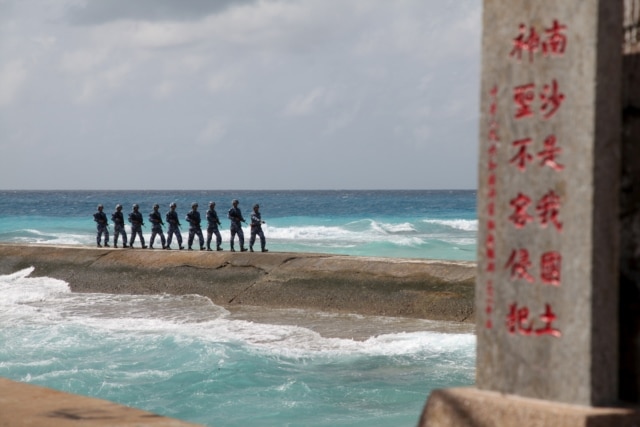
Beyond a sign that says  “Nansha is our national land, sacred and inviolable,” Chinese troops patrol artificial terrain in the Spratly Islands, which are known as a Nansha in Mandarin,  February 9, 2016.


For centuries, these waters also have been vital to the economic survival of neighboring Vietnam, Malaysia, Brunei and the Philippines.

The waters are also prized by regional non-claimants. For U.S.-allied Japan and South Korea, situated far to the north, South China Sea shipping lanes provide access to trade-intensive waters of the Indian Ocean, via which more than half of their respective energy needs are met. For non-claimant Indonesia, Natuna Sea fishing grounds along the southern fringe of the contested region hold vital natural gas reserves.

Many nations have urged Beijing to abide by the United Nations Convention on the Law of the Sea (UNCLOS), which sets maritime zones of control based on coastlines. The United States, which has signed onto UNCLOS without ratifying it, often relies on the international agreement to settle territorial disputes. China has refrained, invoking intertemporal laws based on the deep historical record, such as archaeological findings on disputed reefs and islands. At best, China views U.N.-backed codes of maritime governance as incompatible with domestic laws; at worst, it sees them as instruments of Western hegemony designed to undercut its expanding influence as a world power.

On the horizon


If Asia’s astonishing economic growth of the past two decades continues, however, regional stability will remain a matter of global consequence. Beyond China’s increasingly assertive land grabs and island-building campaigns—some 1,300 hectares of tiny islets have been landfilled to sustain mostly military infrastructure, including runways long enough to accommodate bombers—low-level skirmishes between Chinese naval patrols and civilian fishing fleets from neighboring countries could spark international conflict.

In July, a five-judge panel in The Hague unanimously rejected the legal basis of nearly all of China’s maritime claims. Within weeks, China’s Supreme People’s Court issued a regulation stating a “clear legal basis for China to safeguard maritime order,” in which Beijing vowed to prosecute any foreigners found fishing or prospecting in disputed waters.

Other means of settling complex territorial disputes also appear ineffective. The Association of Southeast Asian Nations’ long-delayed code of conduct for the South China Sea, which Beijing officials said they would finalize in 2017, would do little to resolve conflicting claims of sovereignty. Much like the Hague-based tribunal’s ruling, any legally binding ASEAN declaration would lack meaningful mechanisms of enforcement.

While the United States has long said it does not take an official position on South China Sea disputes, it steadily criticizes China’s behavior there and plans to expand defense alliances with countries that have overlapping claims. By 2021, U.S. Navy officials plan to expand the Pacific Fleet’s overseas assigned forces by approximately 30 percent.

As President-elect Donald Trump takes office, he may be called upon quickly to handle another South China Sea crisis. Just months into his first term, former President George W. Bush faced an international dispute triggered by a midair collision between a U.S. spy plane and a Chinese fighter jet near Hainan Island.

Less than seven weeks after President Barack Obama took office, Chinese ships and planes confronted the USNS Impeccable, a surveillance ship in waters south of Hainan, and ordered it to leave. The U.S. said that it had the right to be there and that the ship was harassed, while Beijing defended its actions. Obama responded by sending a guided-missile destroyer to protect the Impeccable.

Such incidents, engineered or otherwise, are likely to continue defining the dispute as it unfolds in real time. Until broader questions of maritime sovereignty are resolved, the waterway promises to remain a fulcrum upon which the geopolitics of international trade, and thus the global economy, pivots. We’ll keep close tabs on developments here as they occur.

Youngsters breathe new life into Gilgit-Baltistan folk styles

GILGIT: 

Traditional music and poetry in Gilgit-Baltistan (G-B) has been dying a slow death in recent years. However, renewed interest from locals and educated youth has seen reins of the ‘dying art’ taken up again.


The shift from traditional singers to educated youth has come during the past decade when sectarian extremism squeezed out the traditional singers.Image result for culture of hunza


The vacuum has been gradually filled in by the youth, but it has come at the cost of replacing old songs with new ones.


The Shina-language songs “ma gleeto hanus,” (I’m Gilgiti), “morek thenay morek thenay” (please speak up) and the an Urdu number “Ham Gilgit-Baltistan kay hain” (We are from Gilgit-Baltistan) are the product of these new wave of musicians and have proved to be smash hits in G-B and beyond, including in Indian Occupied Kashmir.


Though some have argued that this is primarily due to the permeation of technology and the easy availability of these songs online.


The band


The thrust behind the innovation is Zafar Taj, a noted poet and writer hailing from a literary family in Gilgit. He introduced new trends in the local music scene besides providing the youth with a platform to perform.


“The world has changed and listeners want quality today,” says Taj as he explains why they had to introduce innovations in the overall structure of folk songs.


“You cannot survive through the use of outdated tools and styles,” Taj told The Express Tribune.


Singers and Salma Jabeen are the main stars of the song “Ham Gilgit-Baltistan kay hain”. While Paras is the lead singer, Jabeen adds her own colour to the songs as they perform in the Mayoon band.


Their song has now assumed the status of an anthem in the region and is played at schools and other functions.


“It’s a great feeling knowing that people like the songs,” says Paras, who hails from the Astore valley.


However, neither ever planned to enter the field of music.


Paras, an unassuming youngster, holds a master’s degree from Karakoram International University in Gilgit. Jabeen, a social activist, accidentally entered the field when she agreed to experiment with singing when the band could not find other suitable female performers in the region.


“I knew I could sing but had never thought of performing at this level,” says Jabeen, who hails from Hunza but lives in Islamabad with her family.


Like Paras, Jabeen too is highly educated. She graduated from the Army Burn Hall College in Abbottabad before completing her Masters from the Beaconhouse National University in Lahore.


“I want to tell the world that we have progressive people back in G-B who can perform at any level,” a confident Jabeen told The Express Tribune.


Their band, Mayoon, is based in Islamabad in view of the availability of facilities such as public auditoriums, studios, theatres and musicians capable of playing various modern instruments.


“Unfortunately we don’t have a conducive environment in G-B for music, nor do we have facilities,” complains Paras, who like others, contributes from his pocket money for the band. “That’s why we are unable to promote our local music at the national level.”


“When you don’t have support from the government and society, you are bound to lose heart,” said Jabeen, referring to people who left the job previously. “But we aren’t among those, we are determined to make it to new heights.”


courtesy express tribune

Pluralism as principle

Voices against bigotry: Pro-immigration activists in Heerlen, the Netherlands, urge the Dutch to vote against hate

Voices against bigotry: Pro-immigration activists in Heerlen, the 
Netherlands, urge the Dutch to vote against hate


While nationalism is becoming a dark, divisive force in the West, it is the major cities which are offering non-white immigrants a sense of inclusiveness and openness


Earlier this month, in an election result that ushered a continental sigh of relief, the Dutch dealt a blow to the aspirations of the far-right, anti-Muslim politician Geert Wilders. Many outsiders cheered the verdict. On the heels of Brexit and the election of Donald Trump, a success for Wilders would have signalled a growing wave of right-wing populism sweeping the West.


Once it became clear that Wilders had failed, international interest in the Dutch election evaporated. By virtue of their size or political power or media muscle, there are a handful of countries whose domestic affairs become global stories. One thinks immediately of the United States, but India is also slowly joining this group (note the considerable global attention given to the elections in Uttar Pradesh). The Netherlands doesn’t normally find itself at centre stage. Even though it is a wealthy, formerly imperial western European country, it is also a curiously marginal place.


And yet, its own struggles with identity and multiculturalism offer a microcosm of the crisis facing the West.


Over a decade ago, I was lucky enough to win a fellowship to spend a summer in the Netherlands. Along with a handful of American and Dutch university students, I learned about the history of tolerance (and intolerance) in the Netherlands, from the Holocaust (which eradicated over 75 per cent of Dutch Jews) to the “integration” of Turkish and Moroccan Muslim immigrant communities. I was housed with a lovely family in the western reaches of Amsterdam. On my first morning there, I had the quintessentially Dutch experience of being driven into the centre of the city on the back of a bicycle, clinging nervously to my “host mother” as we skirted tram-tracks and dived over little bridges, tracing the paths of Amsterdam’s canals.


It was a delicate time to study such issues in the Netherlands. Months earlier, a Dutch citizen of Moroccan descent had stabbed to death the director Theo van Gogh who had made a film critical of Islam. Politicians and commentators were all trying to come to terms with the killing and its implications.


We had the chance to speak with a slew of civil society leaders, from the mayor of Amsterdam to the imams of mosques. We learned how the radicalisation of (a relatively small number of) Dutch Muslim youth was often a rebellion against the Islam of their parents, who were steeped in the folk faith and customs of rural Anatolia in Turkey and the Rif mountains in Morocco. Islamist politics, by contrast, seemed quite modern and allowed some Dutch Muslims an affirming identity in opposition to a society that excluded them.


Over the course of that summer, it became clear to me that no honest appraisal of the situation in the Netherlands could overlook the racism endured by Muslim immigrants, who faced discrimination in many corners, from trying to secure employment to interactions with the police. Even if their families had been in the Netherlands for generations, many Muslims found themselves still treated as other, deemed “allochtoon” or outsider because of their skin colour and religion. They couldn’t conceive of themselves as fully Dutch because they weren’t allowed to.


Without the cosmopolitan ideal of American or Canadian identity (open, at least in principle, to everybody) or the helpless pluralism of Indianness, the Dutch struggle to include others in their collective sense of self. You see this same difficulty in other European countries, which though informed by different colonial histories, have had trouble in expanding their understanding of who they are as a nation to include non-white people. That inability lies at the root of the political and societal convulsions roiling the continent.


In this vein, I was impressed by the insight of a municipal programme called ‘We Amsterdammers’ that sought to strengthen the bonds between young black and Muslim youth to the city they lived in. Belonging to a nation requires a leap of imagination, a leap that can be easily blocked by the experience of racism. Belonging to a particular place, on the other hand, is unquestionable, a matter of residence more than culture. For many non-white people, the major cities of the West do offer a kind of inclusion and openness that nation-states do not. I have cousins born and raised in London who think of the city as their only home, but look at the wider UK as an almost alien land.


In 2005, Amsterdam offered me a vision of the way our ideas of nationhood have to evolve. Walking around heavily immigrant neighbourhoods, I was always struck by the profusion of satellite dishes cluttering the balconies and façades of tenement buildings. Previous generations of immigrants in the West were often cut off from their lands of origin. Modern telecommunications help many immigrants maintain ties to the people, events, news, and culture of home. This is not to say that one cannot, for example, watch Algerian TV and be French at the same time, but rather that modern identities are more mingled. There is rarely a clean break between immigrants and the places they came from.


That fact of the 21st century is neither a good thing nor a bad thing, it’s simply a fact that has to be understood. Cities such as Amsterdam, London and New York are and must continue to be places that breed familiarity with difference. If nationalism in the West is becoming a divisive and dark force, cities provide a more hopeful alternative.


Courtesy The Hindu Business Line


Kanishk Tharoor is the author of Swimmer Among the Stars: Stories, a collection of short fiction


(This article was published on March 24, 2017)

Sabotaging Democracy in Gilgit Baltistan

CM Hafeez & Raja Nazim ul Amin to Head the Multi-Million Project for Idled Donkeys in Gilgit-Baltistan.


Gilgit - Pakistan.
In an implicit social media post PML (N) has confirmed to launch a multi-million pilot project in district Hunza. After months of serious deliberations, Chief Minister Hafeez ul Rehman finally broke the silence.Addressing, public officials and school kids who were forced to carry PML (N) flags and to welcome his majesty.While addressing the few locals, Hafeez ul Rehman glorified the achievements the ruling party on the occasion. As a matter of fact, the biggest achievement of the PML (N) in Hunza is that it has successfully kept the people of Hunza in absolute darkness


 Over the last three years it has failed miserably to deliver, adding zero (0) watts of electricity in the district. However,PML (N) should be praised for systematically sabotaging the electoral process. Initially,elections were rigged, then by-elections were delayed twice and last week by sending their own ticket holder Mr Salim Khan to Adyala Jail.


Importantly, Mr Hafeez PML (N) has finally decided to install new stooge in form of Mr Nazim ul Amin. Moreover, the both have ambitions plans of developing donkeys farms across all districts
Chief Minister OF Gilgit Baltistan Hafeez ul Rehman
. 

In a high level meeting headed by CM Hafeez Ul Rehman,it was agreed that GB has enormous potential in the livestock sector.
 During the same meeting it was discussed that GB has enormous capacity to capitalise this opportunity and supply donkeys to thousands of incoming Chinese

Not to forget, the dependable donkey once did it all here in northern areas of Pakistan, from hauling in the harvest to carrying children to remote schoolhouses.


 Now so many of these ubiquitous beasts of burden populate this vast swath of Gilgit-Baltistan that they have become a problem—and for some, an opportunity.

Raja Nizam ul Amin


Modernity and the skyrocketing sale of motorcycles have demoted the burro from its long-held status. Once cherished here for their hardy load-carrying, donkeys are increasingly seen as a nuisance as they saunter into traffic.
Sniffing, this opportunity the Chief Minister Gilgit-Baltistan Hafeez ul Rehman has given special directives to develop world class farming facility for donkeys in all districts of GB. The project will be co-sponsored from CPEC and GB’s development budget.


Special Province for Special People

Naveed Al-Murtaza

Special Province for  People Who are Treated as Special People

According to Legal definition special people are those peoples who have lack of competent physical and mental faculties or the absence of legal capability to perform and act, Special People also indirectly links to the term disability which usually signifies incapacity to exercise all the legal rights ordinarily possessed by an average person.
 You might be wondering about a province for those peoples who have lack of competent physical and mental faculties, you are almost near; yes this is happening in Pakistan but in an essence Pakistan is treating with people of Gilgit Baltistan (GB), like special people who have absence of legal capability to perform and act and like disable people who are not capable to exercise all the legal rights ordinarily possessed by average people.


Gilgit Baltistan a beautiful mountainous  region in north of Pakistan, approximately comprising on 72, 971 sq kilometers was known as the strategic ‘Northern Frontier’ under the British rule owing to its geographical location in the heart of Asia. 


 Image result for ATA Rule gilgit baltistan
Ghizar Valley Gilgit Baltistan

Gilgit Baltistan has been under the direct control of the federal government of Pakistan, even though it is neither a constitutional unit nor a province of Pakistan. Pakistan has kept this region in a political and constitutional limbo on the ground that it was linked to the Kashmir problem.  Gilgit Baltistan which was administrated by government of Azad Jammu & Kashmir and authority of AJK was abrogated in 1949 by signing an agreement in Karachi known as Karachi agreement. It was then governed by the Frontier Crimes Regulations (FCR) Under FCR, people had no right to appeal, to legal representation or to present reasoned evidence. Gilgit and Baltistan along with Hunza, Nagar and the Ladakh Wazarat were amalgamated in 1970. 

When Benazir Bhutto came to power in the late 1980s, she resumed the process of reform and although most of them were inconsequential, they led to the first ever party based elections in Gilgit Baltistan in October 1994. Till 2009, Gilgit Baltistan was referred as the Federally Administered Northern Areas (FANA) by the government of Pakistan. The region currently administered under the Gilgit Baltistan Empowerment and Self Governance Order issued by the government of Pakistan in August 2009. As per this order, there is a Gilgit Baltistan Legislative Assembly which has 24 directly elected members and a 15 member Gilgit Baltistan Council headed by the Pakistan prime minister. The council exercises virtual power in important spheres of governance. There is also a provision for a Gilgit Baltistan supreme appellate court in addition to the high court.
 These structures work under the overall control of the Federal Ministry of Kashmir Affairs and Gilgit Baltistan (KAGB).


On January 3rd 2018 A special meeting of Prime Minister (PM) Shahid Khaqan Abbasi with all the stakeholders was held at PM Secretariat The meeting decided to give legal cover to Gilgit Baltistan Self-Governance and Empowerment Ordinance, 2009, through the parliament. Per the decision, the GB Self-Governance and Empowerment Ordinance, 2009, replaced by the GB Interim Constitutional Act, 2018, to be enacted by the parliament of Pakistan, i.e. opted to maintain the special provincial status and The Interim Constitutional Act will brought little meaningful change at any level as, through various devices, the final authority on all important matters is the federal government. 


People of GB criticized the Interim Constitutional Act as mere eyewash. On social media many polls held regarding status of Gilgit Baltistan in recent taxation issue and almost 80 percent of people voted to self empowerment without taxation preferred i.e. to impose State Subject rule (SSR) which states that that Gilgit-Baltistan was a settled territory and under the state subject rule the natural resources including mountains and water were the property of the endogenous people who had the right to utilize them without any outside interference and The government should not own any piece of land in Gilgit-Baltistan because the status of the region is yet to be determined.  
So due weakness in polices and priorities of changing governments in Pakistan the people of GB are being deprived from their rights, the judiciary cannot strike down any order, rule and even steps taken by the central government and people are given subversive terms who are demanding their fundamental rights and Anti Terrorism Act 


“ATA” is misused by naming innocents to fourth schedule, political and social activists are suppressed, print media is unable to express feelings of people and social media activists are also booked under cyber crime and due to random decisions of biased courts of activists and journalists  are harassed. People of GB also raised concerns over CPEC China Pakistan Economic Corridor that they are not taken in to confidence over development in CPEC and are demanding to give proper representation in forums responsible for executing and monitoring projects under CPEC and also demand for compensating the barren land acquired by government for CPEC projects.


As Gilgit Baltistan is the only way to connect China and Pakistan so for success of CPEC Pakistan need to solve issue of status of Gilgit Baltistan according to aspirations of people of Gilgit Baltistan instead of treating people of GB as special people who have not capability to exercise all the legal rights ordinarily possessed by average people.


Naveed Al-Murtaza is a Social Activist, He is running YAM- Young Activists Movement and Blogger
You can follow his blogs 
Azadi e Izhar
The NiB Post
YAM

The Lasting Legacy Of Central Asia's Writers: The Founding Fathers (Part 1)

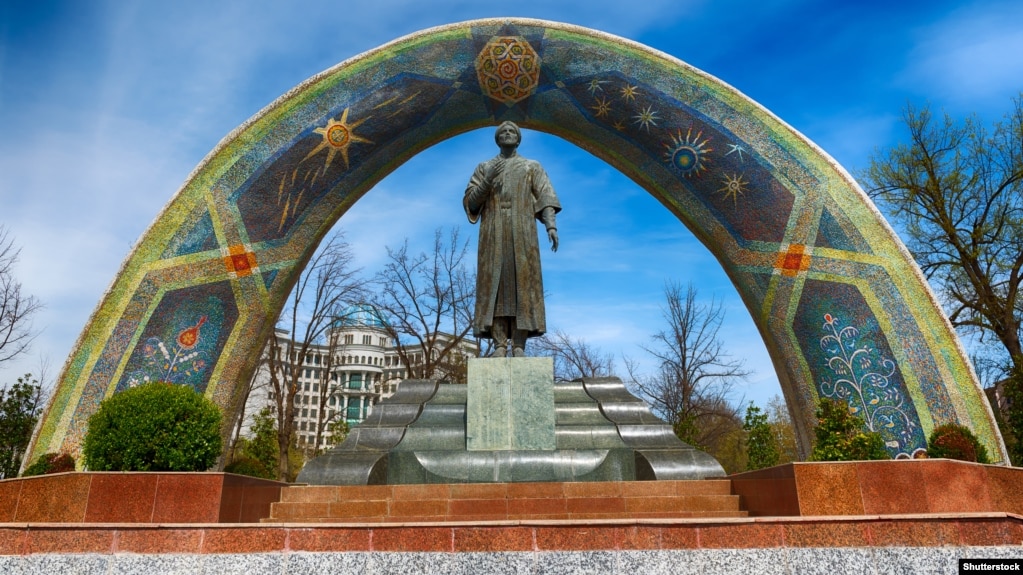
A monument to Rudaki, called the father of Persian poetry, in Rudaki Park in the Tajik capital, Dushanbe A monument to Rudaki, called the father of Persian poetry, in Rudaki Park in the Tajik capital, Dushanbe


The disintegration of the Soviet Union in late 1991 left all the former republics scrambling. Self-rule was a surprise for many, certainly for the leadership in Central Asia.


Among the many pressing matters in those days was establishing signs of sovereignty -- a flag, a national anthem, and so on.


They also needed a history; roots for building a new nation and national identity. No heroes had emerged from independence -- the U.S.S.R. simply fell apart and suddenly there were five countries in Central Asia.

Lacking contemporary heroes, the five governments searched the rich history of Central Asia, looking for known figures who could assume the role of founders of these new nations.


The respected writers of Central Asia's past were obvious choices.


The "founding father" for Tajikistan became Ismail Somoni, the late 9th-century conqueror whose Samanid Empire included what is now northern Iran, northern Afghanistan, and Central Asia south of the Syr-Darya River. His tomb is in Bukhara, in what is currently Uzbekistan.


Tajik authorities also claimed as native sons two of the best-known writers from the late, and post-Samanid, period -- Abu Abd Allah Jaar ibn Muhammad al-Rudaki, or Rudaki (858-941); and Abu Ali Ibn Sina, or Avicenna (980-1037).


The Father Of Persian Poetry


Rudaki is called the father of Persian poetry and is credited with making enormous contributions to modern Persian language. But he was also a prototype for Central Asian writers. Rudaki composed verse and he also played music.


In a time and place where illiteracy was high, music helped carry poetry throughout the region and would continue to be a main transmitter of Central Asian poetry for the better part of the next millennium.


Rudaki was also from Panjikent in what is now western Tajikistan. His tomb is there today, reinforcing Tajikistan's attachment to the poet.


Curiously, the mausoleum was originally built in 1958, by Soviet authorities (they dug up the body first to make sure he was really there). Such was the respect Rudaki commanded, and still commands.


After independence was gained in 1991, Lenin Avenue in Dushanbe became Rudaki Street. There is also a statue of Rudaki in Dushanbe's Rudaki Park, a Rudaki district in western Tajikistan, and another statue of Rudaki in Tajikistan's ancient northern city of Istaravshan.​


A Man Of Many Talents


​Avicenna was an amazing human being. Born in Bukhara, he is said to have memorized the Koran while still a child and was reading translations of Greek philosophy when he was a teenager.


He wrote his own works on philosophy, and also on medicine, mathematics, Islamic theology, science, astronomy, geography, and other subjects. And, of course, he was a poet, too.


The Avicenna State Medical University is in Dushanbe. A statue of him is on Avicenna Square in the Tajik capital.


One of Dushanbe's districts is named for Avicenna, as is the second highest mountain peak in Tajikistan (7,134 meters). It had been Lenin Peak from 1928 to 2006.


Uzbek authorities chose Tamerlane to be the nation's founding father. His connection to the Barlas clan is certain, and the Barlas eventually became a dominant Uzbek clan.


The Uzbeks also claim writer Nizomiddin Mir Alisher, better known under his pen name Navoi (1441-1501), as a native son.


Navoi was born and spent most of his life in the area around Herat, in what is now western Afghanistan, though he did live in Samarkand for a time in the 1460s.


Breaking From Tradition


In Navoi's time the language of art and science was Persian, but Navoi broke from this tradition and composed his works in Chagatai, from which the modern Uzbek language comes.


Near the end of his life, Navoi completed The Comparison Of Two Languages (Muxokamat Allugatayn), in which he attempts to argue the superiority of Chagatai over Persian.


In 1958, when Uzbekistan was a Soviet republic, the city of Karmana (Kermine) was renamed Navoi, and it still bears that name today, as does the airport there.


In the Uzbek capital, Tashkent, there is a statue of Navoi, a main street, and a park named after him, as well as the Navoi National Library and the Alisher Navoi Opera and Ballet Theater.


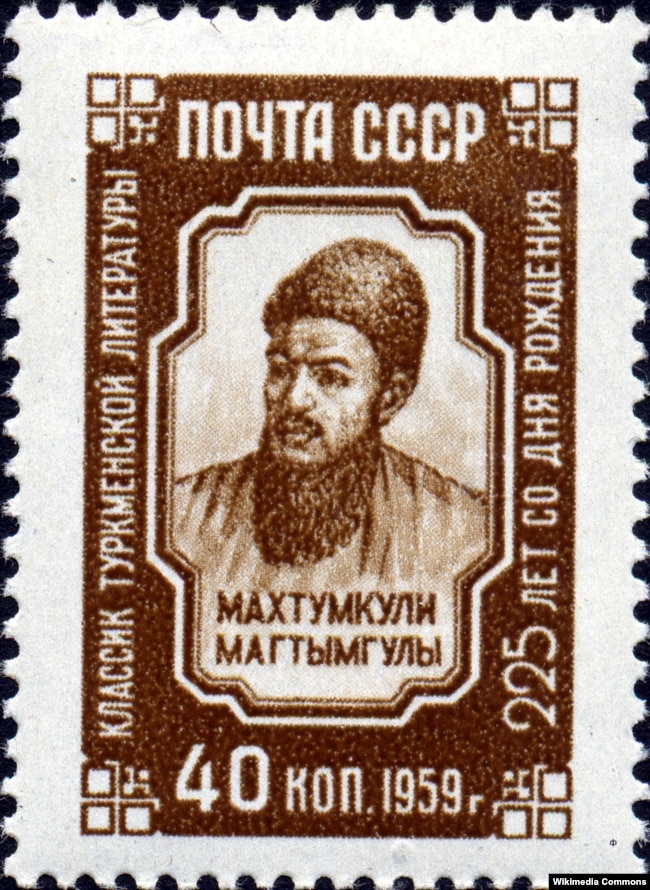
The Turkmen lay claim to the 18th-century writer and poet Magtumguly Pyragy, or simply Magtumguly (1724-ca. 1807)


A Soviet-era stamp dedicated to the writer Magtamguly Pyragy        A Soviet-era stamp dedicated to the writer Magtamguly Pyragy


Magtumguly is a different sort of figure to Rudaki, Avicenna, and Navoi. The latter three enjoyed royal patronage. Magtumguly's life was very different.


His father, Azady, was a famous poet who often wrote about morality. Azady also had a vision of the Turkmen tribes being united and one of his best-known works -- Sermon of Freedom (Wagzy-Azat) -- is a call for Turkmen tribes to band together and stop being dominated by groups around them.

Magtumguly at first wrote in Chagatai, but he eventually composed in Turkmen. Magtumguly is sometimes credited with being the first person to write in the Turkmen language, though this is not clear.


He certainly did make major contributions to the development of the language. His verse was spread by musicians called "bakhsy."


Turbulent Times


Magtumguly lived in turbulent times. He was taken captive at least once. Later in his life most of his manuscripts were lost when a raiding party attacked Magtumguly's village and loaded most of Magtumguly's possessions, including his written works, on a wagon that then tipped over in a river. Magtumguly had found a hiding place and watched as his work floated away.


Like his father, Magtumguly's work also emphasizes morality and urges Turkmen tribes to unite, but it is also, not surprisingly, somewhat bitter, and the poet often criticizes clerics and rulers for their hypocrisy and shortcomings.


Magtumguly's fame and his contributions to the Turkmen language qualify him to be considered a founding father, and it is unavoidable that he should be, but Turkmen authorities are concerned by the occasionally rebellious and critical tone of his works.


Turkmenistan's first president, Saparmurat Niyazov, alternated between praising Magtumguly and disparaging him; for example, as a Sufi who preached a hermit's life.


Niyazov's successor, President Gurbanguly Berdymukhammedov, also has mixed reactions to Magtumguly. Berdymukhammedov is credited with writing the introduction to Magtumguly: Poems From Turkmenistan (see page 4). But in June 2017 Berdymukhammedov ordered the statue of Magtumguly in Ashgabat moved to the hills outside the Turkmen capital, and the Elders' Council adopted a resolution in October 2017 that changed the May 18 holiday marking Magtumguly's birthday to June 27, and it will no longer be a day off work.


But there is a still a Magtumguly Street in Ashgabat and the Magtumguly Turkmen State University (formerly the Maksim Gorky University) and an "international" Magtumguly award for literature.


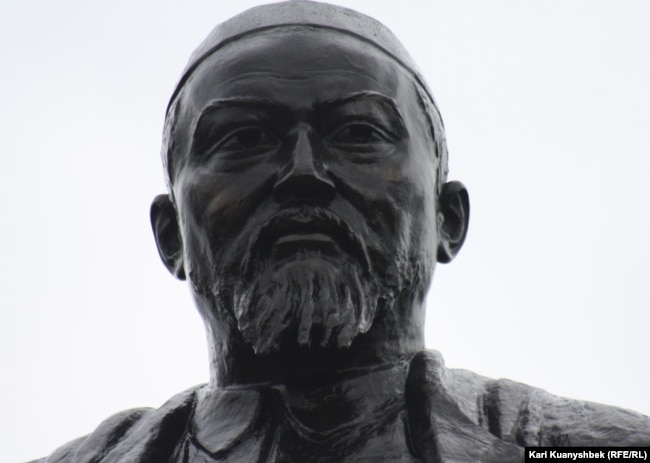
A monument to the Kazakh poet Abai in Almaty. (file photo)

A monument to the Kazakh poet Abai in Almaty. (file photo)


Ibrahim Qunanbayuli, or "Abai" (1845-1904), is perhaps Kazakhstan's great poet, but he made another immense contribution to Kazakh culture and, ultimately, to the Kazakh language by writing down his works. Previously Kazakhs' means of transmission of poetry was oral.


Abai not only wrote his own works, most notably his Book Of Words, but he also translated the works of authors such as Goethe, Pushkin, and Lermontov into Kazakh. Abai was also a musician and mothers in Kazakhstan today still sing their children to sleep with lullabies Abai wrote.


There is a village in Almaty Province named after Abai, and in Almaty the Abai State Theater of Opera and Ballet, Abai State University, and Abai Street. There is also the Abai oil field in Kazakhstan's sector of the Caspian Sea.


The Embodiment Of Kyrgyz History


The names of Kyrgyz writers from hundreds of years ago are, at best, little known today, but the Kyrgyz have what is perhaps the greatest indigenous legend -- Manas the warrior. There is a special group of people --the manaschis -- who have passed the legend of Manas down for more than 1,000 years.


In many ways Manas embodies the history of the Kyrgyz people, since some versions of his story seem to begin during the time of the nomadic Hsungnu some 2,000 years ago, whereas other versions might include events that seem drawn from the Arab invasion of Central Asia in the 8th century and there are even tales of battles Manas fought against with the Manchus of the 18th century.


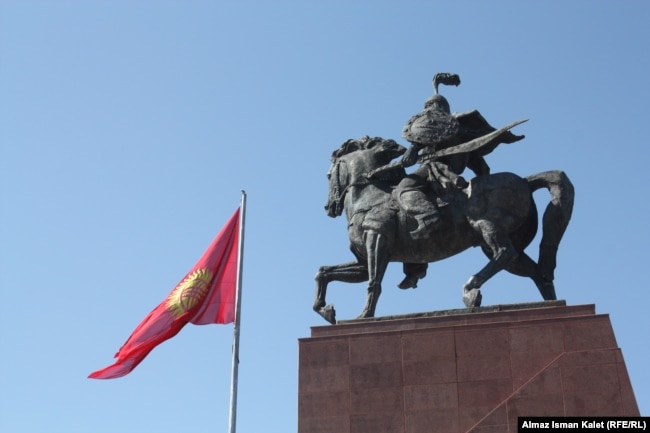
A monument to Manas, which was unveiled in Bishkek in 2011 to mark 20 years of Kyrgyz independence. (file photo)

A monument to Manas, which was unveiled in Bishkek in 2011 to mark 20 years of Kyrgyz independence. (file photo)


Manas is a true "jigit": a horseman, brave and capable with a fierce loyalty to his people, the Kyrgyz people. is 40 "choro," or companions, reinforce the need for unity among the various clans of the Kyrgyz people.


Manas and his choro, though not always the full 40, are now a common feature at outdoor political rallies during Kyrgyzstan's election campaigning. Someone dressed in ancient or medieval armor almost always rides out at some point during these rallies and no one present at these events need to be told who this person is.


Among the many objects named after Manas are a main street in Bishkek, the international airport outside Bishkek, and statues of Manas can be seen throughout the country.


Courtesy Radio Free Europe/Radio Liberty
Corporation

U.S. Suspension of Pakistan Military Aid: What It May Mean USIFP

An Often-Tense Relationship May Be Turning Unpredictable, USIP’s Moeed Yusuf Says


The first week of 2018 has moved America’s relationship with Pakistan to a new low that includes a dangerous element of unpredictability, says USIP analyst Moeed Yusuf.


Related image

The U.S. suspension of most security aid to Pakistan followed a political storm among Pakistanis over a tweet by President Trump on New Year’s Day that declared:


“The United States has foolishly given Pakistan more than 33 billion dollars in aid over the last 15 years, and they have given us nothing but lies & deceit, thinking of our leaders as fools. They give safe haven to the terrorists we hunt in Afghanistan, with little help. No more!”


The United States says Pakistan allows Afghanistan’s Taliban, and notably a faction called the Haqqani network, to operate from Pakistani territory as they launch attacks into Afghanistan against U.S. troops and Afghan targets.


A statement from Pakistan’s National Security Committee called President Trump’s comment factually incorrect and “completely incomprehensible.”


Yusuf, who oversees USIP’s work in Pakistan, said today the U.S.-Pakistani relationship is at a more dangerous point than at any time in its 70-year history.


“The issue is not that either side wants to break the relationship. Nor is a break in itself going to be unprecedented,” Yusuf said. “The problem is that never before has there been a real danger that the U.S. and Pakistan begin to operate like enemies rather than troubled allies. Even when Pakistan went from being the most allied of allies to being the most sanctioned of sanctioned states in 1990, there was never a concern of direct U.S. action against Pakistan. Now, you can’t rule it out completely. I am not saying that is the intent but a tit-for-tat dynamic whereby both sides react to the other’s coercive measures in kind could lead to anything.”


The suspension of security aid is “not itself a game-changer” in the bilateral relationship, Yusuf said. U.S. aid levels get outsized attention in the relationship because they are the easiest thing to play with, he said.


U.S. aid to Pakistan has declined steadily from a peak in 2010-11. Last year, American security assistance and its reimbursement to Pakistan for military operations (called “coalition support funds”) were already well below $1 billion. And only part of what was meant to go there made it due to conditionalities and other technical impediments.


Within Pakistan’s economy, with a gross domestic product of nearly $300 billion per year, the recent level of U.S. aid “simply doesn’t add up to provide strategic leverage for the U.S.” with Pakistan’s government, Yusuf said.


Also, Pakistan has expected this move for a while and already was significantly prepared for it. Over recent years, Pakistan has sought to balance erosion in its relationship with America by strengthening its ties, and its economic gains, from China.


Pakistan historically has supported chosen factions in Afghanistan, its western neighbor, as a way of maintaining Pakistani influence there. Pakistani strategists say their country needs to do so as a defense against its powerful rival to the east, India. Pakistan’s military and security establishment, which determines the country’s foreign policy, fears that Indian influence in Afghanistan has been growing. In the early 1990s, Pakistan supported the Taliban as it took power in Afghanistan.


It’s Pakistan’s fear of India, and not U.S. aid, that is “going to continue driving their strategic calculus,” said Yusuf. “There is also the reality that the U.S. has used assistance cuts to pressure Pakistan in the past with no real gains. In the 1990s, the United States slashed its aid in an effort to force Pakistan to halt its development of nuclear weapons. Not only did the program speed up, but Pakistan’s nuclear kingpin, A.Q. Khan also proliferated nuclear technology,” selling elements of the country’s systems for building nuclear arms.


“If the Trump administration has cut off aid as a one-off punitive measure, it’ll only complicate relations further without producing any desired returns,” Yusuf said. More likely, the move to cut aid is a pressure tactic—a signal that this is the start of a string of actions to hurt Pakistan if it doesn’t do more to help the United States in Afghanistan, he added.


The result could be the reverse. Pakistan is in an election year and “beating up on the U.S. is a popular political strategy,” Yusuf said. Pakistan also can pressure the United States by closing U.S. military supply lines to Afghanistan that pass across Pakistani highways and airspace—a step it took during a 2011 confrontation in relations.


“Deep down, both parties know just how costly a confrontational bilateral relationship will be for them,” and are not likely to be deliberately reckless, Yusuf said. The real danger is the unintended consequences of brinkmanship from both sides.


“Even if neither wants a divorce, with every punitive step, the pressure on Pakistan to react grows, and the slightest miscalculation and overplaying of the hand by either side could be disastrous,” Yusuf said. “The irony is that it is hard to see how any of this will benefit Afghanistan. Yet, the U.S. may lose Pakistan completely to China in the process.”


pakistan-usa copy

Courtesy The United States Institute of Peace

Why Is Afghanistan the 'Graveyard of Empires'?

A brief history of the empires that were broken in the Hindu Kush.


By Akhilesh Pillalamarri

Image result for graveyard of empires

Where is the United States’ war in Afghanistan going? Recently, the Trump administration gave Secretary of Defense James
Mattis the authority to set troop levels there; so far, rumors suggest that 4,000 more American troops may soon be on their
way to Afghanistan. However, this may not be enough; occupying and administering Afghanistan is a herculean task that few
empires have ever had success with. The Taliban continue to gain in strength, while ISIS is expanding throughout the country.
The Taliban, ISIS, various warlords, and the Afghan government all continue to fight each other.
Writing in the Atlantic, Peter Beinart described the current U.S.-led war there as hopeless: the Taliban are unlikely to cut a
deal because time is on their side, and they merely have to wait it out until the United States decides to leave. The United
States has been involved in Afghanistan for almost 16 years, making it the longest conflict in its history (with the possible
exception of Vietnam, depending on how one interprets the chronology of that conflict). Despite spending more on
Afghanistan than on rebuilding Europe after World War II, little progress has been made. It would not be surprising if the
Taliban controlled all of Afghanistan within a decade.
Afghanistan is a notoriously difficult country to govern. Empire after empire, nation after nation have failed to pacify what is
today the modern territory of Afghanistan, giving the region the nickname “Graveyard of Empires, ” even if sometimes those
empires won some initial battles and made inroads into the region. If the United States and its allies decide to leave
Afghanistan, they would only the latest in a long series of nations to do so. As the British learned in their 1839-1842 war in
Afghanistan, it is often easier to do business with a local ruler with popular support than to support a leader backed by foreign
powers; the costs of propping up such a leader eventually add up. The closest most historical empires have come to controlling
Afghanistan was by adopting a light-handed approach, as the Mughals did. They managed to loosely control the area by paying
off various tribes, or granting them autonomy. Attempts at anything resembling centralized control, even by native Afghan
governments, have largely failed.


Afghanistan is particularly hard to conquer primarily due to the intersection of three factors. First, because Afghanistan is
located on the main land route between Iran, Central Asia, and India, it has been invaded many times and settled by a plethora
of tribes, many mutually hostile to each other and outsiders. Second, because of the frequency of invasion and the prevalence
of tribalism in the area, its lawlessness lead to a situation where almost every village or house was built like a fortress, or qalat.
Third, the physical terrain of Afghanistan makes conquest and rule extremely difficult, exacerbating its tribal tendencies.
Afghanistan is dominated by some of the highest and more jagged mountains in the world. These include the Hindu Kush,
which dominates the country and run through the center and south of the country, as well as the Pamir mountains in the east.
The Pamir Knot — where the Hindu Kush, Pamir, Tian Shan, Kunlun, and Himalayas all meet is situated in Badakhshan in
northeast Afghanistan.


Courtesy The Diplomat

Shimshal A Village of Philanthropy


HUNZA-Shimshal is the highest settlement in Pakistan’s northern Hunza region and the last village before the Chinese border. It is reachable via only one rocky, hairpin turn—laden road cut into the Distegill Sar and Karun Kuh mountains. The road, known as the Shimshal Valley Road, is considered one of the world’s most dangerous. Much of it runs along the gorge of the Shimshal River, bordered by nothing but a steep drop off without guardrails. Completed in 2003 after 18 years of construction, it is an unmarked turnoff from the Karakoram Highway, navigable only by four—wheel drive.


In May 2017, I, along with six male cyclists, navigated the 56km road from the turnoff near Passu to Shimshal. For most of the way, I gripped my handlebars so hard my hands cramped. I prayed that my brakes wouldn’t give out. I expected my aluminium bike to shatter beneath me, or at the very least for some integral part to go flying off over a cliff.

None of these things happened. I wasn’t as fast or as confident on the rocks as the guys, so I ended up predominately cycling alone. I rested often, looking out over the cliffs. Something about the view made me think of what I imagine cycling on another planet would be like: no other humans or signs of civilisation anywhere, just rock and mountain, rock and mountain.

Back at the guesthouse dining room later that day, we gathered around a table and Mr Hussain introduced us to Essa Khan, who has lived in the village all his life and can trace his ancestors back 12 generations. Mr Khan said he would tell us about his family first, and then the bridge.

Mr Khan’s grandfather was a carpenter. One day, he decided he’d turn a barren tract of land near Shimshal into a field. He tilled and ploughed the soil so that it would be able to produce crops of wheat, buckwheat and barley, using nothing but his own hands and basic tools like a shovel and rake. The crops were (and still are) used to make bread that was then both shared and traded with the community. His name was Chichan Bag. In 1995, Muhammad Bashi, Mr Khan’s father, built a bridge as ‘Nomus’ for his father.

Nomus, a Wakhi word that can be translated as ‘showing concern for humanity’, is a unique system of social philanthropy – and an integral part of Shimshal society. Essentially, it’s a system in which the wealthier members of the community sponsor a building project like a bridge, trail or wall by providing resources, food and/or their own labour to honour a relative’s memory (whether they are alive or dead) and to generate blessings of God. If a person has donated his wealth for the benefit of all, in turn people will look after and guard his property.

Most of the Shimshalis I spoke with can trace their families back many generations, and have a long memory of their difficult history as servants, tending livestock and acting as porters for the Mir who controlled the Hunza region when it was a princely state – both as a subsidiary alliance with British India from 1892 to 1947 and as a princely state of Pakistan from 1947 to 1974.

After the princely state was dissolved by the Pakistani government, the Shimshali people concentrated their efforts on building their own community, taking pride in being self—reliant. They believe that self—sufficiency is the way to keep control of their own affairs, and that they know best how to take care of their own lands and people. Nomus, with its core goal of benefitting a community, is likely a part of this belief.

I asked Mr Khan and Mr Hussain what they knew about the tradition. They both agreed that the fact that Shimshal was cut off from most of the rest of the world for so long (until 2003 when the Shimshal Valley Road was finished) probably led to the creation of Nomus. Shimshalis needed to figure out a way to take care of themselves and each other; they were too remote and isolated to expect help from anyone outside the community. Essa mused that he suspected that the Nomus tradition was at least 100 or more years old. “In olden times, someone who owned many goats and sheep maybe decided to offer some of them to the community so that they all could benefit from them. In turn, the community, would help graze the herds,” he said.

Most of the infrastructure improvements in Shimshal – including the bridges; the solar panels that power the 250 or so houses and the mobile phone towers with electricity; the rock walls that line the village roads; and the stone and mud houses constructed along the path to the pass ­– are a result of Nomus. There’s the community—run Shimshal Nature Trust, which oversees the region and takes care of its land. Even the Shimshal Valley Road was only made possible through the local community volunteering their labour along with the Aga Khan Rural Support Program and the Pakistan Government. Shimshalis are proud of their homes and the fact that they built their village themselves.

Mr Bashi passed away in the early 2000s, and now Mr Khan maintains the Chichan Bag bridge, rebuilding it in 2004 after a flood washed it out. The descendants of Chichan Bag will continue to maintain the bridge for as long as it exists. And it will always bear the name, and be known as, the Chichan Bag Bridge. To not do so would mean dishonouring the memory of their ancestor and not receiving blessings from God.

“If my children want to build something for me, I will, of course, be happy,” Mr Khan said. “But it depends on whether they can manage to build and honour me with something or if they will maintain what I built for my father who built for his father. Either way, I will be happy.”

courtesy BBC