
HUNZA-Shimshal is the highest settlement in Pakistan’s northern Hunza region and the last village before the Chinese border. It is reachable via only one rocky, hairpin turn—laden road cut into the Distegill Sar and Karun Kuh mountains. The road, known as the Shimshal Valley Road, is considered one of the world’s most dangerous. Much of it runs along the gorge of the Shimshal River, bordered by nothing but a steep drop off without guardrails. Completed in 2003 after 18 years of construction, it is an unmarked turnoff from the Karakoram Highway, navigable only by four—wheel drive.
 In May 2017, I, along with six male cyclists, navigated the 56km road from the turnoff near Passu to Shimshal. For most of the way, I gripped my handlebars so hard my hands cramped. I prayed that my brakes wouldn’t give out. I expected my aluminium bike to shatter beneath me, or at the very least for some integral part to go flying off over a cliff.
None of these things happened. I wasn’t as fast or as confident on the rocks as the guys, so I ended up predominately cycling alone. I rested often, looking out over the cliffs. Something about the view made me think of what I imagine cycling on another planet would be like: no other humans or signs of civilisation anywhere, just rock and mountain, rock and mountain.
Back at the guesthouse dining room later that day, we gathered around a table and Mr Hussain introduced us to Essa Khan, who has lived in the village all his life and can trace his ancestors back 12 generations. Mr Khan said he would tell us about his family first, and then the bridge.
Mr Khan’s grandfather was a carpenter. One day, he decided he’d turn a barren tract of land near Shimshal into a field. He tilled and ploughed the soil so that it would be able to produce crops of wheat, buckwheat and barley, using nothing but his own hands and basic tools like a shovel and rake. The crops were (and still are) used to make bread that was then both shared and traded with the community. His name was Chichan Bag. In 1995, Muhammad Bashi, Mr Khan’s father, built a bridge as ‘Nomus’ for his father.
Nomus, a Wakhi word that can be translated as ‘showing concern for humanity’, is a unique system of social philanthropy – and an integral part of Shimshal society. Essentially, it’s a system in which the wealthier members of the community sponsor a building project like a bridge, trail or wall by providing resources, food and/or their own labour to honour a relative’s memory (whether they are alive or dead) and to generate blessings of God. If a person has donated his wealth for the benefit of all, in turn people will look after and guard his property.
Most of the Shimshalis I spoke with can trace their families back many generations, and have a long memory of their difficult history as servants, tending livestock and acting as porters for the Mir who controlled the Hunza region when it was a princely state – both as a subsidiary alliance with British India from 1892 to 1947 and as a princely state of Pakistan from 1947 to 1974.
After the princely state was dissolved by the Pakistani government, the Shimshali people concentrated their efforts on building their own community, taking pride in being self—reliant. They believe that self—sufficiency is the way to keep control of their own affairs, and that they know best how to take care of their own lands and people. Nomus, with its core goal of benefitting a community, is likely a part of this belief.
I asked Mr Khan and Mr Hussain what they knew about the tradition. They both agreed that the fact that Shimshal was cut off from most of the rest of the world for so long (until 2003 when the Shimshal Valley Road was finished) probably led to the creation of Nomus. Shimshalis needed to figure out a way to take care of themselves and each other; they were too remote and isolated to expect help from anyone outside the community. Essa mused that he suspected that the Nomus tradition was at least 100 or more years old. “In olden times, someone who owned many goats and sheep maybe decided to offer some of them to the community so that they all could benefit from them. In turn, the community, would help graze the herds,” he said.
Most of the infrastructure improvements in Shimshal – including the bridges; the solar panels that power the 250 or so houses and the mobile phone towers with electricity; the rock walls that line the village roads; and the stone and mud houses constructed along the path to the pass – are a result of Nomus. There’s the community—run Shimshal Nature Trust, which oversees the region and takes care of its land. Even the Shimshal Valley Road was only made possible through the local community volunteering their labour along with the Aga Khan Rural Support Program and the Pakistan Government. Shimshalis are proud of their homes and the fact that they built their village themselves.
Mr Bashi passed away in the early 2000s, and now Mr Khan maintains the Chichan Bag bridge, rebuilding it in 2004 after a flood washed it out. The descendants of Chichan Bag will continue to maintain the bridge for as long as it exists. And it will always bear the name, and be known as, the Chichan Bag Bridge. To not do so would mean dishonouring the memory of their ancestor and not receiving blessings from God.
“If my children want to build something for me, I will, of course, be happy,” Mr Khan said. “But it depends on whether they can manage to build and honour me with something or if they will maintain what I built for my father who built for his father. Either way, I will be happy.”
courtesy BBC
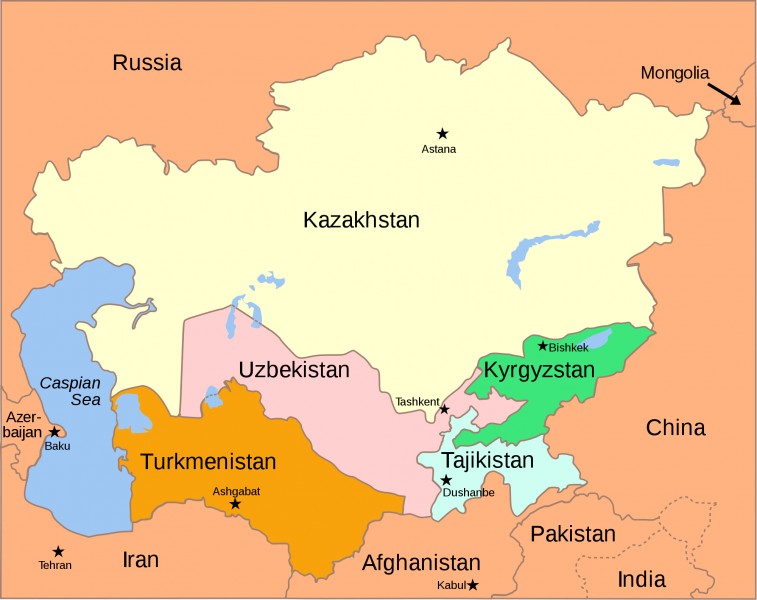 Map of Central Asia[/caption]

Follow Us
Were this world an endless plain, and by sailing eastward we could for ever reach new distances