Advert

Showing posts with label United Nations. Show all posts

Exclusive: 'We will kill you all' - Rohingya villagers in Myanmar beg for safe passage

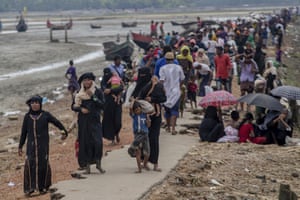
 Rohingya Muslims, who crossed over from Myanmar into Bangladesh, walk towards the nearest refugee camp at Teknaf, Bangladesh


SITTWE, Myanmar (Reuters) - Thousands of Rohingya Muslims in violence-racked northwest Myanmar are pleading with authorities for safe passage from two remote villages that are cut off by hostile Buddhists and running short of food.


“We’re terrified,” Maung Maung, a Rohingya official at Ah Nauk Pyin village, told Reuters by telephone. “We’ll starve soon and they’re threatening to burn down our houses.”


Another Rohingya contacted by Reuters, who asked not to be named, said ethnic Rakhine Buddhists came to the same village and shouted, “Leave, or we will kill you all.”


Fragile relations between Ah Nauk Pyin and its Rakhine neighbors were shattered on Aug. 25, when deadly attacks by Rohingya militants in Rakhine State prompted a ferocious response from Myanmar’s security forces.


At least 430,000 Rohingya have since fled into neighboring Bangladesh to evade what the United Nations has called a “textbook example of ethnic cleansing”.


About a million Rohingya lived in Rakhine State until the recent violence. Most face draconian travel restrictions and are denied citizenship in a country where many Buddhists regard them as illegal immigrants from Bangladesh.


Tin Maung Swe, secretary of the Rakhine State government, told Reuters he was working closely with the Rathedaung authorities, and had received no information about the Rohingya villagers’ plea for safe passage.


“There is nothing to be concerned about,” he said when asked about local tensions. “Southern Rathedaung is completely safe.”


National police spokesman Myo Thu Soe said he also had no information about the Rohingya villages but that he would look into the matter.


Asked to comment, a spokeswoman for the U.S. State Department’s East Asia Bureau made no reference to the situation in the villages, but said the United States was calling “urgently” for Myanmar’s security forces “to act in accordance with the rule of law and to stop the violence and displacement suffered by individuals from all communities.”


“Tens of thousands of people reportedly lack adequate food, water, and shelter in northern Rakhine State,” spokeswoman Katina Adams said. “The government should act immediately to assist them.”


Adams said Patrick Murphy, the U.S. deputy assistant secretary of state for East Asia, would reiterate grave U.S. concern about the situation in Rakhine when he meets senior officials in Myanmar this week.


Britain is to host a ministerial meeting on Monday on the sidelines of the annual U.N. General Assembly in New York to discuss the situation in Rakhine.


NO BOATS


Ah Nauk Pyin sits on a mangrove-fringed peninsula in Rathedaung, one of three townships in northern Rakhine State. The villagers say they have no boats.

Until three weeks ago, there were 21 Muslim villages in Rathedaung, along with three camps for Muslims displaced by previous bouts of religious violence. Sixteen of those villages and all three camps have since been emptied and in many cases burnt, forcing an estimated 28,000 Rohingya to flee.


Rathedaung’s five surviving Rohingya villages and their 8,000 or so inhabitants are encircled by Rakhine Buddhists and acutely vulnerable, say human rights monitors.


The situation is particularly dire in Ah Nauk Pyin and nearby Naung Pin Gyi, where any escape route to Bangladesh is long, arduous, and sometimes blocked by hostile Rakhine neighbors.


Maung Maung, the Rohingya official, said the villagers were resigned to leaving but the authorities had not responded to their requests for security. At night, he said, villagers had heard distant gunfire.


“It’s better they go somewhere else,” said Thein Aung, a Rathedaung official, who dismissed Rohingya allegations that Rakhines were threatening them.


Only two of the Aug. 25 attacks by the Arakan Rohingya Salvation Army (ARSA) took place in Rathedaung. But the township was already a tinderbox of religious tension, with ARSA citing the mistreatment of Rohingya there as one justification for its offensive.


In late July, Rakhine residents of a large, mixed village in northern Rathedaung corraled hundreds of Rohingya inside their neighborhood, blocking access to food and water.


A Rohingya refugee carries a sick infant in Cox's Bazar, Bangladesh, September 17, 2017. REUTERS/Cathal McNaughton


A similar pattern is repeating itself in southern Rathedaung, with local Rakhine citing possible ARSA infiltration as a reason for ejecting the last remaining Rohingya.


‘ANOTHER PLACE’


Maung Maung said he had called the police at least 30 times to report threats against his village.


On Sept. 13, he said, he got a call from a Rakhine villager he knew. “Leave tomorrow or we’ll come and burn down all your houses,” said the man, according to a recording Maung Maung gave to Reuters.


When Maung Maung protested that they had no means to escape, the man replied: “That’s not our problem.”


On Aug. 31, the police convened a roadside meeting between two villages, attended by seven Rohingya from Ah Nauk Pyin and 14 Rakhine officials from the surrounding villages.


Instead of addressing the Rohingya complaints, said Maung Maung and two other Rohingya who attended the meeting, the Rakhine officials delivered an ultimatum.


Slideshow (8 Images)


“They said they didn’t want any Muslims in the region and we should leave immediately,” said the Rohingya resident of Ah Nauk Pyin who requested anonymity.


The Rohingya agreed, said Maung Maung, but only if the authorities provided security.


He showed Reuters a letter that the village elders had sent to the Rathedaung authorities on Sept. 7, asking to be moved to “another place”. They had yet to receive a response, he said.


VIOLENT HISTORY


Relations between the two communities deteriorated in 2012, when religious unrest in Rakhine State killed nearly 200 people and made 140,000 homeless, most of them Rohingya. Scores of houses in Ah Nauk Pyin were torched.


Since then, said villagers, Rohingya have been too scared to leave the village or till their land, surviving mainly on monthly deliveries from the World Food Programme (WFP). The recent violence halted those deliveries.


The WFP pulled out most staff and suspended operations in the region after Aug. 25.


Residents in the area’s two Rohingya villages said they could no longer venture out to fish or buy food from Rakhine traders, and were running low on food and medicines.


Maung Maung said the local police told the Rohingya to stay in their villages and not to worry because “nothing would happen,” he said.


But the nearest police station had only half a dozen or so officers, he said, and could not do much if Ah Nauk Pyin was attacked.


A few minutes’ walk away, at the Rakhine village of Shwe Long Tin, residents were also on edge, said its leader, Khin Tun Aye.


They had also heard gunfire at night, he said, and were guarding the village around the clock with machetes and slingshots in case the Rohingya attacked with ARSA’s help.


“We’re also terrified,” he said.


He said he told his fellow Rakhine to stay calm, but the situation remained so tense that he feared for the safety of his Rohingya neighbors.


“If there is violence, all of them will be killed,” he said.


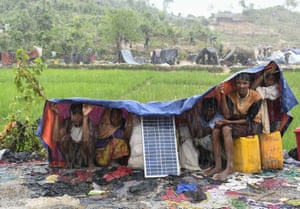
Rohingya refugees protect themself from the rain in Bangladesh’s Balukhali refugee camp

Courtesy


Reporting by Wa Lone and Andrew R.C. Marshall; Additional reporting by David Brunnstrom in Washington; Editing by Ian Geoghegan and Peter Cooney

Our Standards:The Thomson Reuters Trust Principles.

The Threat of Famine Looms in Yemen

BY

Up to eight million Yemenis are severely food insecure while another two million are facing food insecurity at emergency levels, just one phase below famine.


On 6 May 2016 in Yemen, a baby is screened for malnutrition at the UNICEF- supported Al-Jomhouri Hospital in Sa’ada. Credit: UNICEF/UN026928/Al-Zekri

On 6 May 2016 in Yemen, a baby is screened for malnutrition at the UNICEF- supported Al-Jomhouri Hospital in Sa’ada. Credit: UNICEF/IPS

United Nations: Millions of Yemenis could soon face widespread famine if no action is taken to improve food access through humanitarian or trade means, an early warning system has said.


Up to eight million Yemenis are severely food insecure while another two million are facing food insecurity at emergency levels, just one phase below famine, the Famine Early Warning Systems Network (FEWS NET) has found. The World Food Programme (WFP) estimates that the food-insecure population in the Middle Eastern nation could be even higher at up to 14.4 million, representing half of the population.


This has contributed to rising acute malnutrition and risk of mortality. According to the UN Children’s Fund (UNICEF), almost 4.5 million are in need of treatment for malnutrition, including over two million children.


The ongoing conflict between a Saudi-led coalition and the Houthis has largely driven the food crisis in Yemen, which FEWS Net describes as the “largest food security emergency in the world.” The two-year civil war has left thousands dead and three million displaced, limiting humanitarian access and food availability on the market.


The US Agency for International Development-funded system highlighted the need to improve humanitarian access in order to continue and increase much needed food and nutrition assistance.


Though current food assistance from organisations such as the World Food Programme (WFP) is helping mitigate the crisis, FEWS NET noted that such operations alone have been insufficient to meet the country’s needs.


Action is also needed to ensure sustained commercial food trade. Prior to the conflict, Yemen imported approximately 90% of its food. The unrest has since disrupted the government and private sector’s ability to import food. Most recently, wheat imports were suspended in December, a staple grain for Yemenis.


Without such imports, humanitarian actors will also be unable to ensure local food availability.


Though food is still available on local markets, increased prices and reduced income have limited access to goods. WFP found that prices of red bean, sugar and onion were respectively 48%, 24% and 17% higher in November than in the pre-crisis period.


A major reduction in food import levels will only serve to worsen food security in the country.


“In a worst-case scenario, where food imports drop substantially for a sustained period of time or where conflict persistently prevents the flow of food to local markets, famine is possible,” FEWS NET reported.


In 2016, the UN requested almost $1.7 billion towards Yemen’s Humanitarian Response Plan. Approximately 40% remains remains unfunded.


Courtesy The Wire In

New UN chief Guterres takes helm at the world body

[youtube https://www.youtube.com/watch?v=aDAtl1wCjI8]

The UN welcomes the New Year with a new secretary-general and five additional Security Council members on January 1. Some observers say that Antonio Guterres can reinvigorate the UN. But others question whether this is really the start of a new era.


[caption id="attachment_2646" align="alignnone" width="600"]António Manuel de Oliveira Guterres, GCL GCC is a Portuguese politician and diplomat who serves as the ninth Secretary-General of the United Nations since 1 January 2017 New UN chief António Manuel de Oliveira Guterres,[/caption]

At midnight Saturday, Ban Ki Moon relinquished his role as UN secretary general to Antonio Guterres, who then made a global appeal for peace, urging all people to make a shared New Year's resolution: "Let us resolve to put peace first."


His words echo those of his predecessor, Ban, who on assuming the role of secretary general of the United Nations in January 2007 declared that his mandate would be "marked by ceaseless efforts to build bridges and put an end to divisions".


Ten years later, the Korean leader has arguably fallen short of his mark. Critics have blamed Ban for a lack of charisma and a failure to muster the requisite authority to lead the international agency.


Many observers are confident that Guterres, a former Portuguese prime minister and high commissioner for refugees, who was unanimously elected to replace Ban, can breathe new life into the UN.


"We need mediation, arbitration, as well as creative diplomacy," said Guterres, 67, after he was named the new UN chief. He added that the institution "must focus more on delivery and less on process, more on people and less on bureaucracy".


Described as an intellectual with a consensual leadership style, Guterres has been lauded for his political judgment, his vast knowledge of culture and history and for a personality that seeks to be socially engaged.


His supporters say these are the qualities that make him so qualified to take on the mantle of chief international mediator at a time when the UN faces some of its toughest challenges.


Challenges in 2017


In 2017, the UN will be grappling with numerous crises. Bringing an end to the Syrian conflict, which has ravaged the country for nearly six years, managing a migrant and refugee crisis triggered by it, but also ensuring that the gains made in combating climate change, via the COP21, COP22 and the upcoming COP23 agreements, are upheld.


Richard Gowan, an analyst at the European Council of International Relations, says that the new secretary general "could give the UN the kind of kick to the back that it needs".


"Whether it is on Syria, Yemen, South Sudan, the refugee crisis or climate change, he will be judged on his ability to stand up to the powers that have chosen him," said Louis Charbonneau, UN director at Human Rights Watch, in an interview with FRANCE 24.


According to UNHCR, 21.3 million people are refugees around the world. Fifty-three percent of these people are from Syria (4.9 million), Afghanistan (2.7 million) and Somalia (1.1 million). In South Sudan, the UN will have to keep up its engagement to try to put an end to the civil war that has already killed thousands and forced more than one million people to leave their homes.


Human Rights advocates say Guterres’s international work, which includes 10 years serving as UN high commissioner for refugees (UNHCR), has prepared him well for global challenges, particularly those brought on by the refugee and migrant crisis.


“The Security Council has chosen a fervent and effective refugee advocate who has the potential to adopt a radically different tone on human rights at a time of great challenges," said Charbonneau in an article for Le Monde in October following Guterres's nomination.


Is the UN still relevant?


Many believe the UN no longer reflects contemporary international society with increasing criticism focused on its unwieldy bureaucracy and the presence of the five permanent members at the Security Council, which have the right to veto resolutions.


Among recent critics is the US president-elect, Donald Trump, who said, "The United Nations has such great potential, but right now it is just a club for people to get together, talk and have a good time. So sad!"


He took a swipe at the UN Security Council after it passed a resolution to end Israeli settlements – a vote enabled by the US, which took the almost unprecedented decision not to veto it.


New blood


Joining the Security Council this year are Bolivia, Ethiopia, Sweden and Kazakhstan, who replace Angola, Spain, Malaysia, New Zealand and Venezuela as non-permanent members sitting for two years.


Italy, which is the fifth country elected, will be in office for one year only. After five rounds of voting at the UN Assembly back in June, Italy, which had the same number of votes as the Netherlands, decided to share its seats. "We will sit a year each," said Italian Prime Minister Paolo Gentiloni.


These five new members are in addition to the five permanent members (France, United States, Great Britain, China, Russia) and the remaining five non-permanent members: Egypt, Uruguay, Ukraine, Senegal and Japan.


The UN, however, seems fully cognisant of what potentially undermines its capacity to be representative of the international community. On its website it says that “more than 60 UN member states have never been members of the Security Council."


This year’s membership will do little to mitigate the imbalance, with Europe overwhelmingly represented compared to other regions.


The continent has five member countries, while Africa has three representatives along with the Americas and Asia. This year, the Middle East is the only region without representation at the council.


Guterres has promised that the UN’s duty "is to the peoples we serve, is to work together to move from fear of each other to trust in each other, trust in the values that bind us, and trust in the institutions that serve and protect us".


"My contribution to the United Nations will be aimed at inspiring that trust."


This article has been translated from the original in French.


Courtesy France 24 

9 questions about the UN vote on Israeli settlements you were too embarrassed to ask

dome_of_the_rock-0

A picture taken on October 14, 2016, shows the Dome of the Rock, in the compound known to Muslims as al-Haram al-Sharif (Noble Sanctuary) and to Jews as Temple Mount, in Jerusalem's Old City.

A controversial new United Nations Security Council resolution condemning Israeli settlements in Palestinian territory has triggered a brutal and messy diplomatic fight between President Obama, Israeli Prime Minister Benjamin Netanyahu, and now President-elect Donald Trump.


The war of words got even nastier Wednesday, when Secretary of State John Kerry delivereda high-profile speech warning that Netanyahu’s settlement policy could doom any chance at a peace deal and threaten Israel’s future as a Jewish and democratic state.


“The status quo is leading toward one state and perpetual occupation,” Kerry warned. “The Israeli prime minister publicly supports a two-state solution, but his current coalition is the most right-wing in Israeli history, with an agenda driven by its most extreme element.”


Netanyahu immediately shot back that Kerry’s speech was “biased against Israel” and "obsessively focused" on settlements, and “barely touched upon the root of the conflict — Palestinian opposition to a Jewish state in any boundaries."


So who’s right? And why are both countries so angry? It’s a complex answer that involves geopolitical maneuvering, international legal issues, and a healthy dose of seemingly nonsensical diplomatic language, so you’d be forgiven for feeling a little bit lost trying to sort out exactly what’s going on.


If so, don’t worry: We’ve got you covered. What follows is a simple guide to the whole kerfuffle.


1) What did the Obama administration do at the UN?


The United States on Friday abstained on a vote over a UN Security Council resolution demanding an end to Israeli settlements in Palestinian territory. By abstaining — instead of vetoing the resolution, as the United States has reliably done to similar measures for decades — the Obama administration allowed the highly symbolic measure to make it through the chamber by a unanimous 14-0 margin.


It was the first time in nearly 40 years that the Security Council has passed a resolution critical of Israeli settlements. It was also a firm rebuke of both Netanyahu, who had strongly argued against the resolution, and Trump, who had taken the highly unprecedented move of weighing in on Thursday, before the vote, and pressing for the measure to be vetoed.


The Jewish communities in question are in the West Bank and East Jerusalem, both of which were captured by Israel during 1967’s Six-Day War. They range in size from small outposts of just a few dozen people to Ariel, home to some 20,000 people and a thriving university. Two of the more controversial settlements lie inside and adjacent to Hebron, a large Palestinian city that houses the burial place of Abraham, making it one of the holiest sites in both Judaism and Islam. Dozens of Jews and Muslims have been killed in political violence there in recent decades.


Israel’s construction of new neighborhoods throughout East Jerusalem is technically as illegal as its settlement building elsewhere in the West Bank, but many American policymakers from both parties have long acknowledged that Jewish neighborhoods in that part of the city would remain under Israeli control in any peace agreement. That’s particularly true of the Jewish Quarter of the Old City, home to the Western Wall, the most religiously important place in Judaism.


It’s important to note that the settlement population is enormous and rapidly growing; nearly 600,000 Jews live in East Jerusalem and the West Bank, a figure that has grown by 100,000 just since Obama took office in 2009.


Citing those statistics, administration officials say they had to act now because the population is so big that it would soon be basically impossible for Israel to withdraw from any meaningfully large parts of the West Bank — helping to doom the already faint chances of a peace deal.


2) What did the resolution actually say?


UN resolution 2334 is a long document full of diplomatic jargon (you can read the full text here), so we’ll just skip to the important parts.


The resolution demands that Israel “immediately and completely cease all settlement activities in the occupied Palestinian territory, including East Jerusalem,” and declares that the establishment of settlements by Israel has “no legal validity and constitutes a flagrant violation under international law.”


This is far stronger language than the United States has ever officially used to describe Israeli settlement activity before. Although the standard US position has for three decades been that such settlements, which are built on land intended to be part of a future Palestinian state, are “obstacles to peace,” the United States has always stopped short of describing them as “illegal” under international law.


The resolution condemns "all measures aimed at altering the demographic composition, character and status of the Palestinian Territory occupied since 1967, including East Jerusalem." It lists among those measures "the construction and expansion of settlements, transfer of Israeli settlers, confiscation of land, demolition of homes and displacement of Palestinian civilians, in violation of international humanitarian law and relevant resolutions."


The text also calls on all member states “to distinguish, in their relevant dealings, between the territory of the State of Israel and the territories occupied since 1967” — language that, as the Times of Israel’s Eric Cortellessa explains, “Israel fears will lead to a surge in boycott and sanctions efforts.”


Finally, the measure includes a request that the UN secretary general report to the Security Council every three months on the resolution's implementation — all but guaranteeing that there will continue to be regular engagement on the issue.


3) What practical effect (if any) does the resolution have?


The resolution’s effects are primarily diplomatic and political, though there are some potential legal implications in the longer term.


To begin with, it’s a non-binding resolution. That means it’s basically just a strongly worded statement that doesn’t impose any sort of sanctions or other punishments on Israel for its past settlement activity, nor does it put in place such measures to punish Israel for any future settlement activity. Those would have to be included in a separate Security Council resolution, and it’s virtually certain that both Obama and Trump would veto such a measure.


The whole point of the resolution is to further solidify the longstanding international consensus that Israel’s settlement activity is illegal and a roadblock to achieving a peaceful solution to the decades-long Israel-Palestine conflict — in other words, to isolate Israel and show it that the whole world thinks what it is doing is wrong. The hope is that this will make Israel change its policies in order to get back into the good graces of the international community.


But Israel is free to completely ignore the resolution and tell the international community to stuff it. And indeed, Israel’s government initially looked like it would do just that, announcingMonday that it planned to move ahead with the construction of nearly 6,000 new homes in the predominantly Palestinian eastern Jerusalem, with 600 settlements due to be approved Wednesday.


“We remain unfazed by the UN vote, or by any other entity that tries to dictate what we do in Jerusalem,” the city’s deputy mayor, Meir Turgeman, told the newspaper Israel Hayom. However, on Wednesday, Netanyahu reportedly instructed the Jerusalem municipality to wait on approving new housing units in an attempt to avoid further inflaming US-Israeli relations.


Still, the resolution could potentially have some longer-term legal and economic implications for Israel. For instance, Tel Aviv University law professor Aeyal Gross writes at Haaretz that the resolution could encourage the International Criminal Court to be more aggressive in its examination of settlement construction.


ICC prosecutor Fatou Bensouda is currently working on a report on the Israeli-Palestinian conflict, but it is not a full-scale investigation, and no criminal case has been brought against Israel. Gross explains that this could potentially change due to the new UN resolution.


“The consensus that the resolution represents on the illegality of the settlements and the description of their construction as a ‘flagrant’ violation of international law may convince Bensouda that she has strong grounds to pursue the matter before the ICC,” writes Gross.


And indeed, Palestinian leaders are already saying that they’ll use the resolution to seek International Criminal Court indictments of Israeli leaders, push for a formal probe into whether Israel is violating the Geneva Conventions, and get foreign governments to ban the import of any products made in Israeli settlements.


4) Why is this resolution happening now?


The push to bring this resolution before the Security Council in the last few remaining days of Obama’s term as president seems to have been a calculated move by Palestinian diplomats.


The Wall Street Journal reports, “As early as October, Palestinian diplomats at the UN began assessing prospects for a Security Council resolution. They drafted two resolutions: one that would condemn Israel’s rapid expansion of settlements in disputed territories of West Bank and East Jerusalem, and another that would recognize Palestine as a state at the UN.”


Arab diplomats told the Journal that the Palestinians ultimately decided to drop the statehood resolution because they believed it would inevitably be vetoed by the Obama administration.


The Palestinians appear to have seen a path forward all the same, believing that Obama’s long-held opposition to the Israeli settlements — and deep animosity toward Netanyahu — meant the US president might allow a slightly watered-down resolution to make it through the Security Council.


James Zogby, president of the Arab American Institute and an influential pro-Palestinian activist, told Al Jazeera, "Knowing that the Obama administration was not going to restart the peace process, we told them that the least they could do is resurface the issue surrounding the illegality of settlements, something which hasn't been said since the Carter administration."


It was decided that Egypt, as the only Arab member of the Security Council, should be the one to sponsor the resolution. And indeed, Egypt was the measure’s initial sponsor. However, on Thursday, just one day before the vote was scheduled to take place, Egypt suddenly announced that it was delaying the vote indefinitely.


This was apparently in response to an unprecedented intervention by Trump, in the form ofa personal phone call to Egyptian President Abdel Fattah el-Sisi urging him to table the vote. Netanyahu, who has developed a close relationship with Sisi, also pressed the Egyptian leader to withdraw the measure.


The resolution was then reintroduced on Friday by four of the other non-permanent members of the Security Council — New Zealand, Malaysia, Venezuela, and Senegal — but not Egypt. That resolution is the one that the US abstained on, and which ultimately passed.


5) Why didn’t the US veto the resolution?


US Ambassador to the UN Samantha Power said in a statement after the vote that “it is because this resolution reflects the facts on the ground — and is consistent with U.S. policy across Republican and Democratic administrations throughout the history of the State of Israel — that the United States did not veto it.”


Ben Rhodes, Obama’s deputy national security adviser for strategic communications, explained further to PBS Newshour:


We’ve had failed peace processes after failed peace process, and the pace of settlement construction has accelerated significantly. And just recently, you had the Israeli prime minister saying that this is the most pro-settlement in administration in Israeli history, the Israeli government that is currently in place.


We believe that at this pace, a two-state solution could be put at risk. We believe that would be profoundly bad for Israel and its security. And so, that’s why the president took the position that he did.


But beyond the White House’s formal statements on the matter, the move was widely seen as Obama’s parting shot at Netanyahu, with whom the president repeatedly clashed throughout his tenure.


As my colleague Zeeshan Aleem writes, although the Obama administration gave Israel a bigger military aid package than any US president in history, and has vetoed past UN condemnations of settlements, Obama had a “tense and at times outright hostile relationship with the right-wing Netanyahu.” Among other things, they clashed over Israeli settlement expansion and the terms of the controversial Iran nuclear deal.


But Obama’s parting shot was also aimed at Trump, who has indicated he wants to take a much stronger pro-Israel stance. For instance, he has said he wants to move the US embassy to Jerusalem — a step that, as my colleague Zack Beauchamp explains, “every US government has refrained from doing because the future of the disputed city is meant to be resolved as part of direct talks between the two sides for a final status peace deal.”


And Trump’s newly named ambassador to Israel, David Friedman — who has been a personal friend of Trump’s for about 15 years — is staunchly pro-settlement and has said he opposes the two-state solution that has been a cornerstone of US policy about ending the conflict for decades.


It’s possible that Trump’s stunning intervention — directly meddling in a major US foreign policy decision before he has even taken office — may have played a role in ultimately pushing Obama to take the dramatic step of abstaining on Friday’s vote.


But even if so, it’s almost certainly not the main reason. As Kerry stated in his speech defending the decision to abstain on the vote, “We did not take this decision lightly.” The resolution is directly in line with Obama’s own view on Israeli settlements, and the vote was essentially Obama’s way of making a symbolic last stand on an issue that has long concerned him but that he proved wholly unable to do much of anything about during his time in the White House.


6) How did the Israeli government react to the vote?


Not particularly well. In fact, they’re royally pissed.


Speaking in a televised address at a Hanukkah candle-lighting ceremony on Saturday, Netanyahu angrily denounced the Obama administration for having carried out what Netanyahu termed a “disgraceful anti-Israel maneuver.”


“The Obama administration not only failed to protect Israel against this gang-up at the UN, it colluded with it behind the scenes,” Netanyahu’s office said in a statement. The statement also said that Israel "looks forward" to working with the incoming Trump administration to "negate" the resolution's "harmful effects."


Then over the weekend, Israeli officials went even further. David Keyes, a spokesperson for Netanyahu, told Fox News on Sunday that Jerusalem had gathered “iron-clad information from sources in both the Arab world and internationally that this was a deliberate push by the United States and in fact they helped create the resolution in the first place.”


Israeli Ambassador Ron Dermer later told CNN that they would present this evidence of Obama’s plot against Israel to the incoming Trump administration. “If they want to share it with the American people, they are welcome to do it,” Dermer said.


Netanyahu immediately summoned US Ambassador Daniel Shapiro as well as ambassadors from 10 of the 14 countries that voted in favor of the resolution and have embassies in Israel — Britain, China, Russia, France, Egypt, Japan, Uruguay, Spain, Ukraine, and New Zealand — to protest the resolution. The prime minister also instructed the Foreign Ministry to suspend any Israeli diplomatic trips to countries that supported the resolution and reduce contact with their embassies.


The Israeli government also lashed out at the UN, announcing a series of retaliatory movesaimed at correcting what it sees as unfair anti-Israel bias within the institution and declaringit would halt 30 million shekels — about $7.8 million — in funding to five United Nations institutions that are “particularly hostile to Israel,” such as the United Nations Relief and Works Agency for Palestine Refugees in the Near East (UNRWA).


Finally, Netanyahu warned nations against taking any further actions on this issue, declaringthat “Israel is a country with national pride, and we don't turn the other cheek.”


The Israeli leader capped off his attacks at the Obama administration with his blistering public response to Kerry’s speech Wednesday. What the secretary of state did, Netanyahucharged, “was spend most of his speech blaming Israel for the lack of peace.”


7) Why does Israel care so much about this?


There is strong international consensus on the illegality of Israeli settlements. This is based on the Fourth Geneva Convention, which bans nations from the moving of populations into and the establishing of settlements in the territory of another nation won in war.


Israel’s right-wing government, however, disputes that settlements in East Jerusalem and the West Bank are illegal, and maintains that their final status should be determined in future negotiations on Palestinian statehood, not by the United Nations.


The government’s rightward shift toward a more pro-settlement stance in recent years is in part a result of the rapid growth of Israel’s settler population.


According to data from Israel’s Central Bureau of Statistics, the annual growth rate for the settler population (excluding East Jerusalem) in 2013 was more than two and a half times higher than that of the overall population in Israel: 4.4 percent and 1.9 percent, respectively. Kerry, in his speech Wednesday, noted that the number of Israeli settlers in the West Bank, not including East Jerusalem, has increased by nearly 270,000 since the Oslo peace accords (signed in 1993 and 1995), including 100,000 just since 2009, when Obama took office.


As Vox’s Johnny Harris notes, “Over time, and especially as Israeli politics has shifted rightward, the settler movement has become an institutionalized part of Israeli society.”


But there’s another reason the Israeli government cares so much about what happens at the United Nations in particular: Netanyahu’s government believes that the United Nations, and the international community more generally, is biased against Israel, and that it unfairly singles out Israel for censure while ignoring egregious actions by other countries.


This argument is not without merit. Indeed, UN Secretary General Ban Ki-moon, who is stepping down at the end of this year after having served two five-year terms, told the Security Council earlier this month that "[d]ecades of political maneuvering have created a disproportionate number of resolutions, reports and committees against Israel,” and said that “[i]n many cases, instead of helping the Palestinian issue, this reality has foiled the ability of the UN to fulfill its role effectively."


This latest action by the UN, then, is interpreted by the Israeli government as part of a broader campaign to delegitimize Israel on the international stage. That the United States, Israel’s closest and most powerful ally, stood aside and let the resolution pass — and,according to Netanyahu, may have even been instrumental in bringing the measure to the Security Council in the first place — makes it even more painful.


8) Could Trump overturn the resolution when he takes office?


Trump has indicated that after he takes office on January 20, “things will be different” at the United Nations.


not anymore. The beginning of the end was the horrible Iran deal, and now this (U.N.)! Stay strong Israel, January 20th is fast approaching!


And once in office, Trump could theoretically repeal the resolution by introducing a new resolution at the UN that completely revokes this one. He would then need to get at least eight other countries to vote for it, as well as ensure that none of the Security Council's other permanent members — Russia, the United Kingdom, France, and China — veto it.


Trump's pick to be the next US ambassador to the UN, Nikki Haley, would almost certainly support such a move. Haley is perceived as being staunchly pro-Israel: As governor of South Carolina, she passed legislation against the so-called BDS (boycott, divest, sanctions) movement — an international campaign aimed at punishing Israel economically for its actions and policies toward the Palestinians.


She also publicly supported Netanyahu's objections to the Iran nuclear deal when she delivered the Republican Party's official response to Obama's last State of the Union back in January. Haley said that if the GOP were to control the White House, “we would make international agreements that were celebrated in Israel and protested in Iran, not the other way around."


But it is extremely unlikely that Haley and the Trump administration would actually be able to get eight other countries on the Security Council to support a measure revoking this most recent resolution. That’s because, as mentioned above, the notion that Israeli settlements are illegal under international law is widely held by UN member countries.


Finally, even if the Trump administration did manage to get eight other countries to support such a measure, a permanent member veto would be likely, as Russia, China, Britain, and France — all of whom have veto power — all supported Friday’s measure, which passed 14-0.


9) What does this mean for US-Israel relations going forward?


Republican lawmakers immediately condemned the UN resolution and threatened consequences. Sen. Lindsey Graham, who heads the Senate panel in charge of US payments to the UN, said he would “form a bipartisan coalition to suspend or significantly reduce” funding. He added that countries receiving US aid could also be penalized for supporting the resolution.


Sen. Ted Cruz vowed on Twitter to cut US funding to the United Nations until the vote is reversed.


An array of powerful Democrats have also condemned the move. Sen. Chuck Schumer, the incoming Democratic minority leader, took to Twitter to argue that it was “[e]xtremely frustrating, disappointing & confounding that the Administration has failed to veto the UN resolution.”


Rep. Eliot Engel of New York, the ranking Democrat on the House Foreign Affairs Committee, said he was "very disappointed by the United States’ acquiescence to a one-sided, biased resolution at the United Nations Security Council."


“This resolution places the blame for the current impasse in negotiations entirely on Israel, asking nothing of the Palestinians," Engel added.


However, by directly accusing the Obama administration of being behind this UN move, Israeli officials made the fight personal.


As Vox’s Yochi Dreazen explains, “That puts Israel’s allies in the Democratic Party in a bind. Many of those lawmakers would normally condemn the UN vote, but Netanyahu’s attacks on Obama mean that criticizing the measure would look like they were criticizing their own president, too.”


“Netanyahu has also publicly embraced the incoming administration to a degree never done before by an Israeli leader,” writes Dreazen, “leaving no doubt that he believes the new president will be friendlier to his country than Obama had been.”


President-elect Trump, thank you for your warm friendship and your clear-cut support for Israel! 🇮🇱🇺🇸@IvankaTrump @DonaldJTrumpJr https://t.co/lURPimG0wS


— Benjamin Netanyahu (@netanyahu) December 28, 2016


Kerry spent much of his speech repeatedly noting his personal support for Israel, and stressing that “[n]o American administration has done more for Israel’s security than Barack Obama’s.”


“Regrettably, some seem to believe that the US friendship means the US must accept any policy, regardless of our own interests, our own positions, our own words, our own principles,” Kerry said, adding, “Friends need to tell each other the hard truths, and friendships require mutual respect.”


“This administration has been Israel’s greatest friend and supporter,” he insisted. The ferocity of Netanyahu’s response, however, showed that those feelings don’t appear to be mutual.


Courtesy Vox


European Parliament Conference Discusses Environmental Degradation and Human Rights Violations in Gilgit-Baltistan


This article is originally published on UNPO "UNREPRESENTED NATIONS AND PEOPLES ORGANIZATION"


On 9 November 2016, Mr Josep-Maria Terricabras MEP (Greens/EFA) and the Unrepresented Nations and Peoples Organization (UNPO) in partnership with Mahatma Gandhi International, convened a high-level conference entitled “A Recipe for Disaster: Environmental Degradation and Human Rights Violations in Pakistan-occupied Gilgit-Baltistan” at the European Parliament in Brussels. From the controversial construction of mega dams in Gilgit-Baltistan to the impacts on Balochistan and Sindh, the well-achieved goal of the conference was to raise awareness of the immense human suffering that Pakistan’s policies, often in collusion with China, are causing to people of Gilgit-Baltistan, Sindh and Balochistan.


Opening the Conference, the host MEP Josep-Maria Terricabras reminded the audience that even though sensitive topics often trigger discomfort, legitimate claims must be addressed in an open and democratic manner.


UNPO Secretary General, Mr Marino Busdachin, stressed the fact that the human rights and environmental situation in Gilgit-Baltistan is quickly deteriorating and that it may soon “reach a level in which it will be difficult to be considered by the international community”.

Csaba Sógor MEP (EPP), drew a line from their struggle for indigenous rights to minorities in EU member states, stressing that the EU must unconditionally “set a good example for minority and human rights protection in its member states”, which, he lamented, was, unfortunately, missing in the EU today.


Opening the first round of speakers, Mr Senge Hasnan Sering, President of the Institute for Gilgit-Baltistan Studies and Board Member of the Gilgit-Baltistan Congress, gave a compelling introduction to the environmental dangers affecting the indigenous people of the region that are caused by the China-Pakistan Economic Corridor (CPEC) and by the illegal construction of the Diamer-Bhasha dam in the disputed territory. Mr Sering’s explained the intricacies of Gilgit-Baltistan’s ecosystem, “the greenest part of which will be submerged by foreigners” with the construction of the Diamer Bhasha dam. What is more, “there is no way that local people are going to receive royalties from the dam because its turbines are located in a Pakistani province”.

Mr Mirza Wajahat Hassan, Exiled Chairman of the Gilgit-Baltistan Thinkers Forum, further elaborated on human rights violations in Gilgit-Baltistan and on the marginalisation of its people in an elaborate account of the region’s long history, expanding the discussion to the severe disregard for human rights shown by the Pakistani Government in a territory over which they are not even supposed to have jurisdiction. Mr Hassan remarked that if Pakistan adhered to UN resolutions, “Gilgit-Baltistan can become a bridge between Pakistan and India”.

[caption id="attachment_1159" align="alignnone" width="992"]Wazahat feel that Pakistan’s intention to make Gilgit-Baltistan its fifth province is practically impossible. Wajahat Hasan Mirza, Chairman of Gilgit Baltistan Thinkers Forum, Life Threats, Political Leaders, Gilgit Baltistan.[/caption]

The second panel discussed the repercussions of the environmental degradation in Gilgit-Baltistan and CPEC on Balochistan and Sindh. Dr Siegfried O. Wolf, lecturer at the University of Heidelberg and Research Director at the South Asia Democratic Forum, explained that minorities are concerned about the massive influx of Chinese military into the region. He also underlined the argument, brought up towards the end of the Conference, that CPEC chiefly represents a strategic decision on behalf of China to assist Pakistan in their economic development, while the closure of the Sost dry port in Gilgit-Baltistan, provoked by the construction of the Diamer-Bhasha dam, will have the exact opposite effect, costing up to 20,000 jobs.

Closing the event, Dr Lakhu Luhana, Secretary General of the World Sindhi Congress, put the spotlight on the adverse effects that the enormous reservoir dams would have on the everyday life of indigenous populations along the lower Indus River. He pointed out that the “River Indus is the lifeline of the Sindhi people” and deplored the government’s brutal crackdown on any expression of opposition, stating that scores of Sindhi activists have been forcibly disappeared or imprisoned for very long terms.


Member of the European Parliament Dr Klaus Bucher attended the conference to lend his support 


Hitherto not well known by Members of the European Parliament, Gilgit-Baltistan rises as a critical topic that, thanks to growing campaign organised by UNPO in partnership with Mahatma Gandhi International, is likely to become high on the agenda of the European Union institutions. The event, furthermore, widened the discussion to include the ramifications brought about by CPEC for the economic and human rights conditions for minorities in Pakistan.


Below is the full conference declaration adopted by the participants:

In light of the controversial plans to build six mega dams in the Pakistan-occupied Gilgit-Baltistan, this conference discussed the environmental degradation and its consequences beyond the region, as well as human rights violations perpetrated by the Government of Pakistan. Against this background, the participants to this conference adopt the following declaration:

Whereas Pakistan has no right to build a dam in an area which is disputed under United Nations Security Council resolution and whose fate is still to be settled under international law;

Whereas the major development projects by Pakistan in Gilgit-Baltistan are causing severe environmental degradation, damaging sensitive ecosystems; displacing local population; destroying historical sites and changing demography in the wider region

Whereas the people of Gilgit-Baltistan have the legitimate right to protest peacefully against the construction of development projects in the region until they are granted full participation in decision-making;

We urge the Islamic Republic of Pakistan to:

refrain from the use of oppressive measures leading to human rights violations against the peoples of Gilgit-Baltistan and further demands that the perpetrators of human rights violations within the Military, paramilitary and police units of the state should be brought to justice;

pay compensation to residents whose lands have already been used to build the Diamer-Bhasha dam and the Karakoram Highway;

halt the construction of the Diamer-Bhasha dam, which is posing a serious threat to the community and region;

and, finally, we appeal to the European Commission to halt its trade incentives to Pakistan, in the framework of Generalised Scheme of Preferences+ (GSP+), until Islamabad fulfills its human rights obligations and withdraws from Gilgit-Baltistan.

Courtesy unpo.org