Advert

Showing posts with label United States Institute of Peace. Show all posts

Exclusive: 'We will kill you all' - Rohingya villagers in Myanmar beg for safe passage

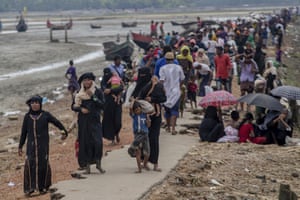
 Rohingya Muslims, who crossed over from Myanmar into Bangladesh, walk towards the nearest refugee camp at Teknaf, Bangladesh


SITTWE, Myanmar (Reuters) - Thousands of Rohingya Muslims in violence-racked northwest Myanmar are pleading with authorities for safe passage from two remote villages that are cut off by hostile Buddhists and running short of food.


“We’re terrified,” Maung Maung, a Rohingya official at Ah Nauk Pyin village, told Reuters by telephone. “We’ll starve soon and they’re threatening to burn down our houses.”


Another Rohingya contacted by Reuters, who asked not to be named, said ethnic Rakhine Buddhists came to the same village and shouted, “Leave, or we will kill you all.”


Fragile relations between Ah Nauk Pyin and its Rakhine neighbors were shattered on Aug. 25, when deadly attacks by Rohingya militants in Rakhine State prompted a ferocious response from Myanmar’s security forces.


At least 430,000 Rohingya have since fled into neighboring Bangladesh to evade what the United Nations has called a “textbook example of ethnic cleansing”.


About a million Rohingya lived in Rakhine State until the recent violence. Most face draconian travel restrictions and are denied citizenship in a country where many Buddhists regard them as illegal immigrants from Bangladesh.


Tin Maung Swe, secretary of the Rakhine State government, told Reuters he was working closely with the Rathedaung authorities, and had received no information about the Rohingya villagers’ plea for safe passage.


“There is nothing to be concerned about,” he said when asked about local tensions. “Southern Rathedaung is completely safe.”


National police spokesman Myo Thu Soe said he also had no information about the Rohingya villages but that he would look into the matter.


Asked to comment, a spokeswoman for the U.S. State Department’s East Asia Bureau made no reference to the situation in the villages, but said the United States was calling “urgently” for Myanmar’s security forces “to act in accordance with the rule of law and to stop the violence and displacement suffered by individuals from all communities.”


“Tens of thousands of people reportedly lack adequate food, water, and shelter in northern Rakhine State,” spokeswoman Katina Adams said. “The government should act immediately to assist them.”


Adams said Patrick Murphy, the U.S. deputy assistant secretary of state for East Asia, would reiterate grave U.S. concern about the situation in Rakhine when he meets senior officials in Myanmar this week.


Britain is to host a ministerial meeting on Monday on the sidelines of the annual U.N. General Assembly in New York to discuss the situation in Rakhine.


NO BOATS


Ah Nauk Pyin sits on a mangrove-fringed peninsula in Rathedaung, one of three townships in northern Rakhine State. The villagers say they have no boats.

Until three weeks ago, there were 21 Muslim villages in Rathedaung, along with three camps for Muslims displaced by previous bouts of religious violence. Sixteen of those villages and all three camps have since been emptied and in many cases burnt, forcing an estimated 28,000 Rohingya to flee.


Rathedaung’s five surviving Rohingya villages and their 8,000 or so inhabitants are encircled by Rakhine Buddhists and acutely vulnerable, say human rights monitors.


The situation is particularly dire in Ah Nauk Pyin and nearby Naung Pin Gyi, where any escape route to Bangladesh is long, arduous, and sometimes blocked by hostile Rakhine neighbors.


Maung Maung, the Rohingya official, said the villagers were resigned to leaving but the authorities had not responded to their requests for security. At night, he said, villagers had heard distant gunfire.


“It’s better they go somewhere else,” said Thein Aung, a Rathedaung official, who dismissed Rohingya allegations that Rakhines were threatening them.


Only two of the Aug. 25 attacks by the Arakan Rohingya Salvation Army (ARSA) took place in Rathedaung. But the township was already a tinderbox of religious tension, with ARSA citing the mistreatment of Rohingya there as one justification for its offensive.


In late July, Rakhine residents of a large, mixed village in northern Rathedaung corraled hundreds of Rohingya inside their neighborhood, blocking access to food and water.


A Rohingya refugee carries a sick infant in Cox's Bazar, Bangladesh, September 17, 2017. REUTERS/Cathal McNaughton


A similar pattern is repeating itself in southern Rathedaung, with local Rakhine citing possible ARSA infiltration as a reason for ejecting the last remaining Rohingya.


‘ANOTHER PLACE’


Maung Maung said he had called the police at least 30 times to report threats against his village.


On Sept. 13, he said, he got a call from a Rakhine villager he knew. “Leave tomorrow or we’ll come and burn down all your houses,” said the man, according to a recording Maung Maung gave to Reuters.


When Maung Maung protested that they had no means to escape, the man replied: “That’s not our problem.”


On Aug. 31, the police convened a roadside meeting between two villages, attended by seven Rohingya from Ah Nauk Pyin and 14 Rakhine officials from the surrounding villages.


Instead of addressing the Rohingya complaints, said Maung Maung and two other Rohingya who attended the meeting, the Rakhine officials delivered an ultimatum.


Slideshow (8 Images)


“They said they didn’t want any Muslims in the region and we should leave immediately,” said the Rohingya resident of Ah Nauk Pyin who requested anonymity.


The Rohingya agreed, said Maung Maung, but only if the authorities provided security.


He showed Reuters a letter that the village elders had sent to the Rathedaung authorities on Sept. 7, asking to be moved to “another place”. They had yet to receive a response, he said.


VIOLENT HISTORY


Relations between the two communities deteriorated in 2012, when religious unrest in Rakhine State killed nearly 200 people and made 140,000 homeless, most of them Rohingya. Scores of houses in Ah Nauk Pyin were torched.


Since then, said villagers, Rohingya have been too scared to leave the village or till their land, surviving mainly on monthly deliveries from the World Food Programme (WFP). The recent violence halted those deliveries.


The WFP pulled out most staff and suspended operations in the region after Aug. 25.


Residents in the area’s two Rohingya villages said they could no longer venture out to fish or buy food from Rakhine traders, and were running low on food and medicines.


Maung Maung said the local police told the Rohingya to stay in their villages and not to worry because “nothing would happen,” he said.


But the nearest police station had only half a dozen or so officers, he said, and could not do much if Ah Nauk Pyin was attacked.


A few minutes’ walk away, at the Rakhine village of Shwe Long Tin, residents were also on edge, said its leader, Khin Tun Aye.


They had also heard gunfire at night, he said, and were guarding the village around the clock with machetes and slingshots in case the Rohingya attacked with ARSA’s help.


“We’re also terrified,” he said.


He said he told his fellow Rakhine to stay calm, but the situation remained so tense that he feared for the safety of his Rohingya neighbors.


“If there is violence, all of them will be killed,” he said.
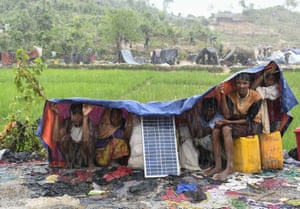


Rohingya refugees protect themself from the rain in Bangladesh’s Balukhali refugee camp

Courtesy


Reporting by Wa Lone and Andrew R.C. Marshall; Additional reporting by David Brunnstrom in Washington; Editing by Ian Geoghegan and Peter Cooney

Our Standards:The Thomson Reuters Trust Principles.

European Parliament Conference Discusses Environmental Degradation and Human Rights Violations in Gilgit-Baltistan


This article is originally published on UNPO "UNREPRESENTED NATIONS AND PEOPLES ORGANIZATION"


On 9 November 2016, Mr Josep-Maria Terricabras MEP (Greens/EFA) and the Unrepresented Nations and Peoples Organization (UNPO) in partnership with Mahatma Gandhi International, convened a high-level conference entitled “A Recipe for Disaster: Environmental Degradation and Human Rights Violations in Pakistan-occupied Gilgit-Baltistan” at the European Parliament in Brussels. From the controversial construction of mega dams in Gilgit-Baltistan to the impacts on Balochistan and Sindh, the well-achieved goal of the conference was to raise awareness of the immense human suffering that Pakistan’s policies, often in collusion with China, are causing to people of Gilgit-Baltistan, Sindh and Balochistan.


Opening the Conference, the host MEP Josep-Maria Terricabras reminded the audience that even though sensitive topics often trigger discomfort, legitimate claims must be addressed in an open and democratic manner.


UNPO Secretary General, Mr Marino Busdachin, stressed the fact that the human rights and environmental situation in Gilgit-Baltistan is quickly deteriorating and that it may soon “reach a level in which it will be difficult to be considered by the international community”.

Csaba Sógor MEP (EPP), drew a line from their struggle for indigenous rights to minorities in EU member states, stressing that the EU must unconditionally “set a good example for minority and human rights protection in its member states”, which, he lamented, was, unfortunately, missing in the EU today.


Opening the first round of speakers, Mr Senge Hasnan Sering, President of the Institute for Gilgit-Baltistan Studies and Board Member of the Gilgit-Baltistan Congress, gave a compelling introduction to the environmental dangers affecting the indigenous people of the region that are caused by the China-Pakistan Economic Corridor (CPEC) and by the illegal construction of the Diamer-Bhasha dam in the disputed territory. Mr Sering’s explained the intricacies of Gilgit-Baltistan’s ecosystem, “the greenest part of which will be submerged by foreigners” with the construction of the Diamer Bhasha dam. What is more, “there is no way that local people are going to receive royalties from the dam because its turbines are located in a Pakistani province”.

Mr Mirza Wajahat Hassan, Exiled Chairman of the Gilgit-Baltistan Thinkers Forum, further elaborated on human rights violations in Gilgit-Baltistan and on the marginalisation of its people in an elaborate account of the region’s long history, expanding the discussion to the severe disregard for human rights shown by the Pakistani Government in a territory over which they are not even supposed to have jurisdiction. Mr Hassan remarked that if Pakistan adhered to UN resolutions, “Gilgit-Baltistan can become a bridge between Pakistan and India”.

[caption id="attachment_1159" align="alignnone" width="992"]Wazahat feel that Pakistan’s intention to make Gilgit-Baltistan its fifth province is practically impossible. Wajahat Hasan Mirza, Chairman of Gilgit Baltistan Thinkers Forum, Life Threats, Political Leaders, Gilgit Baltistan.[/caption]

The second panel discussed the repercussions of the environmental degradation in Gilgit-Baltistan and CPEC on Balochistan and Sindh. Dr Siegfried O. Wolf, lecturer at the University of Heidelberg and Research Director at the South Asia Democratic Forum, explained that minorities are concerned about the massive influx of Chinese military into the region. He also underlined the argument, brought up towards the end of the Conference, that CPEC chiefly represents a strategic decision on behalf of China to assist Pakistan in their economic development, while the closure of the Sost dry port in Gilgit-Baltistan, provoked by the construction of the Diamer-Bhasha dam, will have the exact opposite effect, costing up to 20,000 jobs.

Closing the event, Dr Lakhu Luhana, Secretary General of the World Sindhi Congress, put the spotlight on the adverse effects that the enormous reservoir dams would have on the everyday life of indigenous populations along the lower Indus River. He pointed out that the “River Indus is the lifeline of the Sindhi people” and deplored the government’s brutal crackdown on any expression of opposition, stating that scores of Sindhi activists have been forcibly disappeared or imprisoned for very long terms.


Member of the European Parliament Dr Klaus Bucher attended the conference to lend his support 


Hitherto not well known by Members of the European Parliament, Gilgit-Baltistan rises as a critical topic that, thanks to growing campaign organised by UNPO in partnership with Mahatma Gandhi International, is likely to become high on the agenda of the European Union institutions. The event, furthermore, widened the discussion to include the ramifications brought about by CPEC for the economic and human rights conditions for minorities in Pakistan.


Below is the full conference declaration adopted by the participants:

In light of the controversial plans to build six mega dams in the Pakistan-occupied Gilgit-Baltistan, this conference discussed the environmental degradation and its consequences beyond the region, as well as human rights violations perpetrated by the Government of Pakistan. Against this background, the participants to this conference adopt the following declaration:

Whereas Pakistan has no right to build a dam in an area which is disputed under United Nations Security Council resolution and whose fate is still to be settled under international law;

Whereas the major development projects by Pakistan in Gilgit-Baltistan are causing severe environmental degradation, damaging sensitive ecosystems; displacing local population; destroying historical sites and changing demography in the wider region

Whereas the people of Gilgit-Baltistan have the legitimate right to protest peacefully against the construction of development projects in the region until they are granted full participation in decision-making;

We urge the Islamic Republic of Pakistan to:

refrain from the use of oppressive measures leading to human rights violations against the peoples of Gilgit-Baltistan and further demands that the perpetrators of human rights violations within the Military, paramilitary and police units of the state should be brought to justice;

pay compensation to residents whose lands have already been used to build the Diamer-Bhasha dam and the Karakoram Highway;

halt the construction of the Diamer-Bhasha dam, which is posing a serious threat to the community and region;

and, finally, we appeal to the European Commission to halt its trade incentives to Pakistan, in the framework of Generalised Scheme of Preferences+ (GSP+), until Islamabad fulfills its human rights obligations and withdraws from Gilgit-Baltistan.

Courtesy unpo.org

Jammu, Ladakh key to Valley peace

Dwarika Prasad Sharma

Image result for jammu and ladakh
A former General Officer Commanding of the Srinagar-based 15 Corps of the Army, who is acknowledged for establishing a rapport of the force with common citizens of Kashmir, has been making the significant observation that it is important to bring Jammu and Ladakh into the ambit of a comprehensive initiative for lasting peace in the Valley, and in the state.
Lt-Gen (retd) Syed Ata Hasnain has said that the people of Jammu probably understand the people of Kashmir far better than anybody else. He made this observation at a programme in Jammu marking the landing of Indian Army troops in Srinagar on October 27, 1947, a day after the signing of the Instrument of Accession. Earlier this month, he had made a similar statement at a meeting in Delhi. The theme of that meeting was “The Kashmir flashpoint: how to resolve the crisis”.
At the Delhi meeting, another very significant point he made was that the youth should be brought into the engagement. This is also a departure from the classical pitch and approach that the separatists, self-appointed “representatives” of the people of the Valley, nay, of “Jammu and Kashmir”, were the sole arbiters for the “angry and alienated” people of the Valley, now especially the youth.
Favouring also bringing Ladakh, the third region of the state, into the dialogue, Hasnain said: “Serious efforts are needed to be made towards providing more engagement between the civil societies, youth and business communities of Jammu, Ladakh and the Valley as this could be the workable precursor for more intimate engagement between the people of the region and the rest of India.”
The nose-to-the-ground analyst underlined the home truth that any “change in the ownership of territory is no longer possible anywhere in the world, especially by violence”. This has been stressed also by legions of other analysts, who see that for India, retaining Kashmir is unquestionably an absolute for upholding the sovereignty, integrity and security of the country. This is seen by all other countries, including privately Pakistan itself, except apparently the separatists, the terrorists and the seasonal agitators whom elements in that country manipulate as proxies.
Atal Behari Vajpayee, who had gone several extra miles with Pakistan and the separatists, and who is appreciatively quoted by Kashmiri politicians, journalists and people in general, had said that one could not wish away one’s neighbour. But he drew a red line at changing the boundaries of the state, though he added that these could be made softer.
Hasnain said that in view of the wider reality, “whatever is discussed as a way forward has to be with the assumption that it is for the purpose of mainstreaming those opposed to the idea of India”.  Soon after the Delhi event, former chief minister of the state, Omar Abdullah, expressed views in New York that were along the lines of Hasnain’s observations. Spea-king at a conference organised by students of New York University on the theme “India and Pakistan: a subcontinental affair”, he said that “there is a disaffected population in Jammu and Kashmir that has to be brought into the mainstream”. The usually petulant National Conference leader, when away from the state, put the Kashmir problem in a level-headed perspective amid an impressionable young audience.
Omar also said:”I am not suggesting that we have to open a dialogue with all militant groups. That is not possible. But there are political groups in the Valley that don’t advocate the cause of violence, that are looking for a solution beyond the current status quo. Why not talk to them… Talk with those who are willing to talk.” He said that the present territorial contours of the state are very different from those of 1947, tampered with further some years later, and so a plebiscite is impossible.
In Jammu, Hasnain said: “The people of Jammu, who understand the people of Kashmir socially, politically and, most important, psychologically, can experiment on how to bring the people of the state together. Otherwise, Pakistan will keep disturbing peace in the region.”
It would be highly useful if the mainstream leadership of the state were to mainstream themselves first. Those whose electoral fortunes are derived from the Valley should stop making public observations that add fuel to the fire there. They should bring home to the “disaffected” and “alienated” youth of the Valley that their violent actions are alienating them from large sections in Jammu and Ladakh. That the disaffection over several issues in these regions, the chief of which is perceived discrimination against them across the board, is not any less weighty. That they view the repeated spells of violence in the Valley as communally-oriented and less as stands against human rights violations.
The opposition mainstream parties, along with the ruling combine, have to convince the stone-throwing youth that their deliverance does not lie in stones but in emulating their brethren who have climbed ladders of success through education, who have thrown their lot with a nation that is globally regarded for its steady economic growth. They should pillory Kashmir trouble mastermind (or proxy?) Ali Shah Geelani for his lunatic assertion that the unprecedented shutdown presided over by him has not hit education but helped it “blossom”. They should tell him that he should educate his grandchildren in stone-throwing.
Chief minister Mehbooba Mufti should rediscover her earlier charm with the youth of the Valley. As an opposition leader, she used to be accompanied by youths into South Kashmir’s remote rural areas as her pointmen and protectors. They affectionately called her “baaji”, sister. It is said that several of these youths have been leading violent protests. She should try to talk reason with them to bring them around. But she should avoid talking like an opposition leader in her own government. If she did that, they might again call her “baaji”, but would likely become more recalcitrant.
The PDP-BJP alliance government is a bold initiative that combines a largely Valley-based party, which defines itself as secular, with a Jammu-based party, that the opposition mainstreamers and, of course, the separatists, define as communal. This is for the first time that Jammu has been given a near-equal role with the Valley in the governance of the state. The opposition, by blaming this arrangement for being one of the major causes of the present unrest in the Valley, are only playing a parochial role.
For long since the days of Jawaharlal Nehru, the first Prime Minister of the Indian Republic, there had been a skewed perception that Kashmir Valley was the be all and end all of Jammu and Kashmir and that Sheikh Mohammed Abdullah was the last word in the state. The strong bond between him and the Sheikh, first Prime Minister of the state after the Accession, had been instrumental in nurturing this outlook. The affinity between the two had been in no small measure also on account of their visceral antipathy for Maharaja Hari Singh. In the sum, both leaders tended to overlook the wider picture in the state and dismiss any expression of aspiration outside of the Valley as an aberration or a disruptive attempt to drive in a wedge issue.
This kind of mindset has played out in varying degrees down the years. It has to be consciously cured. The present government at the Centre is going along that path and is displaying a broader and equitable outlook on the state.
(The writer is a Senior Journalist)

Image result for jammu and ladakh

Dhaka siege highlights terror's threat to Asia's pluralism


JAKARTA -- Asian nations were on heightened alert for terrorist plots even before last week's attack in Bangladesh, aiming to avert the kind of violence that could tear rifts in some of the region's pluralistic societies.

Singapore began checking foreigners' fingerprints at airport immigration and border controls in April as a precaution against false passports. Authorities say this measure already has thwarted several attempts at illegal entry. Thailand has increased surveillance cameras on city streets and taken other steps to bolster security since last August's bombing in Bangkok.


Indonesian counterterrorism units are engaged in an ongoing campaign on Sulawesi, a reputed base for radical Islamic groups. President Joko Widodo has picked a counterterrorism expert to head the nation's police force.

In southern Philippines, the jihadist group Abu Sayyaf has perpetrated kidnappings for ransom, among other crimes. Tough-talking new President Rodrigo Duterte has warned the militants that "there will be a reckoning."

All these countries worry about infiltration by radical elements from the Middle East and other hotbeds of terrorism. Authorities are particularly alarmed by the Islamic State group's call for acts of terror during Islam's holy month of Ramadan, which is now drawing to a close.

Indonesian police detained three people in June suspected of a bomb plot in Surabaya, a city in eastern Java. Suicide belts packed with explosives were found on the premises, and authorities allege one suspect confessed to intending attacks like those seen in Jakarta in January.

Singaporean authorities arrested 27 Bangladeshi nationals late last year, including individuals suspected of planning to join radical Islamic groups in the Middle East. In India, five people suspected of being Islamic State operatives have been arrested.

None of these countries has managed to root out terrorism. A suicide bombing outside a Pakistani polio immunization clinic in January provides just one example of an attack that authorities failed to prevent.

Travel between the Middle East and South and Southeast Asia has long thrived, creating pathways for radical ideas to spread eastward. The internet has become a tool for radicalization. Asian nations must contend with the frightening prospect of homegrown terrorist networks and radicalized lone wolves.

Economic disparities contribute to the spread of terrorist ideology. In the Philippines, Christians make up around 90% of a population of 100 million while Islam is confined mostly to the southern island of Mindanao in areas that are separated from Manila by a wide gap in prosperity. This creates fertile ground for resentment among Muslims.

U S EMPHASIZES GREATER CONTACT WITH PAKISTAN TO ADDRESS REGIONAL AND GLOBAL CHALLENGES


Parliamentary Exchanges are Useful to Understand Each Other's Perspective on Issues of Mutual Interest


U S emphasizes greater contact with Pakistan to address regional and global challenges

A four-member US Senate delegation led by Senator John McCain, Chairman Senate Armed Services Committee called on the Adviser on Foreign Affairs Sartaj Aziz in Islamabad.  Welcoming the US Senators, the Adviser said parliamentary exchanges are useful to understand each other's perspective on issues of mutual interest and concerns. Senator McCain and his colleagues appreciated the success achieved by Pakistan in its counterterrorism campaign which they said was so impressively visible during their trip to North Waziristan. The Adviser said Pak-US relationship is important for ensuring peace and stability in the region. With reference to recent developments concerning the India-US relations, the Adviser emphasized the need to maintain strategic balance in South Asia. Sartaj Aziz said Pakistan remains committed to the Quadrilateral Coordination Group process in Afghanistan. He said no country has as much vital stakes in the success of these joint efforts, as Pakistan. In view of the growing challenges confronting the world, the Senators emphasized greater contact between Pakistan and the US to work together to address the regional and global challenges. They highlighted significance of improved relations between India and Pakistan and welcomed closer coordination between Pakistan and Afghanistan on various complex issues. During their visit to North Waziritan, the US Senators witnessed the erstwhile hideouts and communication infrastructure of    terrorism, which has been cleared of terrorists as a result of operation Zarb-e-Azb. The Senators commended the rehabilitation work being carried out by Pakistan Army to resettle the displaced people back in their area with dignity and honour. Later, they also met with wounded soldiers and officers who were seriously affected during initial phases of the operation and have now voluntarily rejoined the battlefield. The visitors appreciated the determination and grit of all affected Pakistani soldiers and their unparalleled sacrifices for their motherland.

“Economic stability is due to the political stability in the country- foreign exchange reserves crossed the mark of twenty three billion dollars”: Information Minister

Information Minister Pervaiz Rashid says economy of the country has been strengthened due to prudent economic policies of the government. In an interview, he said inflation is lowest in history of the country and government reduced prices of petroleum products that resulted in control of prices of different commodities. Next year, additional 10000 megawatt of electricity will be produced against deficiency of 5000 megawatt. Government wants to probe all corruption cases, but some of the opposition parties have person specific agenda, which is unjustified. Opposition should prepare for election campaign instead of staging sit-ins after Eid. Visit of Chinese President was delayed due to sit-ins as it was conspiracy against the development of Pakistan.

Flash Floods Kill 43 in Parts of KPK- PM Directs to Accelerate Rescue and Relief Efforts in the Flood-Hit Areas of Chitral

As many as 17 people were reportedly missing in Ursoon Village while as many were injured due to flash flooding caused by a cloud burst in the area. Around 30 houses were demolished in the rainstorm caused by continuous heavy rainfall in the area near the Pak-Afghan border. The rains began late Saturday and were concentrated mainly in K-P, which has been badly affected by flooding in recent years that some scientists have linked to climate change.

According to ISPR  Army troops are carrying out relief and rescue operation in Chitral. Troops provided food, tents and medical aid to affected people in Ursoon village. Lama helicopter of Army evacuated the injured from affected areas

Talking to Radio Pakistan's News and Current Affairs channel, Mushtaq Ghani said an emergency has been declared in hospitals of Chitral area to provide maximum medical aid to flood affected people and a helicopter has also been arranged to rescue injured.  He says the provincial authorities are closely working with army teams to help the victims.

Interior Minister Will Inaugurate NADRA Mega-Centre In Islamabad Today

According to spokesman of the Ministry, facility of CNIC issuance and registration of family and children will be provided in the center. The spokesman said the centre will be capable to process two thousand applications for Computerized National Identity Card on daily basis. He said six more Mega Centres and fifteen Passport Executive Offices will also be established in the country to provide fast facility to the people regarding registration.

France qualified for semi-finals after beating Iceland by five goals to two in the Euro Football Cup at Saint-Denis

France has qualified for semi-finals after beating Iceland by five goals to two in the last quarter-final in the Euro Football Cup 2016, at Saint-Denis, France. Portugal, Wales and Germany have already qualified for the semi-finals

Weather

Mainly hot and humid weather is expected in most parts of the country during the next twelve hours. However rain-dust thundershower is expected at scattered places of Hazara division and Kashmir while at isolated places of Rawalpindi, Sargodha, Faisalabad, Multan, Dera Ghazi Khan, Malakand, Kohat, Dera Ismail Khan, Zhob, Kalat divisions, FATA and Gilgit-Baltistan.

Temperature of some major cities recorded this morning: Islamabad and Gilgit twenty five degree centigrade, Lahore twenty eight, Karachi twenty nine, Peshawar thirty, Quetta and Muzaffarabad twenty four and Murree seventeen degree centigrade.

This report explores sectarian conflict in the remote, mountainous Gilgit-Baltistan region of Pakistan, which until recently was a relatively peaceful enclave in an otherwise volatile part of the world. It was commissioned by the United States Institute of Peace (USIP), as part of its mandate to understand global conflicts in specific contexts.

About the Author Izhar Hunzai, a native of Gilgit-Baltistan, has a background in community development in Pakistan, Sri Lanka, South Africa, Tajikistan, and Indonesia. Awarded a United States Agency for International Development scholarship, Hunzai received a master’s degree in international development from Cornell University in 1990. Until recently, Hunzai was CEO of Aga Khan Rural Support Program, operating in Gilgit-Baltistan and the Chitral district of Khyber-Pakhtunkhwa province.

An online edition of this and related reports can be found on our Web site (www.usip.org), together with additional information on the subject

https://www.usip.org/sites/default/files/SR321.pdfSR321SR321

USIFP GB

Conflict Dynamics in Gilgit-Baltistan Summary • Gilgit-Baltistan, a historically distinct political entity near the disputed region of Jammu and Kashmir, is located at the junction of China, Central and South Asia, and Afghanistan. • Ideally situated for trade and commerce, its geography also makes it vulnerable to spillover of conflicts from active militant movements in surrounding areas. • Pakistan is home to the largest concentration of Shia Muslims outside Iran, and GilgitBaltistan is the only Shia-majority region in the Sunni-majority country. • Tensions between Shia and Sunni communities have increased since the 1980s, especially after the construction of the Karakoram Highway, which connects this previously isolated region with China and mainland Pakistan. • The first serious sectarian violence in Gilgit broke out in 1983. In 1988, a rumor alleging a Sunni massacre at the hands of Shias resulted in an attack by thousands of armed tribesmen from the south, the killing of nearly four hundred Shias, and the burning of several Shia villages. • In 2012, sectarian violence surged again, triggered by a quick succession of well-organized killings targeting Shia travelers on the two routes that connect Gilgit-Baltistan with Islamabad but including others. As many as sixty have been killed. The ensuing retaliatory killings in Gilgit town and suburbs, by armed militants on both sides, have added to the carnage and fear. • A peaceful Gilgit-Baltistan is essential for regional stability and development. • One possible way forward to reduce the conflict and counter growing militancy in the wider region is to strengthen governance systems and processes to establish inclusive policies for equitable development and redress long-held grievances. Introduction Gilgit-Baltistan, previously known as the Northern Areas, is part of a larger conflict-ridden region of Jammu and Kashmir, which has been disputed between India and Pakistan since United States Institute of Peace www.usip.org SPECIAL REPORT 2 USIP.ORG • SPECIAL REPORT 321 their independence in 1947.1 The Kashmir dispute has remained a major catalyst of militarization, open and protracted wars, extremism, and underdevelopment in South Asia. Situated in the mountains of northern Pakistan, Gilgit-Baltistan covers 72,971 square kilometers. Its estimated population of 1.2 million includes four denominations of Islam—Shiite (39 percent),2 Sunni (27 percent), Ismaili (18 percent), and Noorbakshi (16 percent)—and at least twenty-four ethnic and linguistic groups (see figure 1).3 On February 28, 2012, eighteen Shia pilgrims were openly killed on the Karakoram Highway in Kohistan district while returning from Iran.4 Another attack killed twenty people at Chilas on April 3.5 Yet another—again targeting Shia but also four Sunni who protested—killed twenty-two near Babusar Pass on August 16.6 These events have jolted the communities in Gilgit-Baltistan, which have collectively condemned such killings and demanded decisive action from the government. The brutality and impunity with which these crimes were committed have triggered wider sectarian tensions and hardened attitudes in Gilgit-Baltistan. The situation is tense, especially in Gilgit town, the main city in the province, where the violence and mutual insecurity has deepened sectarian fault lines. Gilgit town is now literally divided into “no-go” areas for the main Shia and Sunni communities, forcing people to use separate transportation, schools, and hospitals. Land travel between Gilgit-Baltistan and Islamabad has become extremely insecure for local travelers, traders, and tourists alike. It is estimated that the government has had to spend over 100 million Pakistani rupee (PKR) on the deployment of security forces alone over the last few months. The magnitude of losses accruing to socioeconomic spheres of life is huge. Trade of high-value horticultural crops, such as seed potatoes, cherries, and apricots (a mainstay of local economy), has been badly disrupted.7 Religiously motivated violence is a recent phenomenon in Gilgit-Baltistan. It has its roots in demographic changes, limited space for political organization, and exposure to rising religious extremism in mainland Pakistan. The Islamic revolution in Iran in 1979, the policy of lslamization under Pakistani military ruler General Zia-ul-Haq, and the Afghan jihad during the 1980s did not leave Gilgit-Baltistan untouched. The cumulative effect has been the introduction of an ideologically motivated outlook, now manifesting itself through sectarian turmoil.8 The dynamics of the region are changing again—from the planned withdrawal of the American forces in Afghanistan, the nuclear stand-off in Iran, and the breakdown of the status quo in the Arab world—and the reverberations are being felt in Pakistan and, by extension, in Gilgit-Baltistan. When not fighting external proxy wars or being squeezed from outside, the rival militant organizations in Pakistan have tended to direct their wrath at each other, thus intensifying sectarian wars.9 Given the sizeable Shia population in GilgitBaltistan, the province is perceived as a Shia fortress by the extremist Sunni organizations, making it a battleground for deadly sectarian attacks. The recent back-to-back sectarian killings appear to be the start of a new phase in the conflict. This report attempts to understand the context and underlying causes of sectarian violence in Gilgit-Baltistan. Background The historical differences between the Sunni and Shia Muslims, who make up about 87 percent and 13 percent respectively of global Islam, can be traced back to the contested legitimacy of succession after the death of Prophet Mohammad, some fourteen hundred years ago. Since then, the schism has been reinforced by continuing rivalry and shifting political power between Sunni and Shia dynasties. Over the centuries, the Shia political power weakened considerably, forcing Shia Muslims to adapt to a subordinated position under Sunni-led empires. The views expressed in this report do not necessarily reflect the views of the United States Institute of Peace, which does not advocate specific policy positions. To request permission to photocopy or reprint materials, e-mail: permissions@usip.org. About the Institute The United States Institute of Peace is an independent, nonpartisan institution established and funded by Congress. Its goals are to help prevent and resolve violent conflicts, promote postconflict peacebuilding, and increase conflict management tools, capacity, and intellectual capital worldwide. The Institute does this by empowering others with knowledge, skills, and resources, as well as by its direct involvement in conflict zones around the globe. Board of Directors J. Robinson West (Chair), Chairman, PFC Energy • George E. Moose (Vice Chair), Adjunct Professor of Practice, The George Washington University • Judy Ansley, Former Assistant to the President and Deputy National Security Adviser under President George W. Bush • Eric Edelman, Hertog Distinguished Practitioner in Residence, Johns Hopkins School of Advanced International Studies • Kerry Kennedy, President, Robert F. Kennedy Center for Justice and Human Rights • Ikram U. Khan, President, Quality Care Consultants, LLC • Stephen D. Krasner, Graham H. Stuart Professor of International Relations, Stanford University • John A. Lancaster, Former Executive Director of the National Council on Independent Living • Jeremy A. Rabkin, Professor, George Mason School of Law • Judy Van Rest, Executive Vice President, International Republican Institute • Nancy Zirkin, Executive Vice President, Leadership Conference on Civil and Human Rights Members Ex Officio Michael H. Posner, Assistant Secretary of State for Democracy, Human Rights, and Labor • James N. Miller, Principal Deputy Under Secretary of Defense for Policy • Gregg F. Martin, Major General, U.S. Army; President, National Defense University • Jim Marshall, President, United States Institute of Peace (nonvoting) USIP.ORG • SPECIAL REPORT 321 3 After the demise of the Ottoman Empire and subsequent decolonization, Shia communities became significant minorities in the newly created Arab states but remained numeric majorities in a few countries —such as Iraq, Kuwait, and Bahrain—where they continued to be ruled by minority Sunni rulers. Shia Islam endured in Safavid Iran, however, and bounced back after the Iranian revolution of 1979. The gradual rise in sectarian tensions, which began in the early 1970s and escalated after the Iranian revolution and the Soviet-Afghan war, had to do with politics and competition for influence and power, notably between Iran and the Arab countries, led by Saudi Arabia. This competition contributed to a sharp rise in sectarian tensions in Pakistan and Afghanistan as both sides tried to use religion as an instrument of policy. Baathist Iraq’s invasion of Iran and the ensuing war throughout the 1980s also played a role in this respect.10 Sunni-Shia Conflict in Pakistan Before partition of the Indian subcontinent, the Sunni-Shia conflict remained mostly under the surface, limited to localized disputes during annual Muharram processions. All Muslim groups living in British India felt compelled to unite against the real or perceived excesses of the Hindu majority. After the creation of Pakistan, and with no Hindus or British rulers around to blame for the internal governance problems, Pakistani Muslims began to find fault with one another. The Ahmadiyya community was the first and easy target.11 Its members were persecuted as heretics and officially declared non-Muslims in 1974 by Prime Minister Zulfiqar Ali Bhutto, who did so to appease religious parties opposed to his government. Bhutto was subsequently deposed and hanged by the military dictator Zia-ul-Haq. The growing intolerance for minority groups in Pakistan, which had begun in the 1970s, received full state support under General Zia-ul-Haq, who pushed Wahhabi-oriented Islamization12 in the country. Islamization under General Zia-ul-Haq affected the judicial system, the penal code, economic activity, and educational policy. Two decisions, in particular, that Source: Hermann Kreutzmann, reproduced with permission Figure 1. Gilgit-Baltistan and Chitral 4 USIP.ORG • SPECIAL REPORT 321 contributed to the rise of sectarianism were the imposition of religious taxes—zakat and ushr13—and the expansion and radicalization of orthodox-Sunni religious seminaries—the madrassas. 14 To legitimize his rule, Zia imported strict sharia laws from Saudi Arabia, financed madrassas, and fronted for the American-sponsored jihad in Afghanistan against the Soviet occupation. His ideological successors in Pakistan replicated this model of holy war in Indian-controlled Kashmir in the 1990s, injecting jihad into a largely secular selfdetermination movement against Indian rule. Zia-ul-Haq is also blamed for throwing state support behind extremist groups in Pakistan, such as the anti-Shia Sipah-e-Sahaba Pakistan (SSP). In response to these policies, the pro-Shia Tehreek-e-Nafaz-e-Fiqah-e-Jafaria (TNFJ) came into existence. Another Shia militant group, the Sipah-e-Mohammed Pakistan (SMP), was formed in the early 1990s. On the other side of the aisle, in 1996, the SSP created an armed wing, the Lashkar-e-Jhangvi (LeJ), which was to become the most lethal anti-Shia outfit in Pakistan.15 Most of these groups were subsequently outlawed, but they have conveniently branched into stealth groups, making it more difficult to control them. Because of their active participation in state-sponsored proxy wars in Afghanistan and Kashmir, they have developed roots in religious political parties as well as in official organs of the state. Sectarian violence in Pakistan has intensified over the past three decades. Each group, led by its most extreme elements, is pursuing a policy of the other’s annihilation; Sunni and Shia sectarian militant outfits now openly declare each other non-Muslim.16 In urban Pakistan, sectarian violence has mostly become a contest for body counts among rival sectarian death squads, which have claimed thousands of innocent lives over the years. Initially, the violence was restricted to targeted killings of sectarian leaders and activists. By the mid-1990s, however, worshippers in mosques and mourners in cemeteries were also added to the list of soft targets of sectarian gunmen, along with bureaucrats and businessmen, Iranian diplomats, engineers, and military cadets in major urban towns such as Rawalpindi, Lahore, Karachi, and Multan. By the start of the new millennium, doctors were also added—the militants believed that “a doctor presented a strategic target because of the publicity his killing generated.”17 These killings are in addition to the ongoing Taliban attacks on Hazara tribes in federally administered tribal areas (FATA) and roadside massacres of Shia pilgrims and passengers in Balochistan and Gilgit-Baltistan. The sectarianism nurtured by Zia-ul-Haq, and supported in part by funding from the United States and Saudi Arabia, now threatens Pakistan’s existence. The sufferings brought about by radicalization of religion have taken a high toll on Pakistani society. The overwhelming majority of Pakistanis, weary of internal and external wars, are against all forms of violence. Sectarianism is no exception in that it lacks grassroots support, but the majority seems to have been silenced by both the absence of the state to back them and the power of the gun that threatens to take down all opposition.18 Nonetheless, sectarian violence cannot be wished away without addressing the underlying causes and contexts giving rise to it.19 A long-term solution of Pakistan’s sectarian and other religiously inspired violence within the country and beyond is cooperation among all stakeholders to resolve local and regional disputes. Policies of global coexistence must replace politics of power and intrigue. Roots of Sectarian Conflict Historically, the diverse communities of Gilgit-Baltistan have lived together in relative harmony.20 Ethnic and tribal identities and social ties developed over centuries were valued more than sectarian affiliations. Local rulers generally followed secular policies in dealing By the mid-1990s, worshippers in mosques and mourners in cemeteries were also added to the list of soft targets of sectarian gunmen. USIP.ORG • SPECIAL REPORT 321 5 with their subjects21 and built alliances with other royals and powerful families in the area through marriages and cultivating foster-family22 relationships, regardless of their religious affiliations. Religious tolerance was, and still is, characteristic of the people of Gilgit-Baltistan, given that the bulk of the population lives in rural areas where family ties, cooperation, and interdependence for managing common resources take precedence over religious identities. Moreover, Islam came to this area through Sufi saints, who preached tolerance and universality of human values. Even in the southern district of Diamer, which borders on the more conservative Kohistan district of Khyber-Pakhtunkhwa province, music and dance were common, even among madrassa students, which remained benign until they were infiltrated by sectarian forces from outside the region.23 Sectarian tension was limited to Gilgit town, with religious clerics shouting insults at each other from the opposite sect’s mosques, and adrenaline-induced fights among the Shia and Sunni youth, especially during Muharram processions, which would be quickly brought under control by local elders. The first case of sectarian violence resulting in the loss of human life occurred in 1975, when the Shia Muharrum procession in Gilgit town was fired at from the Sunni mosque. The subsequent arrest of the Sunni qazi (religious leader) caused riots in the Sunni areas of the Indus valley, south of Gilgit, and its side valleys of Gor, Darel, and Tangir. Sunnis from these regions threatened to attack Gilgit.24 The next major clash took place in 1983, triggered by a dispute over the sighting of the moon—the timing to end the month-long fasting of Ramadan and start Eid festivities. Based on the declaration of moon sighting by their religious leaders, the Shia community ended fasting and started celebrations while the Sunni community was still fasting. The disagreement was significant because Muslims are forbidden to fast on the day of Eid. Tensions rose quickly and resulted in violent clashes in Gilgit town, killing two people and injuring several others.25 Since then, many internal and external factors have contributed to providing a fertile breeding ground for the rise of sectarian conflicts in Gilgit-Baltistan. Some of the internal factors include erosion of traditional culture, especially music and dance, the growing social and economic disparities, and unemployment among the youth. Internal rural to urban migration has also changed the demographic composition of Gilgit and other towns. The disputed status of Gilgit-Baltistan and prolonged direct rule from Islamabad has not only resulted in limited space for political participation and blunted institutional development, but also prevented development of local resources, such as hydropower and minerals. A bulging population and lack of employment opportunities also appear to be contributing to sectarian violence and crime. Among the external factors are an increased exposure to intolerant attitudes from the mainland Pakistan, as well as spillover effects of extremism and sectarian violence.26 In the early 1980s the completion of Karakoram Highway, the highest paved road in the world, which connects China’s Xinjiang province with Gilgit-Baltistan in Pakistan, coincided with the rise of religious militancy in Pakistan. While unlocking Gilgit-Baltistan from its physical isolation and ushering in economic opportunity, the highway has also increased Gilgit-Baltistan’s vulnerability to new threats, such as the influx of illegal weapons, drugs, and intolerant attitudes from the south, and it has changed the demographics of Gilgit and other towns. In 1988, toward the tail-end of Zia-ul-Haq’s rule, a mujahedeen lashkar (religious militia), more than eighty thousand according to some estimates, invaded Gilgit, massacring more than four hundred Shia community members and burning down entire Shia villages.27 This attack was triggered by a rumor alleging a Sunni massacre in Gilgit by Shias, which some say was deliberately spread to provide an excuse for Sunni militants to conduct the attacks. Islam came to this area through Sufi saints, who preached tolerance and universality of human values. The completion of Karakoram Highway . . . increased GilgitBaltistan’s vulnerability to new threats, such as the influx of illegal weapons, drugs, and intolerant attitudes. 6 USIP.ORG • SPECIAL REPORT 321 This massacre marked the beginning of a new and more lethal phase of the conflict, one that involved well-equipped militant organizations, often supported by external sponsors, such as Iran and Saudi Arabia, which provided money and training. Unlike the previous sectarian clashes, which were usually limited, the post-1988 conflict has become more violent, unpredictable, and severe.28 After the massacre, the Shia community in Gilgit-Baltistan realized its vulnerability to well-organized Sunni militant groups and decided to upgrade its capability for a long war with Sunni extremism. It naturally looked to Iran for material support and strategic guidance.29 The Shia perception was that as long as the Sunni militant organizations remained unchecked, much of the violence against them was engineered by the state. Thus an arms race of a sort ensued in which local Sunni and Shia militant groups have been accumulating light and heavy weapons illegally30 and recruiting unemployed youth to their cause. The overall rise in sectarian tensions and killings in Pakistan more generally have also contributed directly to the violence in Gilgit-Baltistan. Significantly, the recent period has witnessed the emergence of a vicious cycle: violence in Pakistan directly inflaming that in Gilgit-Baltistan and vice versa.31 This violence is triggered by both emotional reactions to instant media reporting of attacks on sectarian kin elsewhere and the growing nexus between local militants and their national networks. According to a recent analysis in Gilgit-Baltistan, 117 sectarian-related murder cases were registered between 1988 and 2010, which does not include an estimated 170 attempted murders. In 2011 alone, another forty-four cases of sectarian killings were registered.32 This does not include killings of nearly one hundred people in 2012, mostly Shia, travelling between Islamabad and Gilgit, and the retaliatory killings of Sunnis in Gilgit town that followed. The impact of the deteriorating security situation since the 1990s on the collective psyche and economic life of people living in Gilgit-Baltistan has been severe. Tourism, one of the key industries, has been hit particularly hard, especially since 9/11. Hermann Kreutzmann, a scholar who has studied this region for more than three decades, reports about the effect on the tourist industry: Different crises—either home-made in Pakistan or outside the country with effect on the country—occurred since the mid-1990s with intervals becoming shorter. But nothing had an effect like 9/11[,] when from one day to the other the best tourism season for seven years collapsed to next to nothing. . . . Since then the lowest international tourism flow for more than two decades was observed. Tourism operators had to close offices, tourist guides were laid off, demand for services and local products became non-existent, loans were defaulted and bankruptcy of tourism entrepreneurs is on the brink. People who had extracted a substantial income from tourism so far went back to their roots and practiced mountain agriculture again, basically the only insurance they possess if not drawing a pension from a previous engagement in government jobs.33 The changing environment around Gilgit-Baltistan has certainly helped bring heightened sectarian conflict to the area. Today, it is no exaggeration that a nexus has developed between local sectarian militants and national and global jihadists.34 The recent attacks on commuters on the Karakoram Highway and Babusar Pass appear to be efforts by non-GilgitBaltistan Islamists to inflame sectarian conflicts once again in order to make in-roads into this geostrategically important enclave. After all, Gilgit-Baltistan and the adjoining district of Chitral in Khyber-Pakhtunkhwa province are surrounded by active Islamist militant movements from all directions—from Afghanistan and the Southern Gorno-Badhakshan region of Tajikistan in the west and north, to Xinjiang province of China and Indian-controlled Kashmir in the east, and the Khyber-Pakhtunkhwa and FATA regions of Pakistan in the south. Jurgen Creutzman argues that the strategic relevance of Gilgit-Baltistan and Chitral has increased significantly because of their proximity to the parts of Pakistan and Afghanistan where Taliban and al-Qaeda have established strongholds.35 There are even reports that Taliban are increasing their influence in Gilgit-Baltistan, thus increasing Gilgit-Baltistan’s The overall rise in sectarian tensions and killings in Pakistan more generally have also contributed directly to the violence in Gilgit-Baltistan. The strategic relevance of Gilgit-Baltistan and Chitral has increased significantly because of their proximity to . . . where Taliban and al-Qaeda have established strongholds. USIP.ORG • SPECIAL REPORT 321 7 vulnerability of falling into the hands of extremist elements.36 As it is, its countless passes—to Afghanistan, China, and India on the one hand, and to Pakistani Kashmir, Swat, and other remote valleys of Khyber-Pakhtunkhwa37 on the other—increase Gilgit-Baltistan’s geographical vulnerability. These passes, which average a height of approximately sixteen thousand feet and are located in remote and desolate areas, are extremely difficult to guard. Perspectives from Gilgit-Baltistan The developments over the past three decades have left underlying sectarian tensions in Gilgit-Baltistan to simmer and grow. People increasingly think in sectarian terms and perceive the so-called other as problematic. Because local voices are often crowded out in the public discourse on the conflict, this report attempts to capture perceptions and perspectives from various stakeholders on sectarian clashes, contributing factors, and implications.38 These perspectives—compiled from personal interviews—do not fully or even adequately represent all the diverse views but do provide a sense of the most common local sentiments. None of these views necessarily represent the stances of Gilgit-Baltistanbased formal organizations representing various communities, whether religious or political. Shia The Shia community is highly aggrieved by the treatment it has received from the majority Sunni Pakistan, especially in the 1980s during the rule of Zia-ul-Haq, who not only showed total disregard for numeric minorities, both non-Muslims and non-Sunni Muslims, but also used state institutions to persecute Shia in their own country. These grievances range from what Shia see as anti-Shia laws and educational syllabi to targeted killing of their religious and political leaders, prominent citizens, and professionals. Blame is also ascribed to Zia-ul-Haq and his successors for supporting anti-Shia terrorist organizations that have pursued a relentless anti-Shia campaign, painting them as heretics and non-Muslims and declaring them as liable to be killed. The larger Shia community also feels that it has been at the receiving end of unprovoked sectarian mass killings in Pakistan and Gilgit-Baltistan, which are well documented by human rights and other groups. The Shia believe that they played a key role in gaining independence for Gilgit-Baltistan in 1947 and actively defended the motherland during all aggressions from India. Yet they feel they are treated as second-class citizens and persecuted and killed in the country they helped create. Shias also complain that their numerical majority in Gilgit-Baltistan has been continuously diluted by the influx of Sunni ethnic Pathans and Kashmiris from the south. Some even retain a lingering sense that their existence is threatened and that, because the state has failed to protect them, they have every right to defend their community, faith, and way of life any way that they can. Finally, the Shia community believes that it has a right to its own practices of Islam, which include teaching its children the history and core beliefs of Shia Islam through the public school system in Pakistan. Sunni The Sunni community in Gilgit-Baltistan condemns violence from all sides, claiming that its members are themselves victims of sectarian violence. They argue that Gilgit-Baltistan is as much their home as it is that of the Shia and other communities and that they have nothing to do with Sunni militant organizations. They complain that they are unfairly targeted by Shia militant organizations taking revenge for killings that happen in both Gilgit-Baltistan and elsewhere in the country. The Sunnis point out that because the Gilgit-Baltistan government has remained in the hands of The Shia . . . feel they are treated as second-class citizens and persecuted and killed in the country they helped create. 8 USIP.ORG • SPECIAL REPORT 321 the Shia community because of their numerical majority, it is the government’s responsibility to protect all citizens, including the Sunni community. The Sunni community also feels that it is politically and economically marginalized by the Shia-majority government in Gilgit-Baltistan. The Sunni complain that they have little or no representation in the provincial government, which now enjoys wide-ranging powers and greater resources than before. They argue that much of the development funds are channeled to Shia-majority valleys and that Sunnis are excluded from key positions and employment opportunities, both in government and in the private sector.39 The Sunni community argues that the main responsibility for creating a conducive environment for peaceful existence in Gilgit-Baltistan rests with the majority Shia community, which must live up to its obligations as the community that runs the government, makes policy, and controls law enforcement agencies. Instead, they say, the Shia community lives in a perpetual state of belligerence with its neighbors. Moreover, the Sunni community feels that the Shia community needs to respect the rights and protect the interests of its sister communities if it expects to be respected and protected by the majority Sunni community in Pakistan. Ismaili The Ismaili community in Gilgit-Baltistan holds a neutral but conciliatory position toward its Shia and Sunni counterparts, calling them sister communities. Ismailis are the third largest community after the Shia and Sunni Muslims in Gilgit-Baltistan.40 Acting in individual capacities, members of the Ismaili community have, on occasion, also protected and given shelter to vulnerable individuals from angry mobs from both sides, even at considerable risks to their lives. The Ismaili community remains pro-development, focusing on education for girls and economic opportunity for both men and women. Because of its liberal outlook, the Ismaili community is often an easy target for hard-liners, who accuse Ismailis of being complicit with the West, taking donor money, and quietly promoting their interests while the rest of Gilgit-Baltistan is burning. Ismailis say that their policy of peaceful coexistence and development is misunderstood and assert a track record in sharing the fruits of development with other communities, and they say that they have always acted in the interest of Gilgit-Baltistan and the larger country. They cite the leading role Ismaili notables played in the creation of the economic and social development of Pakistan through investments in industries and in health and education facilities. The contribution of members of the Ismaili community in the liberation, defense,41 community development, and educational development of the area is well recognized and appreciated by most people in all communities. Given their neutral position as far as the Shia-Sunni sectarian divide is concerned, Ismailis can potentially assume a more proactive role in promoting peace and reconciliation in the area. However, the Ismaili community follows a highly centralized and hierarchical system, most of its decision making being located in Karachi, and members are accountable to their spiritual leader, the Aga Khan, who is based in France. This vertical organization allows fewer horizontal links with other Gilgit-Baltistan communities, making the Ismailis passive political participants and absentee stakeholders in their own land. This situation also explains why they are often accused of being self-consumed and opportunistic. Noorbakhshi The Noorbakhshi community is divided into two factions, one leaning toward the Shia and the other toward the Sunni. The Noorbakhshi community is perhaps the most marginalized in Gilgit-Baltistan, mostly concentrated in the remote and underdeveloped valleys of BaltisThe Ismaili community remains pro-development, focusing on education for girls and economic opportunity for both men and women. USIP.ORG • SPECIAL REPORT 321 9 tan. The community traces its origins to a Sufi-saint preacher who came from Kashmir and promoted interfaith harmony. Because of their peaceful outlook and roots in both Sunni and Shia communities, the Noorbakhshi community exerts a moderating influence on the religious and temporal politics of Gilgit-Baltistan, particularly in Baltistan. Overall, however, their influence is fairly marginal. Peace and Reconciliation Initiatives A number of peace and reconciliation efforts have been launched since 1988, involving ulema (religious leaders) and civic leaders from both the Shia and the Sunni communities. The main objective of these initiatives has been to remove irritants and controversial issues from the Shia and Sunni narratives and to evolve a code of conduct for religious clerics from both sides. The greatest difficulty in building a foundation for peace is the deep-rooted contempt and distrust that religious leaders and organizations have for one another, often even refusing to sit together. After many attempts and coaxing, Sunni and Shia organizations signed a six-point peace agreement drafted by the then Northern Areas Legislative Council (NALC) members in February 2005. According to this agreement, the Tanzim Ahle Sunnah wal Jama’at, known by its short name, Tanzim (unity), representing the Sunni community, and the Central Anjumane-Imamia, known as Anjuman (community), representing the Shia community, agreed to immediately stop issuing religious fatwas (edicts) and counter-fatwas against each other and to foster sectarian harmony by resolving other outstanding issues. Each agreed to ensure law and order during Muharram processions and to be held responsible for protecting members from other communities living in their localities and neighborhoods. As recently as May 2012, after scores of Shia travelers were killed by unknown assailants in Kohistan, a Grand Jirga (council) constituted by the Gilgit-Baltistan Legislative Assembly (GBLA) issued an appeal to minimize friction and mitigate causes of conflict. This appeal was followed by a law unanimously enacted by the GBLA aiming to curb sectarian clashes.42 Referred to as the Code of Conduct (CoC), the law forbids prayer leaders from issuing religious edicts against each other’s sect, especially during Friday and Eid sermons. It further states that the clerics will not demand their respective sect’s share in jobs and will not seek influence in other government matters. Community leaders, scholars, poets, writers, and professionals from both sides have also used civil society platforms to further their efforts at peace. For instance, they have recently started a series of peace initiatives, holding rallies and forums in sensitive parts of Gilgit town. The unfortunate reality is that all attempts to reconcile sectarian differences have met with only limited success. Sectarian disasters have remained unmitigated and perpetrators of sectarian crimes have usually gone unpunished. Perhaps forcing religious leaders to respect each other’s sentiments is simply not enough without parallel efforts to curb external influences and address underlying causes and long-standing grievances. Long-standing grievances, such as the pro-Sunni curriculum in schools, are accumulating and taking on more complex dimensions. More significantly, because the main handlers and sponsors of sectarian violence are both external to the area and well-organized, local attempts to calm the situation can go only so far.43 An essential starting point may be to investigate past incidents and to punish those who are found guilty. Policy Recommendations Despite the complexity of the sectarian issue in Gilgit-Baltistan, its roots in Pakistan’s fractious religious politics, and the power games of external forces, a long-term approach to Because the main handlers and sponsors of sectarian violence are both external to the area and well-organized, local attempts to calm the situation can go only so far. 10 USIP.ORG • SPECIAL REPORT 321 building peace is still possible. However, this will need a multidimensional and multigenerational effort. The long-term solution has to include education, political development, and equity in access to economic and social opportunities. The process of peace and reconciliation needs to begin now and in earnest, however, centered on certain strategies. Law Enforcement It is critical to restore the writ of the state in enforcing existing laws. The criminal laws in Pakistan are further reinforced by additional laws that give the government wide-ranging authority to prosecute violent crimes, such as acts of terrorism, and impose the harshest punishments on those convicted. But law enforcement is quite weak in terms of both the investigative and legal process. One major problem is lack of clarity in the respective roles and poor coordination among the myriad security and intelligence agencies functioning in the area. As a result, for decades hardly anyone has been prosecuted successfully for the sectarian killings in Gilgit-Baltistan. Better law enforcement will help stem religiously motivated violence by arresting, prosecuting, and punishing perpetrators and inciters of religious extremism and communal violence, as well as by cutting funding sources. One way to quickly improve law enforcement is to appoint an empowered and impartial police chief in Gilgit town, which is the epicenter of religiously motivated violence in GilgitBaltistan. This appointment should be followed by much-needed police reforms, especially cleansing of the police force, which is not only poorly trained and suffers from low morale, but is also infested with sympathizers of warring groups. Gilgit-Baltistan, and particularly Gilgit town, is brimming with illegal weapons for many reasons, including mutual insecurity and deterrence, especially given that the state is unable to protect the citizens. Professional gun runners, who are also present, are simply after money. Serious and persistent efforts to cleanse the city of illegal weapons and to cut off their supply lines are vital to building public confidence. Gun trafficking can be checked through better monitoring of the only two access roads, the Karakoram Highway and the Gilgit-Chitral Road. A robust and smart security plan is also needed, in which mutual roles and responsibilities of various security forces and agencies are better defined and more political control is exercised over security-related decisions. In essence, bringing the full weight of the state to curb sectarian and other violence will be an important pillar of a long-term strategy to return peace to Gilgit-Baltistan. Accommodation This element of the peace road map should focus on grievance mitigation and management. As noted earlier, the Gilgit-Baltistan Legislative Assembly has already passed a new law and created a peace council made up of representatives nominated by both Shia and Sunni communities. This effort should be further strengthened by creating a permanent Gilgit-Baltistan Peace Commission (GBPC), equipped with a secretariat, empowered and wellresourced to engage professional expertise to develop a long-term program of actions. The GBPC should be able to conduct its own independent research, propose draft legislation for Gilgit-Baltistan Legislative Assembly to promote communal harmony, and engage with civil society in improving communal relations. The ideological differences in defining “proper” Islam between the two communities are significant and cannot be resolved easily. A determined start, however, can be made in which at least a dialogue framework can be created, focusing on commonalities and a broad spectrum from both sides of voices and stakeholders beyond the religious clerics. A key demand of the Shia community, for instance, is to include their understanding and practices of Islam in the school syllabi—a contentious point that has led to communal clashes in the past. To resolve this matter, political leaders, professionals, scholars, and third-party Hardly anyone has been prosecuted successfully for the sectarian killings in Gilgit-Baltistan. USIP.ORG • SPECIAL REPORT 321 11 mediators must be involved to present possible solutions that may be mutually acceptable. Such an approach is certain to galvanize public support of the silent, peace-loving majority of Gilgit-Baltistan. The accommodation strategy will also need to address deeply held grievances from unmitigated disasters, particularly the emotional and economic sufferings of families who have lost family members to violence but cannot bring closure to their grief because the killers remain unpunished. It is reported that the killings on the Karakoram Highway were triggered by a boy whose father had been randomly killed in revenge for an earlier incident and who went to a madrassa in Chilas for help after exhausting all other avenues to justice. Lack of justice compounds the grief, which compels aggrieved families to nurture their enmity and contributes to blood feuds and further lawlessness. One starting step would be to document all cases of grievances since 1988, address them through a judicial commission, and devise at least a humanitarian support package for the families of the victims so that widows and orphans can rebuild their lives. Political accommodation is the ultimate remedy. However, under the current winner-takeall electoral system, the majority community sweeps local elections and is able to control key government institutions, thus creating a sense of deprivation and marginalization among numerically minority communities. Several Sunni community members interviewed for this report expressed this grievance. The Sunni community points out that in the current arrangement they do not have any meaningful share in state institutions: the top positions of governor, chief minister, and speaker of Gilgit-Baltistan Legislative Assembly are all occupied by other communities. Those who are in power say that they have been elected legitimately and that apportioning government positions by religious affiliation would set a bad precedent. A case is to be made for a larger tent approach to governance in Gilgit-Baltistan, because it would give political processes an incentive to replace sectarian strife. Nurturing a political process that is inclusive and accommodates the legitimate interests of minority groups, and is free from domination and persecution, would be fundamental in achieving durable peace and communal harmony. Prevention The sectarian violence in Gilgit-Baltistan is often triggered by random events such as an inflammatory speech by a visiting cleric, a malicious mobile text message, or a homicide unrelated to sectarianism. Much of this violence can be prevented by better intelligence, public awareness and communication campaigns, and efficient investigations. At present, the government has no preventive measures or protocols in place either to counter the disinformation techniques extremists use to create mayhem or to inform citizens about the causes of a random event before it flares up and takes a sectarian dimension. Avoiding potential situations and events that can lead to communal violence is the responsibility not only of the government, but also of citizens—especially those in leadership positions in their communities. The khateeb of a mosque, who delivers a sermon on Friday prayers, carries a huge responsibility in building or destroying delicate communal relations. A number of Muslim-majority countries—including Turkey, Saudi Arabia, and Iran—follow a careful screening process, including proper certification of their education and background in appointing mosque khateebs, who are required to deliver a pre-approved Friday sermon. In Pakistan and especially Gilgit-Baltistan, this model is worth considering. For coexistence, developing a culture of compromise is critical. In the context of Gilgit-Baltistan, the Shia community holds a numerical majority, which naturally results in a greater share of political power. However, the Shia politicians need to be mindful that their Avoiding potential situations and events that can lead to communal violence is the responsibility not only of the government, but also of citizens. 12 USIP.ORG • SPECIAL REPORT 321 community lives in a Sunni-majority country. This reality calls for a careful understanding and internalization of the mutual need for compromise and obligations on the part of the majority communities in both Gilgit-Baltistan and the nation. Numerically minority communities also have certain obligations, in both local and national contexts, to respect and remain sensitive to the sentiments and rights of their majority sister communities. Collaboration Collaboration is a proactive strategy for building common stakes and offers a long-term solution for peaceful coexistence and development. It is the art of finding win-win solutions. Examples of and opportunities for promoting collaboration among different communities in the context of Gilgit-Baltistan are numerous. Peace forums, sporting and cultural events, youth initiatives (especially using social media), cultural and intellectual initiatives, and community building projects are all powerful tools for bringing communities closer. Culture, especially poetry, music, and dance are universal forces that draw people together everywhere, and Gilgit-Baltistan is no exception. At the center of Gilgit town, the main fortress-like Shia and Sunni mosques are located near one another, facing each other and symbolizing strong sectarian identities. Between the two lies the main polo field, called the Aga Khan Shahi Polo Grounds, named for the spiritual leader of the Ismaili Muslims. When tension is high, members of the Sunni and Shia communities avoid each other and converge in their respective mosques. However, at the first beat of the drums during a polo match, they join at the polo ground and cheer their favored teams and dance together as if the sectarian conflict did not exist. Culture can play a pivotal role in promoting communal harmony. In the past, local rulers and colonial administrators patronized local festivals (music and dance) and polo matches, binding people of different persuasions of Islam in a common cultural web, creating empathy and tolerance for each other. Local festivals such as sowing, harvest, and traditional new year (nawroz) celebrations provided important opportunities for people to mingle. Tourism played a supportive role in reviving local culture through dance and music events, sponsored by tour operators. The Silk Route Festival celebrated as an annual event in Gilgit before 1999 and attracted thousands. All this, however, has lost traction. The annual Shandur Festival, at which polo teams from Gilgit and Chitral play at Shadur Pass every July, is the only festival that has survived, but only barely, and solely because it is backed by the royal family of Chitral. Going to Shandur and camping there for several days is not an easy option for ordinary people, however. Still, thousands from both sides flock to the event, as do many national and international tourists. Local culture is now facing a slow but certain death, and traditional festivals are being replaced by religious festivals, such as Eid and other notable days in the Islamic calendar, and Aga Khan’s birthday (celebrated by Ismailis only), which are exclusive and closed occasions among separate communities, and where music and dance are being discouraged as satanic practices under the growing influence of clerics. A peace activist from Diamer, the Sunni majority conservative district in Gilgit-Baltistan, commented on the growing sectarian divide: In the recent past, it was a common practice to celebrate wedding ceremonies with music and dance parties open to everyone in a village. It created opportunities for social integration of people belonging to different communities. Nowadays, music and dance is discouraged, and people have become inward-looking.44 Conclusion Gilgit-Baltistan is still a relatively peaceful and pro-development enclave in a troubled part of the world. It and the neighboring district of Chitral share many cultural and linguistic Culture can play a pivotal role in promoting communal harmony. . . . Local festivals provided important opportunities for people to mingle. USIP.ORG • SPECIAL REPORT 321 13 affinities and have largely remained immune to religious extremism and hard-core militancy that have affected other parts of Pakistan. That they have is mainly attributable to a culture of coexistence that has evolved from an interdependence natural in a closed mountainous environment, supplemented by investments in education and social development. Despite the intermittent violence and recent carnage, Gilgit-Baltistan’s development outcomes are impressive, built on the time-tempered resilience of the people and facilitated by high social capital. The province has also benefited both from the attention of a national government motivated in no small measure by geopolitical considerations and from investments made by development organizations in education, health, and community building.45 The signs of economic and social change are unmistakable. People have moved to cities, connected to markets, adopted new technologies, enrolled in universities, and adopted other trappings of modern life. In some aspects of education, health, and water and sanitation, the people of the region enjoy equal or even better status than is prevalent in the rest of Pakistan.46 In its first economic report on Gilgit-Baltistan, the World Bank asks, “Where to go from here?”47 Gilgit-Baltistan’s strategic location—linking China and Central, South, and West Asia—provides real opportunities for trade and commerce among neighboring countries. The province has a young and increasingly literate and mobile population, not to mention the highest levels (57 percent) of women’s education in Pakistan. The development potential of Gilgit-Baltistan is huge in terms of its water resources for irrigation and hydropower, mineral wealth, tourism, high-value horticulture, and opportunities for trade and transit. If developed, this potential could usher in prosperity for everyone along the ancient Silk Route. Plans have been drawn up to build two megahydropower projects in the area, and widening and upgrading the Karakoram Highway is under way. Long-term plans have also been floated for a rail link with China and even a pipeline for transporting energy to China from Iran and the Middle East. If the current educational trends continue, the majority of Gilgit-Baltistan’s population will become a literate and skilled workforce in due course, providing a huge demographic dividend for Gilgit-Baltistan and for Pakistan. With a literate population, a solid start in development, huge resource potential, a responsive local government, a responsible civil society, and, hopefully, stable democracy in the country, the dream of turning this area into a stable, peaceful, and prosperous border economy will be closer than ever, benefiting everyone in the region.48 However, the people of Gilgit-Baltistan are increasingly nervous. They have much to lose from the growing menace of extreme political ideologies and religiously motivated violence, given their hard-won transformation from a feudal past and their recent development gains. Their future trajectory is at stake. Indeed, if the current conflicts and uncertainties continue in the region, and if the area becomes a pawn in the hands of larger forces, development potential in Gilgit-Baltistan will be ruined. It was recently reported that the Asian Development Bank (ADB), under pressure from India, is pulling out of an earlier understanding to lead a consortium of investors in the Diamer-Basha Dam project.49 The World Bank has already indicated that it will not be able to play any significant role in the financing of this project, for similar reasons. Reportedly, financing is also not available for the Bunji Hydropower Project, which was to be an even bigger reservoir. Together, these two projects have the potential to generate more than 10,000 megawatts of clean and low-cost hydropower, which would become a source of prosperity for the whole of Pakistan. Pakistan is also under pressure to scrap its planned Iran-Pakistan gas pipeline, which originally included an extension to India and China that would flow through Gilgit-Baltistan.50 Many people interviewed for this report expressed a concern that the recent attacks on Karakoram Highway are part of a larger plan to thwart these and other developments in the region.51 This perception is If the current educational trends continue, the majority of GilgitBaltistan’s population will become a literate and skilled workforce. 14 USIP.ORG • SPECIAL REPORT 321 supported by false and unfounded reports in the international media about Chinese designs to annex Gilgit-Baltistan and a presence of Chinese troops in Gilgit.52 In Gilgit-Baltistan, as well as in mainland Pakistan, sectarian differences have always existed and have sometimes erupted into violent conflicts. However, until recently, they were locally manageable conflicts. The old sectarianism was part of a social dialogue, an ongoing bargain for peaceful coexistence and equilibrium. Its capacity to destabilize established communal relations was limited. The new sectarianism, however, has the potential to destroy the basis for a social dialogue through the application of terror. Politically mobilized religion perpetuated by the state and sustained by global power-politics has changed the dynamics of sectarian conflict. Gilgit-Baltistan is at a crossroads. Its development potential and geography can make it an ideal place for trade, commerce, and transit for the entire region. However, the same geography, unresolved subnational and regional conflicts, and global politics can also pull it in the opposite direction, making it even more of a complex conflict zone and a source of discord and destabilization. The current upsurge in sectarian violence has added a new dynamic and increased the odds for an uncertain future. The choices people of this strategic area will make, and how global events will influence these choices, will determine the direction and destiny of Gilgit-Baltistan, even Pakistan. USIP.ORG • SPECIAL REPORT 321 15 Notes 1. The people of Gilgit-Baltistan contest their disputed status, having revolted against the Maharaja of Kashmir and joined Pakistan on Nov. 1, 1947, two months after the Maharaja had opted to join India against the wishes of his Muslim majority population. 2. The term refers to Twelver Shias, not other groups under the broader category of Shia Muslims. 3. Hermann Kreutzmann, “The Karakoram Landscape and the Recent History of the Northern Areas,” in Karakoram: Hidden Treasures in the Northern Areas of Pakistan, ed. Stefano Bianca (Turin: Allemandi, 2007). 4. “Kohistan, Kaghan Incidents: Hazara Police Claim to Have Traced Sectarian Killers,” Express Tribune, August 29, 2012, www.tribune.com.pk/story/427658/kohistan-kaghan-incidents-hazara-police-claim-to-have-tracedsectarian-killers. 5. AFP, “At Least 20 Shias Pulled off Bus, Shot Dead in Northern Pakistan,” Dawn.com, August 16, 2012, www.dawn. com/2012/08/16/several-forced-off-buses-killed-in-northern-pakistan. 6. AFP, “Shia Killing: TTP Claims Responsibility for Mansehra Attack,” Express Tribune, August 16, 2012, www.tribune. com.pk/story/422907/sectarian-attack-16-sunnis-gunned-down-near-gilgit. 7. Zafar Iqbal, “Gilgit Baltistan: Paradise on Fire,” Viewpoint, no. 129, November 30, 2012, www.viewpointonline. net/gilgit-baltistan-paradise-on-fire.html. 8. Seema Shekhawat, “Sectarianism in Gilgit-Baltistan,” Faultlines vol. 20, article 4, January 18, 2011. 9. “Terrorism in Pakistan,” Wikipedia, November 15, 2012, http://en.wikipedia.org/wiki/Terrorism_in_Pakistan 10. Shireen Hunter, “Sunni-Shia Tensions Are More About Politics, Power and Privilege than Theology,” Prince Alwaleed Bin Talal Center for Muslim-Christian Understanding, Georgetown University, February 5, 2007, http://acmcu.georgetown.edu/135390.html. 11. Also known as Qadiyanis, the Ahmadiyya community believes that their leader Mirza Ghulam Ahmad was the promised messiah. They consider themselves Muslims; some other Muslims consider them apostates. 12. The Wahhabi school is most predominant in Saudi Arabia. 13. These are religious taxes over whose specifics there is no consensus by the various Muslim schools of thought. 14. The Economist, 28 January 28, 1996, p. 37. 15. ICG, “Pakistan: Madrassas, Extremism and the Military,” Asia ICG report no. 36 (Islamabad/Brussels: International Crisis Group), July 29, 2002. 16. Huma Yusuf, “Sectarian Violence: Pakistan’s Greatest Security Threat?” (Oslo: Norwegian Peacebuilding Resource Centre, July 2012), www.peacebuilding.no/var/ezflow_site/storage/original/application/949e7f9b2db9f947c956 56e5b54e389e.pdf. 17. Suroosh Irfani, “Pakistan’s Sectarian Violence: Between the ‘Arabist Shift’ and Indo-Persian Culture,” in Religious Radicalism and Security in South Asia, eds. Satu Limaye, Robert Wirsing, and Mohan Malik (Honolulu: AsiaPacific Center for Security Studies, 2004), www.apcss.org/Publications/Edited%20Volumes/ReligiousRadicalism/ PagesfromReligiousRadicalismandSecurityinSouthAsiach7.pdf. 18. Ibid. 19. Ibid. 20. Myra Imran, “True Culture of Gilgit-Balistan,” The News, June 10, 2011, www.thenews.com.pk/Todays-News-6- 51720-True-culture-of-Gilgit-Baltistan. 21. An exception was the attempt by the Mehtar of Chitral in the first quarter of the twentieth century to forcefully convert Ismailis from Upper Chitral to the Sunni faith. These events led to substantial outmigration of Ismailis from Chitral to the Gilgit Agency that was under British administration (Hermann Kreutzmann, “Kashmir and the Northern Areas of Pakistan: Boundary-making along contested frontiers,” Geography vol. 62, no. 3: 215). 22. The foster-family relationship is similar to the godparent relationship practiced in many parts of the world. Children born into royal families were adopted by commoners at birth, primarily for nursing and child-care purposes because the concept of paid nannies did not exist. The relationship entailed benefits for both parties: political backing and unpaid soldiers for the ruler from the foster family’s extended tribe, and economic gain and social standing for foster families. 23. Ghulam Nabi, in a discussion with the author on the causes of growing sectarianism, Gilgit, October 12, 2012. 24. Magnus Marsden, “Selves and Others: Representing Multiplicities of Difference in Gilgit and the Northern Areas of Pakistan” in Islam and Society in Pakistan: Anthropological Perspectives, ed. Magnus Marsden and Ali Khan (Karachi: Oxford University Press, 2011), p. 240. See also Muhammad Feyyaz, “Sectarian Conflict in GilgitBaltistan” (background paper, Pakistan Institute of Legislative Development and Transparency, Lahore, May 2011), p. 14, www.pildat.org/publications/publication/Conflict_Management/GB-SectarianConflit-BackgroundPaperEngMay2011.pdf. 25. Kreutzmann, “Kashmir,” 216. 26. Abdul Malik and Izhar Ali Hunzai, “The Promise and Challenge of Pluralism for Sustainable Development in Mountain Areas” (paper presented at the international workshop “Strategies for Development and Food Security in Mountainous Areas of Central Asia,” Dushanbe, Tajikistan, June 6–10, 2005), www.akdn.org/ publications/2005_akf_mountains_paper11_english.pdf. 27. Ismail Salami, “Target Killing, Mass Murder of Shia Minority in Pakistan,” Global Research, September 5, 2012, www.globalresearch.ca/target-killing-mass-murder-of-shia-minority-in-pakistan/5303348. 28. Malik and Hunzai, “Promise and Challenge.” 29. Feyyaz, “Sectarian Conflict.” 30. Ibid. 31. ICG, “The State of Sectarianism in Pakistan,” Asia ICG report no. 95 (Islamabad/Brussels: International Crisis Group), April 18, 2005. 32. Gulmina Bilal Ahmad, “The Cannibal King and the Awaited Hero,” Daily Times, May 18, 2012, www.dailytimes. com.pk/default.asp?page=2012%5C05%5C18%5Cstory_18-5-2012_pg3_6. 33. Hermann Kreutzmann, “The Karakoram Highway as a prime corridor exchange between Pakistan and China,” in Integrated Tourism Concepts to Contribute to Sustainable Development in Mountain Regions, eds. Hermann Kreutzmann, Amin Beg, Lu Zhaozhi, and J. Richter (Bonn, 2008), pp. 30–31. 34. Aziz Ali Dad, “Anatomy of Sectarian Violence,” Pamire Times, September 25, 2012, www.pamirtimes. net/2012/09/25/anatomy-of-sectarian-violence. 35. Jurgen Creutzman, “Gilgit-Baltistan: A Land Seldom Traveled, ” Gilgit-Baltistan Tribune, August 23, 2012, http:// gbtribune.wordpress.com/2012/08/23/gilgit-baltistan-a-land-seldom-traveled. 36. Ibid. 37. These are Chulung la, Gyang la, Marpola, Burzil Pass, Zoji la, Kamri la, Chorbat la, Gasherbrum la, Skyang la, Sovoia la, Muztagh la, Sarpolago la, Khunjerab Pass, Mintika Pass, Killik Pass, Hapuchan Pass, Irshad Uween, Khora Bhurt, Qalandar Uween, Karumbar An, Bashkaro An, Dadarilli An, Kheli Gali, Shrilli Gali, Jumagh Gali, Kuba Gali, Babusar Pass, Shonthar Pass, and Fulway Pass. 38. These perspectives were collected through informal interviews with individual community leaders, professionals, intelligentsia, and university students. 39. These perceptions are difficult to verify. However, they stem from the current political reality that under the Gilgit-Baltistan Empowerment and Local Governance Ordinance (2009), local government is more autonomous, and as politicians all over the world, a Shia majority government would be more keen to serve its electoral constituencies. In the past, federal authorities checked potential imbalances, resulting from the winner-take-all electoral system. 40. Ismailis branched out from the main Shia community in the seventh century and are regarded as a distinct community. Their current imam (spiritual guide), believed by Ismailis to be the direct descendant of imam Aly, the first imam of Shia Muslims, lives in France. 41. Ismailis are among the highest martyrs and decorated soldiers in military service in Pakistan on a per capita basis. Lalik Jan, a soldier from the Gilgit-Baltistan Ismaili community, is among only ten recipients of Nishan-e-Haider, the highest military award in Pakistan, given posthumously. 42. Shabbir Mir, “Pakistan’s First: GBLA Passes Law to Curb Sectarianism,” Express Tribune, May 29, 2012, www.tribune. com.pk/story/385520/pakistans-first-gbla-passes-law-to-curb-sectarianism. 43. These outsiders are often taken away by federal intelligence agencies after they are apprehended by local police, never to be seen again. 44. Nabi, discussion with the author. 45. On a per capita basis, GB receives more development funds and subsidies from the federal government than other peer regions of Pakistan. It is also a tax-free zone. GB’s per capita income, however, is only one-third of the national average. 46. “Gilgit-Baltistan Economic Report: Broadening the Transformation” Report no. 55998-PK (Washington, DC: World Bank, 2010). 47. Ibid. 48. Mahpara Hunzai, “Development as Transformational Politics: A Case of the Northern Areas” (master’s thesis, University of London, 2009), summary reprinted in Kakakoram Knowledge Highways vol. 1, no. 2 (April-June 2009), article 6. 49. Mushtaq Ghumman, “Diamer-Bhasa Dam Project: Centre Blames ADB for $2bn Loss,” Business Recorder, October 18, 2012, www.brecorder.com/top-news/1-front-top-news/86704-diamer-bhasha-dam-project-centre-blamesadb-for-2bn-loss-.html 50. Zaheerul Hassan, “US Dirty Tricks & Pak-Iran Gas Pipeline,” PakTribune, March 6, 2012, http://paktribune.com/ articles/US-Dirty-Tricks- percent5E-Pak-Iran-Gas-Pipeline-242879.html 51. Altaf Hussain, “Sectarian Violence Might Break Out in Pakistan,” Daily News and Analysis (Mumbai), September 2, 2012, www.dnaindia.com/world/report_sectarian-violence-might-break-pakistan-altaf-hussain_1735695. 52. China, as a rising economic power, is certainly interested in the mineral resources and transit facilities in Pakistan but, given its own problems in the Xinjiang Region, is extremely careful not to embroil itself in a larger and more complex conflict with the Islamist militants in Pakistan.