Advert

Russia's winning the war for Turkish public's trust


khkh.png

The United States and Europe are on the verge of losing the Turkish public to Russia. Since November 2016, when reports appeared of Turkey’s decision to purchase S-400 Triumph air defense systems from Russia, Moscow has been trying hard to win the hearts and minds of the Turkish people.


Russia has never deviated from this objective despite major crises in the military/security arenas with Turkey, such as the assassination of Russia’s ambassador in Ankara, Andrei Karlov, by a Turkish police officer in December 2016; embargoes on Turkish agricultural product exports to Russia; and the mistaken killing of three Turkish soldiers by a Russian plane Feb. 9 during Operation Euphrates Shield in Syria.


A study of news, comments and analyses in Turkish social and conventional media since October, when the debate on the S-400 became a hot public topic, clearly shows Russia has taken steps to improve its strategy to alter the perceptions and thinking of the Turkish public.


It's unlikely that Turkey would deploy the S-400 before 2020, and there are still serious outstanding issues, such as financing and technology transfer, so it is too early to declare a done deal. Moscow, however, persists in disseminating reports designed to manipulate and extend coverage of the deal.


Since November 2016, I have been emphasizing that for Moscow, the actual deployment of S-400s in Turkey is not of paramount importance, but the process is. So Russia is happy to spread out news of the $2.5 billion deal over time.


Russia is trying to make sure the S-400 story continues to erode Turkey’s traditional NATO-centric orientation and fortify the Turkish public’s opinion that Russia is its most dependable ally; ensure Moscow a chance to create a structural crisis between Turkey and the Western security bloc; and advertise its weapons systems to facilitate its military presence in the Middle East. Moscow is negotiating with Saudi Arabia and Egypt and also has initiated negotiations with Morocco for the S-400.


Turkey, which had sensed a military threat from the Soviet Union during the Cold War, joined NATO and formed a barrier to the Soviet threat to the alliance’s southeast. Ankara is now, paradoxically, opening the way for Russian military presence in the region by keeping the S-400 debate alive.


The Turkish media almost daily carry reports that Turkey and Russia have entered intensive cooperation in the defense industry/security field. Just recently, there were many reports of Turkish Aerospace Industries signing a strategic cooperation and partnership memorandum of understanding with the Russian company Irkut at the Dubai Air Show, which took place Nov. 12-16.


Nihat Ali Ozcan, a consultant with the Economic Policy Research Foundation of Turkey, believes Russia is indeed laying the groundwork to recast the Turkish public’s perception of the United States, the European Union and NATO. "No wonder we are overwhelmed with Russian-origin news, some factual and some manufactured according to the need of the day," he told Al-Monitor.


"Putin’s team is competent — not a bunch of pompous imbeciles — and under the management of a former intelligence man and [with] a wisely designed strategy," he added. Ozcan, an academic and retired major with the Turkish armed forces, underlines that the West's contradictory policies and populist narratives against Turkey are also driving the Turkish public toward Russia.


My personal opinions match those of Ozcan and are backed by the results of a poll, “Turkey’s Foreign Policy: Research on Public Perceptions," released by Kadir Has University in July. The poll showed “combating terror” was seen by 44.2% of respondents as the biggest problem for Turkish foreign policy. The Syrian war was second, with 24.6%.


Moscow, which is aware of these two sensitivities, skillfully paints the United States as the leading threat in terror and on Syria issues, while managing to keep a low profile in the media regarding its own relations with the Kurdistan Workers Party and its supposed Syrian offshoot, the Democratic Union Party — both of which Turkey considers terrorist groups. In this annual poll, one striking finding was that the percentage of the Turkish public that perceives Russia as a threat dropped from 34.9% in 2016 to 18.5% in 2017.


Last year, poll respondents said Middle Eastern countries posed the biggest threat to Turkey, but this year, 66.5% said the United States is the worst threat to Turkey, up from 44.1% a year before. Last year, only 14.8% thought that strategic cooperation with Russia could be an alternative to EU membership. This year, that figure reached 27.6%.


All told, the poll presents us with this hard fact: While Russia’s image in Turkish public opinion in 2017 was rapidly improving, the images of the United States and European countries were deteriorating.


I've frequently been hearing in Ankara an increasing dose of “Isn’t it time for Turkey to withdraw from the military wing of NATO?” If these whispers gain traction and Turkey’s ties to the Western security bloc weaken, it is likely that calls for Turkey to leave the military wing, if not NATO itself, will intensify.


We'll have to wait and see if Moscow can degrade Ankara’s trans-Atlantic ties by focusing on the process and not the outcome of the $2.5 billion S-400 deal. I think the stances of others, not Ankara, will provide the answer.


Then my question to the others will be: How ready are you for the geostrategic and geoeconomic costs of losing Turkey?


Courtesy Al Monitor


Metin Gurcan is a columnist for Al-Monitor's Turkey Pulse. He served in Afghanistan, Kazakhstan, Kyrgyzstan and Iraq as a Turkish military adviser from 2002 to 2008. After resigning from the military, he became an Istanbul-based independent security analyst. Gurcan obtained his PhD in 2016 with a dissertation on changes in the Turkish military over the preceding decade. He has published extensively in Turkish and foreign academic journals, and his book “What Went Wrong in Afghanistan: Understanding Counterinsurgency in Tribalized, Rural, Muslim Environments” was published in August 2016. On Twitter: @Metin4020 


No Taxation Without Rights: Riches of Gilgit-Baltistan


By Tara Kartha

Massive Protest against taxation of Pak Government in Gilgit City


A scene from the days of the Boston Tea party in 1773 was recently replayed in Gilgit, in Pakistan-administered-Kashmir. At the time of strong resistance against the British, irate demonstrators in Boston had thrown chests of tea into the sea, on the rallying cry of “no taxation without representation”. That call was recently heard in the streets in that "Other Kashmir" during a three-day complete shutter down strike against taxes imposed by faraway Islamabad. The hashtag #notaxationwithoutrights was briefly trending on Twitter, but the issue remained unreported by the rest of the world. Even Srinagar media did not bother to report the event, let alone national dailies.


Demonstrators of 1773 had probably more ability to influence London than today’s Gilgit-Baltistan has over Islamabad. Essentially the area that was earlier called the Northern Areas, exists in a legal black hole. Once part of the Dogra kingdom of Jammu and Kashmir for nearly a century, it had a 16-day independent existence, under the leadership of among others, a certain Major Mirza Hassan Khan who had declared independence in a move that was coordinated with the British head of Gilgit Scouts Major Brown and a Captain Mathieson. That date – 1 November, 1947 – is celebrated as Independence Day.


A request for ‘accession’ was made by this rebel leadership, without any consultations with the people of the area. According to Pakistani sources, the Major had adequate time to regret his decision, and was later part of political activities against the tyranny of the Pakistani state. The practice of deciding the fate of the people over their heads continued when the Karachi Agreement 28 April 1949 was signed that gave the administration of the area to Pakistan rather than the so called government of “Azad Kashmir’. Not a single representative of Gilgit or Baltistan was present to even witness this secret agreement that divided up their state. Suitably enough, the whole area was given no formal name, but were simply called “Northern Areas’ to denote a general direction.


When the Kashmir issue reached the United Nations, Pakistan’s demand for a plebiscite was based on the fact that it held the larger area that included Gilgit and the rest of Pakistan administered Kashmir, which would, therefore, ensure a comfortable win in any such exercise. The request for accession was rejected, and Gilgit-Baltistan remained in a constitutional limbo. Over the years, successive Pakistani governments have doled out limited self governance measures, but which retained the overarching control of what was then called the Ministry of Kashmir Affairs and Northern Areas.


Representational image. Reuters

Ironically, it was General-President Pervez Musharraf who went the furthest in granting more local government. He vastly expanded the Legal Framework Order to allow greater fiscal responsibility and created the Northern Areas Legislative Assembly, with decision making powers over 61 subjects. The chairman of the Assembly however remained a Pakistani minister. The key was that it also allowed the Assembly to make some changes to the Order, a liberal gesture that was withdrawn by Prime Minister Yousuf Raza Gilani. Another exercise began to provide some “autonomy” to the region.


It was thus only in 2009 that the area finally received a formal name of Gilgit-Baltistan. Discussions on a new administration were held within the Pakistani ministry, and again there was little consultation with the people. In the event, the result was a sham.

The office of a chief minister was created, as also a Governor to give a semblance of likeness to the rest of Pakistan. But there it ended. The powers of the Assembly were diluted by creating a Council wherein nine of fifteen members were Pakistani government representatives. Unsurprisingly the Council usually met in Islamabad. A portent to the future was apparent in division of powers. The Council had far more powers than the Assembly. A reading of the Rules of Business for instance, indicates that all matters relating to Power and Water are under the Council. For instance decisions on granting of power projects to the Chinese under the China-Pakistan Economic Corridor, will primarily be the work of the Council. Minerals are also part of the Council ‘s charter under Entry 41 of Schedule III, as are forests and tourism. Simply put, any exploitation of the riches of the Gilgit Baltistan non-province, are therefore at the discretion of the Pakistani state only.


That, however, does not prevent Pakistan from levying any taxes its chooses in an attempt that is portrayed as bringing Gilgit-Baltistan into the mainstream. The present agitation is against a withholding tax , somewhat like an advance tax, under Section 148 of the Income Tax Ordinance 2001. While the sum has to paid by those who import goods, these importers are not allowed credit at the time of assessment by Gilgit Baltistan Income Tax Authorities since the tax collected is not transferred to the Gilgit-Baltistan Income Tax Authorities by the Pakistan Income Tax Authorities.


That is surreal, considering that legally, the Income Tax Ordinance cannot apply to a territory which is not part of Pakistan. Though Pakistan’s tax regime has been incorporated by the Council and the Legislative Assembly through the Azad Jammu and Kashmir Adaptation of Laws Act, 1959 and the Gilgit-Baltistan Council Income Tax (Adaptation) Act, 2012, it is still an anomaly. It is, therefore, not surprising that market associations, lawyers and businessmen are up in arms, supported by various opposition parties including the Majlis-e-Wahdat-e-Muslimeen, a Shia organisation that operates in mainland Pakistan, to protect the rights of the embattled Shia. Shia’s are majority populations in two of the ten districts, and have significant representation in another three.


The strange position of Gilgit-Baltistan is unique in the world. In sum, it is not part of the territory of Pakistan according to the Pakistani Constitution. It is not even marginally ‘independent’ like the so called “Azad Kashmir”.


It has no representation in Parliament, and therefore is not entitled to funds from the common divisible pool, from which each province is sanctioned finances. Political parties may never take part in activities “prejudicial to the ideology of Pakistan” – which may mean almost anything – and newspapers and magazines virtually don’t exist. There is the ultimate irony. Time after time, the people of Gilgit and Baltistan have demanded union with Pakistan as a province.


This has been rejected by the rump Azad Kashmir on the grounds that it is part of the State of Jammu and Kashmir, and would therefore militate against the final goal of self-determination. There is another interesting position from ‘Azad Kashmir” leaders, where they insist that any change in the position of Gilgit Baltistan, should be decided by Muzaffarabad, and not Pakistan. Which brings everything back to square one. Tired of the whole squabble, the people of the area have called for merger with India, or at least a road through Kargil into India that would prevent them from being marooned, when the Karakorum highway is closed, as it often is. That demand is seen as treacherous, and many locals have “disappeared” thereafter. Into this mess, came China with its offer of an Economic Corridor and all that comes with it. But every time a power project is awarded, or a road is built, the fundamental question that arises is, who’s land is it? Closely followed by the question, should taxes be paid to. For Chinese banks, that could be a nightmarish legal tangle.


Courtesy First Post

Tibet forges ahead as its people prosper


Local development has been given strong government support and will continue to receive it, Party chief says.


Tibet will give equal priority to growth, stability and ecology to ensure sustained socioeconomic improvements, Wu Yingjie, Party chief of the Tibet autonomous region said in an article published in the People’s Daily recently.

The Central Committee of the Communist Party of China and the central government have given strong support to Tibet’s development since the 18th National Congress of CPC convened in November 2012 in Beijing, he said.

Over the past five years the central authorities’ support has included starting many infrastructure projects, issuing preferential policies specifically for Tibet, making the region a higher priority in the national development strategy and offering guidance for the autonomous region’s growth, Mr Wu said.

Tibet is now in the best period of development in its history in terms of social stability, economic growth, ecology and people’s quality of life, Mr Wu said.

During the first half of this year, Tibet ranked first in the country in the growth of gross domestic product, industrial gross profit, retail sales of consumer goods and per capita incomes for rural and urban residents, he said. It ranked third in the growth of fixed-asset investment.


The government will invest 73.7 billion yuan (£8.48 billion) this year in 32 key projects for improving residents’ living conditions.


Tibet will make further efforts to help increase growth, ensure social stability and improve people’s lives, he said. The government will invest 73.7 billion yuan (£8.48 billion) this year in 32 key projects for improving residents’ living conditions.

The spending and other efforts will ensure that 130,000 people in Tibet can be lifted above the poverty line by the end of this year. About 20 counties will be removed from the list of impoverished areas, he said.

Tibet is highlighting the role of industrial development in eradicating poverty, both in cities and the countryside.

Farmers, herders and local businesses are joining efforts to extend industrial chains of local produce such as highland barley and yak dairy products, which are playing an increasingly important role in raising locals’ incomes, he said.

Various measures will be taken to promote employment, especially for new graduates from colleges and universities, he said.

Graduates are encouraged to start their own businesses, and the government has set aside 2 billion yuan for an entrepreneurship fund for graduates. About 3,000 new graduates from universities have opened their own businesses this year in the region, Mr Wu said.

Medical care is crucial for improving local people’s lives, so authorities will adopt preferential policies to attract medical professionals from the rest of the country, to encourage medical workers to work in rural communities and improve education for rural medical professionals, he said.

Mr Wu highlighted the role of religious affairs in maintaining social stability in Tibet.

The Party’s and the government’s management of religious affairs should be enhanced, he said, adding that efforts should be made to ensure freedom of belief and improve the lives of Buddhists and other believers.

On the other hand, the Tibetan people oppose all kinds of separatist activities and violence in the disguise of religions, he said.

Mr Wu said Tibet should strengthen collaboration with other regions of the country. He said Tibet will have more preferential policies to encourage talented people from the rest of China to come to Tibet to work or start businesses — and Tibetans are encouraged to work outside Tibet to learn more skills for working or doing business.

Mr Wu said good ecology plays an important role in Tibet’s development and the well-being of its people.

To protect the local environment, Tibet should take stricter measures to control pollution and restore plateau ecology by minimising the impact of human activities, he said.

China Urges India to Reconsider Joining Belt and Road Initiative


A man walks past the China National Convention Center, a venue of the upcoming Belt and Road Forum in Beijing, China, May 12, 2017


New Delhi objects to the China-Pakistan Economic Corridor (CPEC), which is a major strand of the BRI and passes through the Gilgit-Baltistan region that is currently administered by Pakistan, but which India claims as its own.


Image result for indo china relations
Ahead of his talks with Narendra Modi, Xi Jinping hailed the benefits of 
stronger ties to ‘bring benefits to the 2.5 billion people in China and
India’. Photo: Reuters


New Delhi (Sputnik) — A day after Russia urged China and India to resolve their disagreements over the Belt and Road Initiative (BRI), a Chinese foreign ministry spokesperson asked India to set aside its objections to the China-Pakistan Economic Corridor (CEPC) and take advantage of the trillion-dollar infrastructure initiative, which Beijing claims has widespread international support.


"India is quite wavering on the issue of the Belt and Road Initiative…. We remain quite open and inclusive to cooperation involving the BRI. The BRI will bring benefits to more countries along the BRI. We have also said many times that the CPEC corridor is an economic cooperation. It is not targeted at any third country and does not involve territorial disputes," Chinese foreign ministry spokesperson Hua Chunying said in response to a query on Russia's move.


India was among a few countries that had not attended the BRI Summit organized in Beijing in May this year. The BRI is an ambitious plan to connect Asia, Africa and Europe through a maze of roads and waterways and personally backed by Chinese President Xi Jinping.


"No country can accept a project (OBOR, CPEC) that ignores its core concerns on sovereignty and territorial integrity," India's foreign ministry had said in mid-May this year.


Chinese President Xi Jinping, right, shakes hands with Iranian President Hassan Rouhani in an official arrival ceremony, at the Saadabad Palace in Tehran, Iran, Saturday, Jan. 23, 2016.

© AP PHOTO/ EBRAHIM NOROOZI


The recently concluded 19th National Congress of the Communist Party of China (CPC) amended the party's Constitution to include the promotion of the BRI as one of the major future objectives.


Experts say the BRI's inclusion in the Chinese Constitution is not a minor development, especially in the context of tension between India and China over the CPEC.


"The BRI's inclusion in the Chinese Constitution clearly means it will be pursued more vigorously, more than ever before and with President Xi Jinping securing his second term in the 19th CPEC. We also need to understand that President Xi has now consolidated his position as well with even his name included in the Constitution along with founder Mao Ze Dong and another great Chinese leader Deng Xiaoping. Xi's whole ideological thought process will now remain etched in the Chinese Constitution and the BRI is part of that," Dr Swaran Singh, a professor with the School of International Studies at JNU, told Sputnik.


India is not fully out of the BRI; it is taking part in discussions and working groups that are linked to the mega-infrastructure project. However, it has made its objections clear against the CPEC, which passes through the Gilgit-Baltistan region, a disputed territory between India and Pakistan.


"Despite Chinese assertion, the fact that the economic corridor passing through the Pakistan-occupied Kashmir and referred as the China-Pakistan Economic Corridor is a change of stance on Beijing's part," Dr Swaran Singh added.


Courtesy sputnik

IMF reports on Caucasus and Central Asia: Time for Decisive Action

By Juan Treviño


Middle East and Central Asia Department


The economies in the Caucasus and Central Asia (CCA) are recovering
supported by improving economic conditions in their main trading partners, higher commodity prices, and reforms taking hold, observes the newly
launched 2017 CCA Regional Economic Outlook. Countries in the region
should use the opportunity created by the global uptick in growth and
various integration initiatives to diversify their economies and reinforce
growth over the longer term.


“The CCA region faces an opportunity created by improving global economic climate and several regional initiatives promoting integration. To capitalize on this opportunity, countries should work on reforms that attract foreign investment, create jobs, and promote diversification. The region would benefit from stronger institutional frameworks too,” said Juha Kähkönen, Deputy Director of the Middle East and Central Asia Department at the IMF.


Growth is recovering, but remains below recent trends 


GDP growth in the CCA region will pick up to 3.6 percent this year, from 2.5 percent in 2016, and gradually accelerate to 4.7 percent in 2022. The improvement is mostly due to a stronger economic performance of the region’s main economic partners, such as China and Russia, and the firming of key commodity prices, including oil, copper, cotton, and gold.


But over the medium term, growth is expected to score much lower than the 8.1 percent average observed between 2000 and 2014. That is primarily because economic conditions abroad and prices of commodities are projected to remain subdued relative to this historical period. Additional structural reforms are needed throughout the CCA region, and in some countries the capacity of the financial sectors to support the recovery is at risk.


A better integration of the region into the global economy, including through China’s One Belt and One Road Initiative and Uzbekistan’s reform program, would help the CCA countries address infrastructure needs, create stronger economic and financial ties, and support the much-needed diversification away from commodities and remittances.


Need to strengthen public finances


Although governments in the region have taken steps to streamline spending and increase revenue to replenish fiscal buffers, they have not managed to make up for the gap created by appropriate earlier steps to shore up economic activity when commodity prices and remittances declined. While public debt has stabilized, it remains high in some countries and more is needed to reduce it from current levels.


To this end, governments should invest public funds more efficiently, contain current expenditures—including public sector wage bills—and find new sources of revenue, for example, by reducing tax exemptions and improving tax collections. However, critical social expenditures should be protected.


Financial sector repair 


Exchange rate depreciations and greater exchange rate flexibility have helped reduce the budget and trade deficits in several countries, but at the same time have exposed deep-rooted vulnerabilities in some banking systems. In those countries, credit growth has sharply slowed and reforms are needed for financial sectors to be able to support the recovery. With the exchange rates no longer fixed, countries need to strengthen their monetary policy frameworks by setting out clear monetary policy objectives, communicating them to the public, and boosting central bank independence. They also need to promptly improve banking supervision and regulation, cope with problem banks and bad loans, and eliminate business practices that result in risky lending.


Policies to boost growth


In the pursuit of stronger and more inclusive growth, and less dependence on commodity exports and remittances, countries in the region should also improve the business environment, diversify their economies, and deepen trade integration, the report suggests.


Many countries have outlined ambitious structural reform strategies and started implementing them. However, more remains to be done. Given the strengthening global recovery, now is the time to make a decisive push for such reforms.

Pakistan army chief makes historic visit to Iran

Image result for Pakistan army chief makes historic visit to Iran

ATTA KENARE/AFP/Getty ImagesPakistan army chief Gen. Qamar Javed Bajwa (L) meets with Iranian President Hassan Rouhani during a trip to Tehran, Iran, Nov. 6, 2017.


In a visit to Iran to boost military relations, Pakistan’s chief of army staff, Gen. Qamar Javed Bajwa, expressed interest in learning from Iran’s Basij Organization. The meeting between the two countries at the military level was hailed in Iranian media as a new era in Iran-Pakistan military relations.


Speaking to Maj. Gen. Mohammad Ali Jafari, the head of Iran’s Islamic Revolutionary Guard Corps (IRGC), Bajwa said, “We believe the most important factor in your success against enemies is the support of the people, and I hope this trip will be the basis for transferring to Pakistan the experience of the Basij and the example of the Iranian people’s forces.”


The Basij Organization, which formally operates under the IRGC, was created after the 1979 Islamic Revolution on the orders of Ayatollah Ruhollah Khomeini, the founder of the Islamic Republic of Iran and former supreme leader. It was not until after the Iraqi invasion of Iran in 1980 that the Basij took on a life of its own and became a popular force for its role on the front lines. Basij popularity took a hit after the 2009 presidential election, in which its forces played a significant role in quelling protests. Iranian officials have claimed that Basij membership is in the millions, which may be technically accurate. However, full-time, active membership is likely 100,000.


Despite some differences on regional issues, the two military leaders heaped praise on each other’s countries and promised greater military cooperation. “The mutual cultural and linguistic similarities of a part of Pakistan and Iran shows the depth of this relationship,” said Jafari. He added, “With the existence of conspiracies and treachery of the enemies against Islam and regional countries, with respect to the past, Iran and Pakistan’s relationship will become deeper.”


In reference to the experiences of Iran’s armed forces during the Iran-Iraq War, Jafari said, “The presence of the people in defending the Islamic Revolution and the homeland resulted in changing the fate of the war.” The United States, Western European countries and nearly all of the Arab countries supported former Iraqi President Saddam Hussein’s invasion of Iran, which was under sanctions and was forced to rely on volunteer forces such as the Basij. Jafari called the people’s forces such as the Basij the “most important component of the Sacred Defense,” which is what the Iran-Iraq War is called in Iran.


To what degree Iran’s wartime experiences, especially the evolution and formation of the Basij, can be transferred to Pakistan remains to be seen. Iran does, however, have experience in building up and supporting forces in Iraq and Syria. Of Iran’s efforts in helping the Iraqi and Syrian governments to build up a people’s force, Jafari said, “Today, this example has been transferred to other countries. And in Syria and Iraq — when the decision was made for the entrance of the people into the war — their presence was organized, and the defense of the people alongside the army turned the page against Daesh [the Islamic State] and marked the defeat of takfiris.”


During his three-day visit, Bajwa also met with President Hassan Rouhani, Foreign Minister Mohammad Javad Zarif and the chief of staff of Iran’s armed forces, Maj. Gen. Mohammad Hossein Bagheri.


Courtesy Al-Monitor

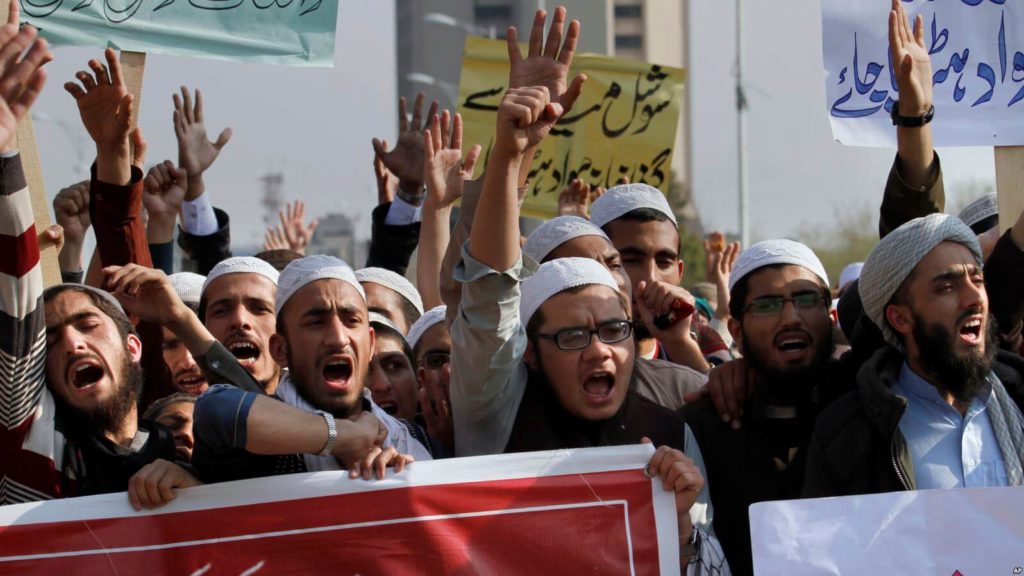
Pakistan’s capital Islamabad shut down by Islamists

 Pakistani Law and Enforcement Agencies   helpless as capital #Islamabad shut down by Islamists.


Several thousand Islamists in Pakistan have effectively blocked a main crossing near the national capital, Islamabad, crippling the daily life of millions of people and underscoring challenges facing the country’s counter extremism efforts.


The rally began with a few hundred members of the small radical Tehreek-i-Labaik Ya Rasool Allah party who had gathered earlier this week at the main Faizabad crossing outside Islamabad.


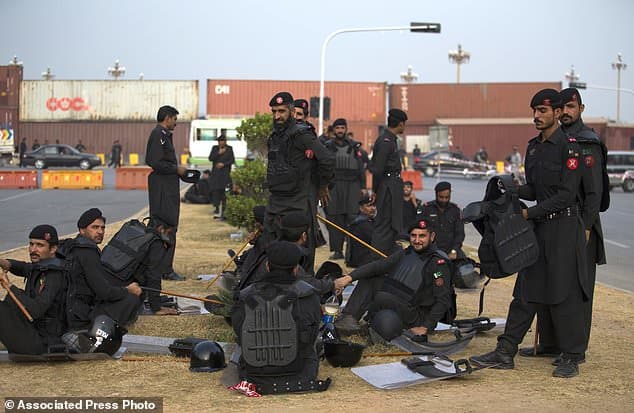
By Friday afternoon, the gathering grew to over 3,000, disrupting public life and prompting police to set up shipping containers on the throughway to prevent the protesters from entering the city. The demonstrators sought the removal of Zahid Hamid, although he has apologized and said the omission of the reference how Muhammad is the last prophet in Islam was a clerical mistake that was later corrected by the parliament.


But demonstrators claim Hamid made the omission purposefully to appease the minority Ahmadis sect.


Addressing emotionally charged demonstrators, Khadim Hussain Rizvi, the head of the Tehreek-i-Labaik Ya Rasool Allah party, said they will not end their protest until the government has sacked Hamid.


“We will not allow anyone to change Islamic laws,” he said, as people chanted: “We will die to protect the honor of the Prophet.”


The rally drew criticism from residents and rights activists when an infant died Thursday on the way to a hospital due to the road blockades in Islamabad. Police say they have charged the rally’s organizer, Rizvi, with manslaughter following complaints from the child’s parents who claim his life could have been saved had they reached the hospital in time.


The government has said it wants the protesters to peacefully disperse and authorities are in communication with Rizvi — who has not yet been detained over the charge — to end the sit-in along with the other clerics in attendance.


Pakistani Interior Minister Ahsan Iqbal told media that the government has rejected the protesters’ demand for the law minister to be removed, saying there is no charge against him.


“There is a small group of certain demonstrators who are sitting on one road. We are trying to talk to them through dialogue to persuade them that this is an illegal action to make a sit-down on the road because there is a restriction on such an assembly under the law. However, if they indulge in any violent activity the law will take its course,” Iqbal said.


The rally has also caused inconvenience to commuters as authorities have suspended the only bus service linking the nearby garrison city of Rawalpindi with Islamabad.


Islamabad’s administration has placed scores of shipping containers and deployed up to 4,000 policemen to prevent protesters from entering Islamabad’s key areas, particularly the “Red Zone” housing foreign diplomatic missions, government offices and the parliament.


Authorities have hinted at using force over the weekend if their talks with Rizvi fail.


On Friday evening, authorities started cordoning the rally amid rumors of imminent action against the demonstrators, who have virtually sieged an important entry gateway into the capital.


Pakistan has also stepped up security at places of worship for Ahmadis, as the protesters are accusing Hamid of transgressing to appease the small sect.


Ahmadis are declared non-Muslims under the Pakistani constitution and considered apostates by the clergy. Members of the community in Pakistan are barred from calling themselves Muslims or referring to their worship places as mosques.


Ahmadis’ interpretation of Islam differs from traditional orthodox positions, and community leaders insist their faith has been misinterpreted by mainstream Muslims, encouraging fundamentalists to persecute and preach violence against them.


Courtesy Rabwah

Deprived people of Gilgit-Baltistan seek their CPEC share

Image result for people of Gilgit-Baltistan

Gilgit-Baltistan [Pakistan]: The multi-billion China-Pakistan Economic Corridor (CPEC) which has repeatedly been touted as the game changer for the Pakistan economy by Islamabad, is in reality, a project being accomplished against the agonies and sufferings of the people of Gilgit- Baltistan.


The CPEC corridor, which traverses through the heart of disputed territory of Gilgit Baltistan, has a myriad of under construction projects and various others lined up in the territory of Gilgit Baltistan but the oppressive government of Pakistan has not given even an iota of share to the locals.


Land was seized and an ample compensation amount was promised to the locals. However, they have not been provided even a penny till now.


Malik Zafar, a local resident, said, “We want all what we deserve; don’t we have kids? Don’t we want to secure our future? Are we not humans? Are we animals? They have been spreading lies. Tell me one region except Pakistan which is getting benifitted from the project. Interests of local people have not been taken into account, Whatever they have been doing is in their interest, tell me one region of Gilgit- Baltistan which is getting benefit because of the (CPEC) project. They have given us nothing on Diamer Bhasha Dam project, we have not been given royalty in it. Our primary demand is that the region should be getting complete royalty in the project.”


Reasonable voices have been muzzled by the high-handed measures of the government and rest of the common people have been deceived by making large claims through media channels.


However, nothing which has been claimed by the government has attained by the government.


Shahzad Hussain, a civil society activist, said, “We will just see the containers, there are no schemes; everything is a lie spread by the government. There are no policies in place. We totally condemn it. We have not been counted in any of the CPEC projects. We are here just to breathe smoke. This project has been taken to fill the treasuries of Nawaz Sharif and his family. There are no intentions of a project in Gilgit Baltistan. Khunjerab Pass is our territory, there are no intentions, these are schemes limited to newspapers only.”


The people of Gilgit Baltistan are always given a second class treatment and no real work is undertaken by the people sitting in Islamabad for the welfare of these people.


Ebadat Ali, a local politician, said, “They have only one thing to say that we have included Diamer Bhasha Dam and Ghizer-Chitral road in CPEC project for the people of Gilgit Baltistan. I challenge them if they can prove this that project is for us. The reality is that KPK (Kyaber Pakhtunkhwa) is going to benefit from this and they are trying to fool us by calling these project ours. We have nothing except smoke from these two projects and there seems no probability in the future as well for people of the region getting anything and even more atrocious thing is that they want to take our land for free, they are not willing to compensate even for the land they are occupying for these projects.”


Image result for cpec share gilgit

Islamabad has resorted to a systematic and diabolic design of violence to crush anyone who dares standing against its projects.


The China-led 51.5 billion dollar multi-layered infrastructure project aims to connect Kashgar in China’s western province of Xinjiang, with the port of Gwadar in Balochistan.


The CPEC enters Pakistan from China through the Karakoram Highway in Gilgit Baltistan, the part of undivided Kashmir, and was forcibly occupied by Pakistan in 1948 and claimed by India. (ANI)


Image result for cpec share gilgit

Courtesy Sisat.pk


Disclaimer


It is not necessary that writer’s opinion is based on ideas and views of our blog.

The Politics of Pluralism in US

Image result for pluralism in usa flag

Zeina, left, who gave only her first name, helps display an American flag
during a “Peace for Iran” rally near the White House on Feb. 4 to protest
the Trump administration’s bid to deny entry to the United States to
citizens of seven mainly Muslim nations.
(Washington Post photo by Bill O’Leary)


There’s a lot of “us” and “them”-ing going on these days. Try as we may, it is almost impossible for you and me to avoid being labeled.  Some labels are simply about us:


They are White.


They are Black.


They are of mixed race.


They are from California.


They are from Kenya.


They are from Charlottesville.


They are from outside Charlottesville. 


They are parents.


Their daughter was killed.


But today’s labels mostly seem to tear folks down, divide and bedevil unity in our communities. Often we call using these labels “prejudice” and “bigotry.”


They are White nationalists.


They don’t believe in free speech. 


Those people are terrorists.


They came to my country to take my job. 


None of these labels describes the nuances that we know to be true about us as individuals. There are areas in which we are consistent and areas about which we are emboldened to be ambiguous; some labels hold and others do not. And they all, ideally, should nest in the tree of Pluralism.


I am White.


I am an American patriot.


I am Muslim.


I believe in free speech.


I decry racism.


How shall we describe American pluralism in a time when divisions command the headlines and accusations of “White nationalism” and “anti-free-speech” fly in the face of epluribus unum? What brings us together? What holds us there? How shall we remain democracy’s defender when its practice at home is under a microscope?


Simple answers used to include “our diversity,” “our dreams for a better life,” and “our Constitution.” However, questions are complex and answers may be even more so, especially as we acknowledge that the American example is part of an international phenomenon.


If we didn’t recognize the racism simmering beneath the American surface since the Civil War, it might seem that the United States was a late-comer to the ethnic, linguistic, religious and racial divisions that consumed portions of Europe, Asia and Africa in the late 20th and early 21st century. Alternate voices are emerging that assume credible and equal status alongside the voices of the status quo. Which are majority and which are minority is increasingly difficult to determine.


Jason Kessler, who described himself as a “White advocate” to a New York Times reporter, said that during the August 12 rally he organized in Charlottesville, Virginia, his group had been “forced into a very chaotic situation,” and that “the police were supposed to be there protecting us and they stood down.”


Balancing the voices, needs, hopes and fears of increasingly decentralized communities may be the government’s big assignment over the next decades. A popular euphemism for America’s 20th-century pluralist society was “the melting pot.” We saw ourselves as a vibrant multi-part community into which everyone assimilated into unum.  All were welcome to blend into the American experiment wherein a magical formula of capitalism plus opportunity plus equality equaled democracy. Melting-pot terminology was bandied about with great pride: We had a marvelous mix of humanity where many other countries were homogeneous. In the United States, all people could be accepted into the culture at large. Shared geography, political institutions and economic institutions were to fuse multiple cultures into a new culture, sociologists surmised.


Sometime during the 1960s, the nation was forced to admit that the term “melting pot” was inaccurate. Citizens kept their “old country” distinctions: foods, faiths and family values. Races lived in like-looking neighborhoods. People kept their ignorance of one another intact in many cases. Bias and fear —the parents of racism, sexism and religious discord— were allowed, even encouraged, to fester. In truth, Americans weren’t melted together after all: Not every ore was admitted. Indeed, the pot itself was in meltdown. Civil Rights riots, antiwar protests, free love and political assassinations upended the melting-pot theory.


Next came the “soup bowl” analogy: meat and potatoes, carrots, celery, rice and beans all simmering in a Constitutional broth. In the soup of pluralism, each ingredient would maintain its own integrity, color and consistency, and offer digestible traces of itself to the whole. It was a new concept for integration. But the broth wasn’t thick enough. For example, even if schools became integrated, neighborhoods did not.  Integration did not guarantee a good education for all nor access to the American dream of a job and a home.


In The Price of Inequality: How Today’s Divided Society Endangers Our Future, Joseph Stiglitz takes this to its logical conclusion.


Thus there are economic forces that lead from differences in household wealth (and home ownership) to differences in the civic quality of the community in which a household lives. U.S. policy to increase low-income ownership rates reflects the understanding that home ownership rates affect neighborhood quality and that growing up in a violent, crime-ridden neighborhood impairs health, personal development, and school outcomes. But home ownership—a major way in the Unites States that households access better neighborhoods and also accumulate wealth—is not sustainable for households with no wealth to start and with little income.


A RALLY AT THE COMMUNIST PARTY HEADQUARTERS IN WASHINGTON IN 1930. >FLICKR/WASHINGTON AREA SPARK


Economic segregation also prevails in the “salad-bowl” metaphor. But there’s too much Boston lettuce and not enough okra to get some on everyone’s plate. What’s a chef to do when the dietician insists on a healthy economy?


“A healthy economy is a mixed economy, in which government and the marketplace both play their role,” writes Jeffrey Sachs in The Price of Civilization: Reawakening American Virtue and Prosperity. “Yet the federal government has neglected its role for three decades. Just when the government was needed to chart a course through the twists and turns of globalization … it turned the levers of power over to the corporate lobbies. America’s economic failures are therefore at least as much political as economic.”


Our economy is not mixed and neither are American citizens.


What’s next in the world of gastronomical metaphors for pluralism? Smoothies? Banana splits? Let them eat cake? No.


We have run out of food metaphors for our multicultural, multi-confessional, multiracial society. Instead we should look at the cloth from which we are cut. Literally. E pluribus unumis best likened to a patchwork quilt.


Consider the colors and patterns of stitched-together squares, brilliantly complementing one another with apparent randomness. A large swatch on the upper left is related to a smaller swatch at center right; another piece of that theme is on the next-to-bottom row. Vertical black-and-white stripes appear here and horizontal stripes are there. None of the pieces is identical, still all the swatches carry commonalities. The thematic structural, repeated concentric squares might represent the physical forms we all share: human heart, brain and body. A sample of every fabric is sewn into the exterior frame as if to affirm universal inclusivity.


In November 1996, Gustav Niebuhr wrote on the quilt for the New York Times. In “A Religious Quilt That Is Largely Patchwork,” he asks, “Is the field of religious studies about theology, how believers understand the divine? Or is it more anthropological, the study of regional histories and cultures in which different faiths developed? Or is it social science, heavy on statistics and the charting of trends?”


It is all of the above. He cites Barbara DeConcini, executive director of the American Academy of Religion: “What’s happening now is the extraordinary explosion of pluralism in the culture.”


Is pluralism now imploding, giving way to a determined quest for identity and preservation of unique cultures? Or will identity, pitted against a fierce appreciation for diversity and equal rights for all, recognize there is room for all of the above?


Can unity exist without uniformity?  The answer is “yes,” if Joseph Campbell is correct. The American writer and lecturer best known for his work in comparative mythology and comparative religion, whose work covers many aspects of the human experience, notes that, “If you travel far enough, you’ll eventually meet yourself.”


*Image: The wall of a butcher shop in Australia. >Flickr/Chris Fithall 


Courtesy The Islamic Monthly

About Anisa Mehdi


Anisa Mehdi

Anisa Mehdi is an Emmy Award-winning broadcast journalist, a writer and a flutist. Her acclaimed National Geographic documentary "Inside Mecca" is available on Netflix. Anisa writes for Stratfor.com, and consults to the Doris Duke Foundation for Islamic Art and the Association of Performing Arts Presenters. She is vice-chair of the Abraham Path Initiative.

Disclaimer


It is not necessary that writer’s opinion is based on ideas and views of our blog.

Attacks on India's pluralism and secularism are a 'run from unity'

Every blow to pluralism is a shot in the arm for the two-nation theory propounded by MA Jinnah


Jugal R Purohit
JUGAL R PUROHIT

@jrpu


With his gaze fixed on an article concerning the rise of the Islamic State (IS) in Iraq and Syria, one of India's senior-most intelligence functionary said, "The reason why this doesn't succeed here is because of our pluralism. A Muslim attacked is defended by scores of Hindu and vice versa." Instances of religious intolerance "do not help our case".


Only yesterday (October 30), as reported by The Indian Express, in one of India's most-watched trials pertaining to religious intolerance, the judge made a very serious observation. Fifteen-year-old Junaid Khan, who, as per the prosecution, was lynched after being abused on religious lines, the judge hearing the case, additional district and sessions judge YS Rathore, said Haryana's additional advocate general Naveen Kaushik was seen suggesting questions to be put to the witnesses at two hearings.


While Kaushik is a man not linked "directly" to the Rashtriya Swayamsevak Sangh (RSS) and the BJP government in Haryana, his action have damning repercussions. Junaid's family has voiced its apprehension over the possibility of a "sabotage" even before this development was reported. “This act amounts to professional misconduct and is against legal ethics and highly unbecoming of an advocate, particularly because he is a law officer in the office of the advocate general, Haryana,” said judge Rathore and asked for action to be taken against him.


indian-muslim-body_103117045202.jpgThere are societies where majority-domination translated into minority subjugation.


The day after this order, the family of 55-year-old Pehlu Khan who was lynched by cow vigilantes near Alwar on April 1, came to Delhi and pressed for a Supreme Court-monitored probe because the Rajasthan Police gave a clean chit to many of the accused.


There are societies where majority-domination translated into minority subjugation. For example, Pakistan and its bloodlust for minorities, Myanmar's treatment of Rohingyas, the case of Iraq, where the minority Sunni population enjoyed domination while Saddam Hussein's rule lasted. When the end came, the majority Shias struck with vengeance and this fear was exploited to the hilt by the Sunni-dominated Islamic State.


I'd urge you also look east, towards Indonesia. The parliament of that most-populous Muslim country, Indonesia, last week chose to act against rising Islamisation and extremism. It gave the government the power to ban any organisation which acts or goes against the country's secular character.


[youtube https://www.youtube.com/watch?v=-LLKsRH3bmI]


What about Indian Parliament?


On April 12, senior lawyer and Rajya Sabha member KTS Tulsi sought the home ministry's response on the "attacks on minority communities in the country". This is what the minister of state for home, Kiren Rijiju, had to say: "The available information does not indicate any instance which can be categorically called pre-meditated attack or stated to have been carried out purposely against any member of the minority community. However, 'public order' and 'police' are state subjects as per the provisions of the Constitution of India. The responsibilities of maintaining law and order, registration and prosecution of crimes, including those against minorities, and maintaining relevant data in this regard rest primarily with the respective state governments."


Let's dwell on the country that has unfortunately become the centre of our discourse in India-Pakistan. If the creation of that country was the result of reinforcement of the "Muslim identity" of Indians by the British, it was also the product of the fear of the "Brahmin Bania Raj" in united India as historian Ramachandra Guha puts forward in his book, India After Gandhi.


Every blow to pluralism and secularism here is a shot in the arm for the two-nation theory propounded by Pakistan's founder MA Jinnah.


Coming back to the present, invisible men like the senior intelligence officer in India and across the world are up against an ideology, which detests the world as we know it. "Their goal is the other realm. Death, they say, is their gateway, and life, our society, relationships and values that we have cherished mean nothing. Creating a just and equitable society, or at least making visible attempts towards that is no longer an option before us," he stated.


How are we faring?


[youtube https://www.youtube.com/watch?v=Sxwln96ZNu8]


Courtesy Dailyo.in


Disclaimer


It is not necessary that writer's opinion is based on ideas and views of our blog.


Diversity Is Not Enough. We Need Pluralism


In a pluralistic society, power is dispersed, and mutual consent is the order of the day


.

Image result for diversity and pluralism


Ben Borgman, who is gay, recently ejected a group of Christian anti-abortion activists from his coffee shop in Seattle. He took great offense at one of their flyers, which he found outside, and understandably so: It graphically links gay pride with a dismembered fetus. He told them to get out in no uncertain terms (and in very colorful language).


"Heroic Gay Coffee Shop Owner Kicks Out Anti-LGBTQ Group," exulted Out magazine. "Gay coffee shop owner throws out Christian zealots whose leaflets feature rainbow hands dripping blood," is how Pink News put it.


The parallels with a current Supreme Court case are obvious. The justices soon will decide whether a Christian baker can decline to make a wedding cake for a gay couple. Gay-rights activists say refusing to do so amounts to blatant discrimination that violates public accommodation laws. Defenders of Masterpiece Cakeshop say the owner, Jack Phillips, is not discriminating against gay people—he will gladly sell them all sorts of baked goods—but rather, exercising a First Amendment right not to create cakes that violate his religious convictions. (He won't make Halloween cakes, either.)


The degree to which religious believers deserve accommodation also turned up last week in two moves by the Trump administration. In one, Attorney General Jeff Sessions laid down new guidelines for federal agencies, directing them to protect the ability of religious people to live out their faith. In the second, the administration expanded religious exemptions to Obamacare's requirement that employers provide insurance coverage for contraception.


Liberal interest groups immediately went ballistic over both.


Which is rather telling. And what it tells us is that "celebrating diversity" means somewhat less than you might think at first blush. It suggests there are really two kinds of diversity—and that only one of them is considered worth cheering.


We might call the first kind shallow diversity. It's the kind that is only skin-deep: the kind that complains the Oscar nominations include too few minorities, or that not enough women major in economics, or that all-white juries are inherently suspect, or that Asians are overrepresented on college campuses.


Shallow diversity is still important and useful: Diverse companies tend to make better decisions and higher profits, for example. Diversity also suggests the absence of discrimination (although organizations can use discrimination to achieve a diverse mix). This kind of diversity enriches everyday experience, fosters tolerance, and broadens understanding.


But a superficially diverse community can still lack diversity in a deeper sense. Take higher education: Colleges and universities go to great lengths to pursue demographic diversity in the faculty and the student body. But over the past couple of decades campuses have grown decidedly more liberal—to the point that in some fields, conservative voices are nearly extinct. Yet there is no corresponding effort to increase ideological diversity in higher education.


And this holds true despite the fact that while conservatives and liberals might disagree about, say, whether racism is a personal character flaw or a coordinated system of social control, they share many values and assumptions common to the American upper middle-class. They are apt to live in similar homes, read similar books, and—most importantly—share similar ideas of what the good society entails.


Celebrating diversity gets harder the further down it goes. What happens when people disagree fundamentally about what the good society looks like?


One answer involves the use of raw power to make others knuckle under. That is the answer preferred by many on the right: Build a wall. Make English the nation's official language. Lock up drug addicts. Ban pornography. Prohibit gay marriage. Fire every pro football player who doesn't stand during compulsory patriotic rituals preceding sporting events that mimic wars between nation-states. And so on.


But it also seems to be the answer preferred by many on the left as well: Ban or disrupt any speech that threatens liberal orthodoxy. Make Catholic nuns provide contraception. Reject and defund student groups guilty of wrongthink. Force Christian bakers to participate in gay weddings. And so on.


Deep and genuine diversity requires something more—namely, pluralism. In a pluralistic society, power is dispersed, and mutual consent is the order of the day. Different visions of the good society are permitted to coexist—even if some of them are offensive. People are allowed to be wrong—sometimes even outrageously so.


Suppose Ben Borgman had been a printer instead of a coffee shop owner, and the Christian group had asked him to print its bloody flyers. Should the government have made him do it?


This column originally appeared in the Richmond Times-Dispatch.

BREAKING: Madrid eyes crackdown after Catalonia's parliament passed a resolution declaring independence from Spain

Catalan parliament passes resolution declaring independence

An image from the debate ahead of the vote in the Catalan regional parliament. Photo: Lluis Gene/AFP

Catalonia's parliament passed a motion to declare independence from Spain after a tense debate that resulted in some opposition politicians leaving the chamber in protest.


Following a request from one of the pro-independence MPs, parliament speaker Carme Forcadell read part of the preamble from the motion, in which a declaration of independence is made


The vote then took place, resulting in 70 votes in favour of approving the text, ten against and two blank votes.


Opposition politicians from Citizens and the PP left the chamber before the vote in protest, and did not take part.


Separatists who had gathered on the streets of Barcelona and near the parliament building celebrated as the news of the vote came in.


Catalan president Carles Puigdemont casting his vote on the motion declaring independence. Photo: Lluis Gene/AFP

Attention now turns to Madrid, where the Senate is due to vote on measures to intervene in the region’s autonomy and remove the Catalan government from power. PM Mariano Rajoy made an appeal for the measures to pass earlier on Friday, insisting it was a response to "a continuous process of anti-democratic decisions" in Catalonia.


Ahead of the vote, Marta Rovira from the governing pro-independence Together for Yes coalition argued "we need a more mature and demanding culture of democracy. The debate about the constitutional process has to be constant".


"Today we will found a new country based on these principles, and dignity. We're doing it."


Inés Arrimadas of Citizens called the vote "an attack on the fundamental values of the European Union," adding "that's why you have no support".


"Are you not ashamed to lead a political movement that excludes those who think differently?" PP MP Alejandro Fernández asked.


But Carles Riera from pro-independence party CUP insisted that Spain's constitutional framework is broken:


"It is a problem because it doesn't provide solutions for the current issue. We propose a new framework of a republic that offers democratic solutions".


PM Rajoy reacted almost instantly to the vote on Twitter, asking Spaniards to be "calm" and insisting that "legality will be restored in Catalunya".


Pro-independence supporters in Barcelona. Photo: The Local


People wave "estelada" or pro independence flags in Barcelona, Spain, after Catalonia's regional parliament passed a motion with which they say they are establishing an independent Catalan Republic, Friday, Oct. 27, 2017. Photo: Santi Palacios, AP / Copyright 2017 The Associated Press. All rights reserved.


Madrid taking away Catalonia's regional powers is likely to be seen as a humiliation and a provocation by Catalans. A backlash is anticipated, with street protests planned for Sunday, while regional government workers could follow a policy of disobedience or non-cooperation.


On top of that, an expected early election within six months could still deliver a steadfastly pro-independence Catalan parliament, even if recent polls have suggested the region of 7.5 million people is roughly evenly split on secession and some Catalans strongly oppose independence.


A spokesman with Spain's prosecutor office, meanwhile, said the prosecutor would seek to lay rebellion charges against those responsible for the Catalan independence vote.


The day of drama, featuring emotional speeches and scenes of joy and despair, went to the heart of Spain's political and cultural history.


The 1978 Constitution, drawn up after the end of Gen. Francisco Franco's decades-long dictatorship, created a decentralized Spanish state that devolved power to 17 autonomous regions, including Catalonia. The regions have broad administrative and legal powers. The Spanish Constitution, however, also describes Spain as "indivisible."


Catalonia has its own cultural traditions and its own language. Having long seen themselves as different from Spain, the Catalan drive for independence began in 2010 when the Constitutional Court struck down key parts of a groundbreaking charter that would have granted Catalonia greater autonomy and recognized it as a nation within Spain.


Catalonia represents a fifth of Spain's gross domestic product and many want the tax revenues generated by the industrious region to remain at home.


After the vote on independence in the Catalan parliament, an unprecedented challenge to Spain's status quo, officials and lawmakers let loose cries of "Freedom!"


Outside parliament, thousands who had gathered cheered the news, some dancing and raising a toast. In Barcelona, people crowded around TV sets to watch the historical events unfold. The famous St. Jaume square outside the regional government office was packed with thousands of people celebrating. Many of them were draped with the "Estelada" flag that adds a blue triangle to the red and yellow Catalan flag and has become a symbol of the separatist struggle.


"I feel so emotional after the huge fight we went through, we finally got it ... the independence of Catalonia!" said 74-year-old Rosalina Cordera Torelles.


Nearby, 24-year-old Rita Carboneras could hardly contain her excitement.


"I'm super, super, super happy. Super excited," she said. "So relieved. Now we are Catalan at last. We can be ourselves. We are just happy, look everyone around. Everything is so exciting."


The exhilaration was short-lived. Some 500 kilometers (300 miles) to the south, the Senate in Madrid voted by an overwhelming margin of 214 to 47 in favor of granting the government exceptional powers.


"I call on all Spaniards to remain calm. The rule of law will restore legality to Catalonia," Rajoy said on Twitter, adding that what is happening in Catalonia is "a clear violation of the laws, of democracy, of the rights of all, and that has consequences."


The main opposition Socialist party supports Rajoy's stance on Catalonia, and many Spaniards outside the region are scornful of Catalonia's secession ambitions.


Rajoy has also received support from outside Spain, with other European leaders rejecting Catalonia's claims. The U.S. administration also backed Rajoy, after President Donald Trump last month branded the Catalan independence ballot as "foolish."


"Catalonia is an integral part of Spain, and the United States supports the Spanish government's constitutional measures to keep Spain strong and united," U.S. State Department spokeswoman Heather Nauert said in a statement.


Also supporting Rajoy's warnings of trouble in Catalonia if it forges ahead with its secession bid, more than 1,500 businesses have moved their official headquarters out of Catalonia this month to ensure they can continue operating under European Union laws if Catalonia secedes. The EU says Catalonia will be tossed out of the bloc if it leaves Spain and would have to apply to become a member, a lengthy process.


google-site-verification: googlea1b9a1d535276555.html

google-site-verification: googlea1b9a1d535276555.html

[googlea1b9a1d535276555.html]

[googlea1b9a1d535276555.html]