
Showing posts with label Indo pak. Show all posts

 There are societies where majority-domination translated into minority subjugation.
Will India’s Lobbying Change U.S. Policy Toward Pakistan?
India hopes a connection with Trump’s national security advisor can tip the scales against Pakistan
By Prateek Joshi

Courtesy The Diloplomat
By Prateek Joshi
At a time when India-Pakistan tensions are high, New Delhi has once again ramped up its efforts to get Washington on its side. Hopes are high that that a new foreign policy team under the Trump administration might possess the key to curb the asymmetric warfare India faces from its western neighbor. In this context, it will be important to note how the relationship between the two countries’ national security advisors develops and to what extent National Security Advisor Michael Flynn may be able to influence U.S. policies on Pakistan.
New Delhi has every reason to believe that engaging with the new NSA offers a golden opportunity to break the long-standing Pakistan paradox. There’s no doubt that U.S.-India defense ties have soared under the Obama administration, but there has always been a feeling in New Delhi that Washington has not done enough to rein in the anti-India non-state actors operating from Pakistan — despite U.S. attacks having taken out both Osama bin Laden and, more recently, Taliban leader Mullah Akhtar Mansour on Pakistani territory.
Under a Trump administration, collaboration between the U.S. and Indian NSAs (who share intelligence backgrounds as well hawkish traits on Pakistan) may potentially define U.S. policies toward Pakistan. Unsurprisingly, Indian NSA Ajit Doval has a strong background on the Pakistan issue. He spent much of his career in intelligence, where he is even said to have secretly stayed in Pakistan for seven years as an undercover spy. The so-called ‘Doval doctrine’ of “Defensive Offense,” according to which the terrorists targeting India should be bought over and used against the enemy, has unnerved Islamabad. In his earlier career with the Indian Police Service, Doval’s handling of high-risk assignments, a number of them dealing with threats emanating from Pakistan, played an important role in getting him considered for the NSA position under the Modi administration.
Meanwhile, Flynn has an apt understanding of the role non-state actors in Pakistan continue to play in Afghanistan, having spent time in Afghanistan during Operation Enduring Freedom and as the director of intelligence in the International Security Assistance Force (ISAF) from 2009-10. He later served as director of the U.S. Defense Intelligence Agency. Flynn has been accused of inappropriately sharing classified information with foreign military officials in Afghanistan in 2010 despite lacking authorization, as a recent Washington Postreport noted. “Flynn had disclosed sensitive information to Pakistan in late 2009 or early 2010 about secret U.S. intelligence capabilities being used to monitor the Haqqani network, an insurgent group accused of repeated attacks on U.S. forces in Afghanistan. Flynn exposed the capabilities during meetings with Pakistani officials in Islamabad,” the Post notes.
While the debate surrounding this issue centered on Flynn exposing U.S. intelligence-gathering sources and methods, his actions allude to a more crucial point: his conviction that Pakistan-based non-state actors are destabilizing Afghanistan, something which successive U.S. administrations have tacitly accepted.
In an appearance on an Al-Jazeera discussion, with the ex-chief of the Pakistani Inter-Services Intelligence also participating, Flynn accused the ISI of playing a double game in which it pretended to support the United States, but in reality only furthering its own strategic agenda in Afghanistan by supporting the Taliban. In the same discussion, Flynn described Pakistan’s role as a “selfish” actor and stated that the national security interests of Pakistan were never aligned with those of the United States. Also, Flynn’s book, The Field of Fight,discusses his concerns with the proliferating roots of organizations promoting radical Islam, a large number of which he has accused the Pakistani establishment of harboring.
All these remarks are music to India’s ears. The challenge now is whether New Delhi can convince Flynn to influence U.S. foreign policy-making to redirect its efforts to contain the proxy war India faces from some of these groups based in Pakistan — if not through official diplomatic channels, then at least at the level of intelligence and covert policies, which are his forte. Doval flew to the United States and met Flynn on December 19 and discussed issues of strategic importance to India-U.S. ties. The details of the discussion are yet to emerge, but there’s no doubt that Pakistan would have come up.
New Delhi’s increasingly hawkish posture toward Pakistan is also visible in recent appointments in the Indian military and intelligence bureaucracy. General Bipin Rawat has been appointed the next chief of the Indian Army, superceding two officers senior to him. Having extensively served in the sensitive areas of Jammu and Kashmir and with rich experience leading counterinsurgency and counterterrorist operations, Rawat was a natural choice for the army chief, even enticing the government to break the seniority convention in appointing army chiefs. Meanwhile, the new chief of the Research & Analysis Wing (RAW, India’s external intelligence organization), Anil Dhasmana, also happens to be an expert on Balochistan, the restive Pakistani province that Islamabad has accused India of converting into a proxy warfare battlezone.
As a response to the expected bonhomie between New Delhi and Washington, Islamabad is frantically reaching out to the United States, especially after the flak it drew when Prime Minister Nawaz Sharif’s office released detailed notes of his phone conversation with President-Elect Trump, in violation of diplomatic norms. Tariq Fatemi, Sharif’s special assistant on foreign affairs, was sent to the United States to meet key people expected to influence the new government. Though many suspected Pakistan had put all its eggs in the same basket in favoring Hillary Clinton, the country still remained in contact with the Republican Party through Sajid Tarar, a Pakistani-American who headed the “Muslims for Trump” campaign. It also emerged that it was Tarar whoarranged the Trump-Sharif phone call. Interestingly, in an interview, Tarar stated that contact between Sharif and Trump became a necessity after the latter’s early chat with the Indian prime minister.
As the upcoming U.S. administration considers how to handle relations with India and Pakistan, New Delhi and Islamabad are each trying their best to lobby for favorable shifts in U.S. policy. Though to Islamabad’s relief, the Trump transition team has expressed its willingness to have a strong working relationship with Pakistan in the future, it still remains to be seen how Flynn’s views in particular are accommodated by the new government and to what extent the understanding between him and Doval may be reflected in U.S. policy toward Pakistan.
Prateek Joshi is a post-graduate in International Relations from South Asian University (a SAARC nations project) and a researcher on South Asia’s strategic issues.
Courtesy The Diloplomat
Is Pakistan's National Action Plan Actually Working?
Two years after Pakistan unveiled its strategy for fighting terrorism, the results are mixed.
By Zeeshan Salahuddin
[caption id="" align="alignnone" width="1650"]
 Photo Courtesy ; Pakistan Today [/caption]
The National Action Plan (NAP) was created on December 25, 2014, in reaction to 133 children being murdered by the Taliban. Ostensibly, NAP was designed with the consent of all political parties, and the blessing of both civil and military leadership, as a comprehensive document detailing ideal steps to rid Pakistan of the menace of terrorism and militancy. Two years on, this idealism is tempered by ground realities, the limited ambit of political will, and a tenacious, unrelenting enemy. Thus, Pakistan’s course of action is nebulous, unrealized, and incomplete.
The first point in the NAP is the controversial lifting of the moratorium on the death penalty. The problem is that there is no mechanism to selectively apply the lifting of the moratorium to a particular group of death row inmates. Once it is lifted, all on death row must be put to death. During the first 13 months, there was a surge in executions, 345 to be exact, catapulting Pakistan to the country with the second highest number of executions worldwide. This year, that figure has crept up to 419. This impedance in the frequency of executions comes from pressure from civil society and rights groups. The government was mired in scandals earlier this year as it tried to execute a quadriplegic inmate. A scathing report recently also showed that the bulk of executions, analarming 98 percent, are not related to terror convictions at all.
Setting up military courts (MCs) to convict terror suspects faster was another salient feature of the NAP. In the first full year, these courts convicted 40 individuals. In the second year, this number has risen to 85. Considering that a province like Sindh, which accounts for about 17 percent of the country’s population, had3,360 pending cases in anti-terrorism courts (ATCs), and some cases have been in limbo for up to eight years, this rate of convictions from the MCs is simply insufficient to deal with the scale of the problem. MCs, while constitutional and legal, are not the long-term solution to a systemic problem.
Enjoying this article? Click here to subscribe for full access. Just $5 a month.
Proscribed outfits in Pakistan have several points in the NAP dedicated to the mitigation and curtailment of their operations, communication networks, and funding sources. The government maintains a list of 63 banned organizations, but this list has been around since well before the NAP, and only the Islamic State (ISIS) has been added to it since the NAP went into effect in the first year. Two additional organizations were added this year, Jamat Ul Ahrar (JuA) and Lashkar-e-Jhangvi Al Alim (LeJA). However, being a proscribed organization has little meaning, as there are consistent reports of their members moving freely, holding rallies and public gatherings, openly inciting hatred and bigotry, and being given airtime. Schedule IV should go into effect, restricting their movements and communications, but it is rarely applied. As proof, the country was shocked by the victory in a by-election of Masroor Nawaz Jhangvi, a veritable person of interest under the fourth schedule, a son of the founder of one of the most violent sectarian groups in the country. But even this fails in comparison to reports of the Interior Minister Chaudhary Nisar meeting with the heads of banned organizations in the country.
Counterterrorism, understandably, is a big aspect of the NAP, which details steps to strengthen the National Counter Terrorism Authority (NACTA), establishes a dedicated counterterrorism force, and sets generic goals as well as specific goals for improvement in the overall security situation. NACTA remains a significant challenge as the political will needed to strengthen the organization is fleeting at best. The government continues to claim, without proof, that NACTA is fully operational and functional, raising questions about its commitment and solemnity. Since the enactment of the NAP, there has not been a single meeting of the NACTA board of governors, and despite the belated allocation of funds, it has failed to set up a Joint Intelligence Directorate (JID).
The military began a comprehensive ground campaign to liberate areas that had fallen under enemy control in the Federally Administered Tribal Areas (FATA), a semi-autonomous region bordering Afghanistan, and in the city of Karachi, a massive metropolis with an estimated population of 24 million. The operation began on June 15, 2014, and in September 2016, the then-chief of the army staff, General Raheel Sharif, declared two years of success, stating that Pakistan was safer as a result of the operation. His words are not without merit. The number of violence-related fatalities in the country dropped from 7,611 in 2014 to 4,653 in 2015. Data from the first three quarters of 2016 suggests that the decline is still sharp and continuous, with 2,061 people losing their lives to violence in the last three quarters, and each quarter less violent than the one prior. The overall security situation has undoubtedly improved by leaps and bounds.
However, this progress a) may plateau out; b) is most certainly artificial and temporary; and c) does little to address the root causes of militancy and extremism that plague the country. The military is the primary driving force behind counterinsurgency, counterterrorism, and in the case of Karachi, urban crime pacification. This is neither a perpetual solution, nor a sustainable one. The long-term solution is the complete overhaul and strengthening of the civilian law enforcement agencies and the systemic reform of the criminal justice system. The NAP also speaks about improving the criminal justice system, but to date progress on this front has been lackadaisical and stagnant. Law enforcement has seen limited improvement in select cases, such as the police force in the Khyber Pakhtunkhwa (KPK) province, but that is more of an exception than the norm.
Despite this, highly coordinated and brazen attacks in 2016 indicate that while militants and extremists have been undoubtedly weakened, their capacity has not been reduced and they still have both resources and access. In January, militants stormed a college, killing 20. In March, a local court in Charsadda was attacked, killing 16. In March, a bomb went off in a children’s park in Lahore, killing 70 and injuring 331. In August, the lawyer community in Quetta was targeted, killing 72 in a horrendous suicide attack. In October, militants infiltrated a police training center, and killed 61. A bombing at a religious shrine in November took the lives of 61. Despite a reduction overall, this shows that the enemy is obstinate and ingenious. A judicial inquiry into the August bombing recently made its findings public, lamenting the lack of government buy-in and empathy and chastising virtually every link in the chain of law enforcement and public safety.
The NAP also has stipulations for combating hatred, sectarianism, and intolerance. A report from August reveals significant movement toward the attainment of these goals. Law enforcement agencies arrested 15,259 clerics, religious teachers, and prayer leaders for delivering hate speech and inciting violence, and registered 14,869 cases. Tens of thousands of arrests were also made in combing operations across the country, while close to 6,000 cases were registered against shop owners for selling hate materials. By the numbers, the number of people who died at the hands of sectarian conflicts in the country reduced from 616 in 2013, to 420 in 2014 to 304 in 2015. In the first three quarters of 2016, so far, this number stands at 147. This shows a marked and undeniable reduction in sectarian violence across Pakistan. While not completely eliminated, this level of mitigation is a positive sign.
Crackdown on seminaries in the form of uniform registration, curriculum reform, and routing their finances through banking transactions was a highly controversial point in the NAP. This goal was so volatile that just days after the school attack, hardliner religious right parties refused to get on board with the NAP if seminaries were targeted. The net result is that even two years after the fact, progress on this objective remains stunted and negligible. Even the official form for registering the 26,465 seminaries did not have the prime minister’s approval as of September. In October, in a meeting, it was decided that the process would be “sped up” without giving any details on what said speed would entail. The government’s progress on this front has been nothing short of timid and docile.
Rehabilitating internally displaced persons (IDPs) and repatriating (or assimilating) refugees are the remaining two points of the NAP. The COAS in June stated that 61 percent of IDPs had already been successfully rehabilitated. By this count, nearly 600,000 IDPs still remain. The focus, he said, would now shift to better border management. There are between 1.5 and 1.6 million Afghan refugees in Pakistan, and following a border skirmish with Afghan forces that claimed the lives of Pakistani soldiers, there has been a concerted, accelerated push to repatriate the refuges. Unfortunately, the push has only garnered Pakistan ill-will from both Afghanistan and rights groups, as exemplified best by “Afghan girl” Sharbat Gula’s deportation scandal earlier in October and November. Nevertheless, the porous mountain terrain and allegations from Pakistan that Afghanistan allows its soil to be used for planning attacks on Pakistan, and vice versa, exacerbate this matter further.
All things considered, Pakistan’s military, with a long-standing history of coups and aversion for their civilian counterparts, stands as the clear victor here, and to the victor goes the spoils. The military has run very successful urban pacification and armed non-international conflict campaigns against militant and criminal elements. Their efforts can be measured from the dramatic decrease in violence-related casualties across the country in the last two years. They are not without fault, and their methods are often questionable and blur the boundary between the judicial and extrajudicial, but they have reaped immense public support and sympathy for their efforts.
The civilian government is an entirely different story. Whether it is the interior ministry, or the stillborn and flailing NACTA, or the law enforcement agencies, the implementation of NAP and its various objectives leaves a lot to be desired. There seems to be a particular bottleneck whenever the religious right is involved (proscriptions, seminaries, hate speech, etc.) There also seems to be a distinct lack of political will for reform of the criminal justice system, or the inept police forces.
More than ever, NAP feels more like a political tool than a unified, unifying plan. What started off as an integrated means to eradicate extremism in the country is now at best a sidelined instrument, with every state organ clamoring to claim the smallest of the limited victories, and scrambling to shift the blame for its many, many failures. Ultimately, Pakistan has grown surgically adept at killing terrorists, but unable (or unwilling) to kill the ideas that fuel them.
Zeeshan Salahuddin is a Pakistan-based journalist.
Courtesy The Dilplomat
Kashmir is on the edge after the death of 22-year-old militant who used Facebook as a weapon
SRINAGAR: Eight people have died and nearly 200 people have been injured in clashes in Kashmir, a day after Hizbul Mujahideen commander Burhan Muzaffar Wani was killed, the police said. Police stations and minority camps have also come under attack, a senior officer said.

“A life lived well, his 22 years are better than a hundred years of a hundred thousand of us,” wrote a Kashmiri in his forties on Facebook late on Friday evening.
Many in the Kashmir valley are in mourning, and disquiet is rising over the death of a young militant commander who sparked a resurgence in the decades-long insurrection in this restive region. Tellingly, his powerful weapon was social media.
Burhan Muzaffar Wani, a 22-year-old militant commander of Hizbul Mujahideen, was killed in a gun-battle with security forces on Friday (July 08) in a remote village in southern Kashmir. The Hizbul Mujahideen is a Muzaffarabad-based militant group which favours Kashmir’s merger with Pakistan.
At least eight persons have reportedly died and over 60 have been injured in protests and clashes since.
For four years, the boyish, tech-savvy Wani had rattled the Indian security establishment with his brazen display of fearlessness in videos and photographs circulated across social media.
He was also unlike any militant leader ever seen in the valley, which witnessed the rise of militancy in the 1990s. Perhaps the youngest divisional commander of the Hizbul Mujahideen, Wani did not cross the Line of Control for training, almost a norm for influential militant leaders in the past.
Instead, he gathered immense influence by remaining resolutely visible to the Kashmiri public, using social media. Every now and then, Wani’s photos and videos would appear on Whatsapp and Facebook. Some of his earlier videos showed Wani in army fatigues, cracking jokes and playing cricket at unknown locations in the south Kashmir.
Wani’s tech-savvy tactics turned militant-free south Kashmir into a hotbed of militancy.
But it was his speeches in other videos that compelled a large number of educated youth to join his ranks. His tactic of denouncing the local police for using excessive force against protestors helped him earn the goodwill of people. He struck a chord with Kashmir’s youth, especially those who were facing charges of stone-pelting and other anti-India activities.
“It was unusual,” a police official told the Greater Kashmir newspaper. “No one could even believe that militants are coming out openly, unveiling their masks unlike the past when they would hide their faces. It threw a challenge to the security grid. It certainly motivated youth into militancy.”
Wani’s tech-savvy tactics turned militant-free south Kashmir into a hotbed of militancy. As more and more youth started joining his ranks, the number of local militants operating in the region outnumbered foreign-born rebels for first time in a decade.
Since 2015, Wani carried a bounty of Rs 10 lakh on his head and was wanted both by the Indian security agencies and the locals—although for altogether different reasons.
A school boy’s revenge
The son of a school teacher, Wani grew up in South Kashmir’s Tral township.
He decided to join the insurgency when he was 15-years-old and a Class 10 student, after he was allegedly harassed by the Special Operations Group (SoG) of the Jammu Kashmir Police.
In 2010, Wani, his brother and a friend were reportedly riding on a motor cycle in their hometown, when they were stopped by the SoG personnel. The policemen asked the three to fetch cigarettes for them. Despite complying, all three were “thrashed and humiliated” before they managed to escape, according to reports in Kashmiri media.
A few months later Wani disappeared, only to emerge as a militant associated with the Hizbul Mujhideen. Within four years, he rose to become a divisional commander, aided by his social media prowess and the deaths of senior militants above him.
On April 13, 2015, Wani’s elder brother, a commerce graduate, was killed by security forces. He was on his way to meet his younger sibling in a forested area in Tral.
Funeral and protests
Kashmir has been on boil since Wani’s death.
Burhan-Wani-Kashmir-India-Militant
Kashmiri women mourn the death of Burhan Wani, a separatist militant leader, during his funeral in Tral, south of Srinagar, July 9, 2016.(Reuters/Danish Ismail)
On Friday evening, thousands of people poured into the streets of Srinagar and towns across Kashmir. Funeral prayers in absentia were held at many places and there have been reports of night-long protests in the southern districts of Anantnag, Pulwama and Wani’s hometown of Tral.
On Saturday, authorities suspended mobile internet and train services in Kashmir. Prominent Kashmiri separatist leaders, including Mirwaiz Umar Farooq and Yasin Malik, have been placed under house detention. The annual Hindu pilgrimage to the Amarnath shrine was also halted.
Thousands gathered in Tral to participate in his funeral prayers, including a dozen militants who fired aerial rounds.
Yet, there is little consensus on what Wani’s death will mean for militancy in Kashmir.
“I don’t think it will leave any major impact on militancy as such,” said veteran journalist Yusuf Jameel, who has covered the insurgency from its earliest days. “Only an iconic militant commander has gone which may be a set back to Hizbul Mujahideen, and may affect its network in South Kashmir.”
Omar Abdullar, the former chief minister of Jammu and Kashmir, however, felt markedly differently.
“Mark my words,” he said on Twitter, “Burhan’s ability to recruit in to militancy from the grave will far outstrip anything he could have done on social media.”
7 Ways by Which Israel helped Turn Kargil War for India.
Courtesy Hindutva A Blog About Hinduism

Large scale intrusions by Pakistan army into the forward areas of Kargil Dras sector in May 1999 tested India’s ability to quickly adapt and fight a low intensity war with a nuclear armed neighbour, s something that country’s armed forces did so brilliantly with active support from Israel, a country best equipped in border control and fighting limited wars.
- Israel was one of the very few countries that directly helped India during the Kargil War.

- When hostilities broke out in the summer of 1999, India was short of mortar and ammunition. Israel proved to be an reliable partner by quickly providing the much needed mortar and ammunition that made the difference on the front lines.

- USA (United States of America) and many other countries mounted tremendous pressure on Israel to delay delivery of shipment of arms orders that had been placed before the Kargil intrusions were detected. Israel resisted international pressure and instead speeded up the delivery order

- Being a low intensity war and not wanting to risk a full scale war, required tremendous restraint on the part of Indian forces because the military operations had be restricted to the Indian side of Line of Control (LOC). Surveillance and precision bombing material provided by Israel during the height of Kargil War enabled the Indian armed forces to push back the intruding Pakistani army behind behind the LOC
Indian Air Force felt the need for laser guided missiles to support ground operations and Israel was quick to supply them. Indian fighter jets equipped with these hitech bombs hit camouflaged Pakistani bunker targets in the mountains with such precision that the LOC was not violated.
From June 1999, the precision strikes by Mirage 2000H fighter planes armed with laser guided bombs neutralized the Pakistani army’s position of sitting at higher positions that eventually turned the battle in India’s favour.
The Heron and Searcher Unmanned Aerial Vehicle (UAV) provided by Israel gave the Indian ground forces the advantage of better high altitude surveillance with accurate imagery for locating enemy targets.


[youtube https://www.youtube.com/watch?v=aj1EFrWBurU]
Locating Gilgit-Baltistan in India’s Policy If India has genuine concern for the territory it claims as its own, it has to first stop claiming Gilgit-Baltistan only through cartographic assertions

Article written By Prateek Joshi
Since independence, India’s official map depicts Gilgit-Baltistan (GB) as a part of its territory currently under Pakistani occupation, terming it as Pakistan-occupied Kashmir (PoK). Unfortunately, however, India’s engagement with GB has been limited to cartographic assertions, despite real issues in the region that demand serious attention.
Gilgit-Baltistan as Kashmiri territory?
The region’s tryst with Kashmir began with Gilgit’s annexation by the Sikh army in 1843.[i] After the Sikh empire folded, Gilgit’s control went to the newly established princely state of Jammu and Kashmir.[ii] Throughout the latter half of the 19thcentury, the Maharaja was encouraged by the British to conquer more territories to the north of Kashmir, to fend off a potential Russian invasion from the northern frontier.[iii]
In the seven decades following the inception of the Kashmir dispute, New Delhi has barely raised the issue of Gilgit-Baltistan or the plight of its population, which is not even constitutionally represented. From the Indian side, the only mention the region gets is as “Pakistan-Occupied Kashmir (PoK).” Even in 1994, when the Indian Parliament passed a resolution stating that PoK is an “integral part of India,” there was no specific reference made to GB.
Issues never raised by India
There is a sense of alienation in the GB region due to the ethno-religious threats facing its inhabitants. In 1973, Pakistan’s then Prime Minister Zulfiqar Ali Bhuttoscrapped state subject rule, which essentially gave those from outside GB access to land in the region. This in part altered the demography, which was earlier primarily composed of ethnic Shinas, Burushaskis, and Baltis. Later, Zia ul Haq’s Islamization policies threatened indigenous populations, predominantly those of the Shi’ite, Nurbakshi, and Ismaili faith (followers of Aga Khan). Administratively, the region still does not have the status of a province, and the GB Legislative assembly has its autonomy stifled by another decision making body—the federally elected GB council, headed by Pakistan’s prime minister.
The announcement of China-Pakistan Economic Corridor (CPEC) has brought Gilgit-Baltistan to the forefront of geopolitical wrangling, as China seeks direct access to the Arabian Sea via Gwadar Port. The actual share of economic benefits from CPEC to the GB region are yet to be declared, and due to its alienation, the population of the region is unable to change this.
Despite these issues in the public domain, New Delhi has chosen to limit its concern for the region to occasional protests by the Ministry of External Affairs. Political activists from GB have expressed their desire to engage with India on issues of substance, not cartographic claims, and have accused New Delhi of playing “a wait-and-watch game.”
Moving beyond cartographic nationalism
In what seems to be a renewed thrust to its claim over Pakistan-occupied Kashmir, the Indian government has proposed the Geospatial Information Regulation Bill, intended to “regulate the acquisition, dissemination, publication and distribution of geospatial information of India which is likely to affect the security, sovereignty and integrity of India”. The draft bill proposes a hefty fine of upto $15 million or seven years imprisonment to any person/entity whose description of the map of India does not match the government of India’s official version. Pakistan was the first nation to respond to the new development when its permanent representative raised the issue at the United Nations, claiming that the proposed bill was a violation of international law.
With the new bill, India’s territorial assertions are reminiscent of the past conquests of the region. India is merely reproducing the same Eurocentric tactics of cartographic assertion that imply legal control. If India has genuine concern for the territory it claims as its own, it has to first stop claiming Gilgit-Baltistan only through cartographic assertions. A new approach should entail direct engagement with the people of Gilgit-Baltistan in the manner they choose. The first step India needs to undertake is to stop associating the people of Gilgit Baltistan with Kashmir, and recognize their original identities. This can open the doors for much-needed engagement in the near future.

[gallery ids="668,657,1159,560,720" type="slideshow" link="file"]
[i] John Holland Rose, Arthur Percival Newton, and Ernest A. Benians, eds., The Cambridge History of the British Empire, Volume 6 (Cambridge University Press, 1930), 547.
[ii] B.G. Verghese, A J & K Primer: From Myth to Reality (India Research Press, 2007), 18.
[iii] Chad Haines, Nation, Territory, and Globalization in Pakistan: Traversing the Margins (Routledge, 2012), 22.
Lahore blast: Taliban bomb kills 65 and injures 300 outside public park in Pakistan.A Taliban splinter group has claimed responsibility for the explosion which took place as Christian families gathered in the park to celebrate Easter
At least 65 people have been killed and another 300 injured in a blast outside a public park in the eastern Pakistani city of Lahore.
Taliban splinter group Jamaat-ul-Ahrar have claimed responsibility for the attack, stating that they specifically wanted to kill Christians. The bomb detonated on Sunday evening in local time, when many Christian families were visiting the Gulshan-e-Iqbal park area to celebrate Easter. It exploded as families were leaving the park and the majority of victims are believed to be women and children. It is believed to have detonated close to children's swings
 Officials say that at least 65 people have died and a further 300 people are injured- of the injured, at least 50 are children. It is reported that many of the injured have been seriously harmed in the explosion, prompting fears that the death toll could rise considerably higher.
Rescue officials said that the bodies of more than 30 deceased had been taken to hospitals around the city. All hospitals in the city have been put on emergency alert to tend to the injured.
Salman Rafique, health advisor to the Punjab provincial government, said: "Many [of the wounded] are in operation theatres now being treated and we fear the death toll may climb considerably."
Senior police officer Haider Ashraf says the explosion appeared to be a suicide bombing but that investigations were ongoing to establish the cause.
He said that the park was manned by police and security guards, telling reporters: "We are in a war like situation and there is always a general threat but no specific alert threat was received for this place."
Eye witnesses have described the scene as chaotic and said that a stampede ensued following the blast, causing children to be separated from parents.
Javed Ali, who lives opposite the park, told local media that the force of the blast shattered the windows of his home. He said: "Everything was shaking- there were cries and dust everywhere. After ten minutes I went outside. There was human flesh on the walls of our house."
He added: "It was overcrowded because of Easter- there were a lot of Christians there. It was so crowded I told my family not to go."
Hasan Imran, 30, says he was talking an evening walk in the park when the explosion detonated. He said: "When the blast occured the flames were so high they reached above the trees and I saw bodies flying in the air."
The government of Punjab has issued an urgent appeal online for blood donations to help treat the wounded. The government's official twitter accounted posted a message offering free transport to anyone who wished to donate blood.
http://twitter.com/GovtOfPunjab/status/714142322938802178/photo/1
Chief minister of the Punjab province Shahbaz Sharif has announced three days of official morning and vowed to bring those responsible before the courts.
Local officials have ordered all play parks in the province to shut.

Lahore is the capital of Prime Minister Nawaz Sharif's political heartland Punjab, which is the country's biggest and wealthiest province.
Courtesy The Independent
Siobhan Fenton is a London-based Northern Irish journalist writing about gender and politics
Taliban splinter group Jamaat-ul-Ahrar have claimed responsibility for the attack, stating that they specifically wanted to kill Christians. The bomb detonated on Sunday evening in local time, when many Christian families were visiting the Gulshan-e-Iqbal park area to celebrate Easter. It exploded as families were leaving the park and the majority of victims are believed to be women and children. It is believed to have detonated close to children's swings
Officials say that at least 65 people have died and a further 300 people are injured- of the injured, at least 50 are children. It is reported that many of the injured have been seriously harmed in the explosion, prompting fears that the death toll could rise considerably higher.Rescue officials said that the bodies of more than 30 deceased had been taken to hospitals around the city. All hospitals in the city have been put on emergency alert to tend to the injured.
Salman Rafique, health advisor to the Punjab provincial government, said: "Many [of the wounded] are in operation theatres now being treated and we fear the death toll may climb considerably."
Senior police officer Haider Ashraf says the explosion appeared to be a suicide bombing but that investigations were ongoing to establish the cause.
He said that the park was manned by police and security guards, telling reporters: "We are in a war like situation and there is always a general threat but no specific alert threat was received for this place."
Eye witnesses have described the scene as chaotic and said that a stampede ensued following the blast, causing children to be separated from parents.
Javed Ali, who lives opposite the park, told local media that the force of the blast shattered the windows of his home. He said: "Everything was shaking- there were cries and dust everywhere. After ten minutes I went outside. There was human flesh on the walls of our house."
He added: "It was overcrowded because of Easter- there were a lot of Christians there. It was so crowded I told my family not to go."
Hasan Imran, 30, says he was talking an evening walk in the park when the explosion detonated. He said: "When the blast occured the flames were so high they reached above the trees and I saw bodies flying in the air."
The government of Punjab has issued an urgent appeal online for blood donations to help treat the wounded. The government's official twitter accounted posted a message offering free transport to anyone who wished to donate blood.
http://twitter.com/GovtOfPunjab/status/714142322938802178/photo/1
Chief minister of the Punjab province Shahbaz Sharif has announced three days of official morning and vowed to bring those responsible before the courts.
Local officials have ordered all play parks in the province to shut.
Lahore is the capital of Prime Minister Nawaz Sharif's political heartland Punjab, which is the country's biggest and wealthiest province.
Courtesy The Independent
SIOBHAN FENTON
Siobhan Fenton is a London-based Northern Irish journalist writing about gender and politics
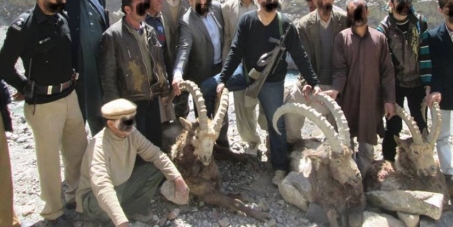
Pakistan’s National Animal Ibex Hunted & Endangered in Gilgit Baltistan Social media has been swarmed by heartbreaking and utterly cruel pictures of these hunters.
An increase in ibex hunting in Gilgit Baltistan has resulted in shock and outrage amongst the environmentalists and activists involved in the conservation efforts. What is outrageous is that not only is the Ibex i.e. Markhor is an endangered animal but is also the National Animal of Pakistan.
Social media has been swarmed by heartbreaking and utterly cruel pictures of these hunters
Gilgit Baltistan, along with the mountainous regions of the Chitral, is a major breeding ground for the South Asian ibex, a national animal of Pakistan. However, due to the recent hunting trend that has picked up the momentum we see the presence of these famed goats going down
Take a look at these images
[gallery ids="981,980,979,978,977,976,975,974,962" type="slideshow" link="file"]
Local as well as foreign hunters deliberately travel to the remote areas in Gilgit Baltistan in order to pursue this guilty passion
The most seen hunters on the fertile ibex hunting ground in Gilgit Baltistan are the elite who hunts theses mountain goats with liberty. And with the profiles of these influential individuals ranging from legislators to tribal chieftains, forest officers deployed to curtail such activities remain powerless to do anything.
The Foreign Tourists also descend on the GB to try their hands at hunting ibexes. Marcopolo Sheeps and Deers. Some of the most popular regions in GB preferred for hunting trips are Hunza, Astore, Nagar and Baltistan Region.
GB forest and wildlife department still does not spurred into action in response to the increasing amount of social media campaigns which protested the hunting of ibexes.
With such high casualties of our endangered species and our national animal, the actions taken by the Government is not ‘sufficient’ at all, let alone efficient.
The Government of Pakistan needs to wake up before it is too late.
This would in turn result in a significant financial impact and would help the locals in preserving and protecting our endangered species.


Rajnath Singh rakes up rights violation issue in Gilgit Baltistan
WASHINGTON: On a five-day visit to the US, BJP President Rajnath Singh has raked up the issue of human rights violations and oppression of the people of Gilgit Baltistan in the illegally occupied parts of Jammu and Kashmir.
"India and Afghanistan have traditionally been tied together by the Silk Route. If India does not share a land border of 106 kms with Afghanistan today, it is because of Pakistan's illegal occupation of this historical part of the state of Jammu and Kashmir.
"India and Afghanistan have traditionally been tied together by the Silk Route. If India does not share a land border of 106 kms with Afghanistan today, it is because of Pakistan's illegal occupation of this historical part of the state of Jammu and Kashmir since 1948," Rajnath Singh said in a keynote address at a conference on Afghanistan held at the Capitol Hill.
"The Northern Regions of Gilgit and Baltistan, whose people are subjected to massive oppression and human rights violations are a gateway for India to Central Asia with which we have had millennia-old relations. India should get rightful access to Central Asia through the Gilgit-Baltistan region, with connectivity being established between Kargil in India and Skardu in Gilgit," Singh said.
The conference was jointly organised by the Foundation for India and Indian Diaspora Studies; US India Political Action Committee and American Foreign Policy Council.
[gallery ids="720,719" columns="2" link="file"]
The organisers had also invited Senge Sering president of Institute of Gilgit Baltistan Studies, a Washington-based think tank to the conference.
In his speech, Sering said of late China has been making undue inroads inside Gilgit Baltistan, Claiming that thousands of Chinese workers and security personnel have entered the disputed region endangering the well-being of locals and placing an extra burden on resources.
It is estimated that China will invest more than USD 30 billion in Gilgit-Baltistan in the coming years to build dams and connect Xinjiang with Gwadar via rail and road, Sering said.
Sering said not long ago, Gilgit-Baltistan was considered the hub of international trade, connecting Afghanistan and Central Asia to India and beyond.
Free movement and commerce created a culture of co-existence and tolerance, he said.
"Today, we have a choice to carry forward that tradition or to allow a darker scenario to emerge with global security implications. Ignoring Gilgit-Baltistan's strategic value puts the entire region on a brink for political isolation, economic vulnerability and the growth of extremism and authoritarianism.
"The only tenable solution is to help transform Gilgit-Baltistan from the linchpin of terror to a hub of international trade, commerce and prosperity where all stakeholders have an incentive to maintain free movement between South and Central Asia," Sering said.
India, disappointed with Obama regime's notification to sell F-16 fighter jets to Pakistan, has decided to summon US envoy Richard Verma to lodge protest over
NEW DELHI: India, disappointed with Obama regime's notification to sell F-16 fighter jets to Pakistan, has decided to summon US envoy Richard Verma to lodge protest over the issue.
"We are disappointed at the decision of the Obama Administration to notify the sale of F-16 aircrafts to Pakistan. We disagree with their rationale that such arms transfers help to combat terrorism. The record of the last many years in this regard speaks for itself. The US Ambassador will be summoned by the ..
"We are disappointed at the decision of the Obama Administration to notify the sale of F-16 aircrafts to Pakistan. We disagree with their rationale that such arms transfers help to combat terrorism. The record of the last many years in this regard speaks for itself. The US Ambassador will be summoned by the ..
Conservators seek restoration of national treasures in Kashmir museum “The Gilgit manuscripts, belonging to the 6th century have been totally destroyed. These rare scriptures talked about the Buddhist life,”
 An 18th century shawl is lying on the footpath for drying, precious artefacts from the 6th century and valuable manuscript have been damaged due to massive floods in Kashmir. But these national treasures at Srinagar’s SPC museum have been completely forgotten by government authorities in their restoration drive.
To highlight the dismal state of these national treasures, a conference was organised jointly by SAHMAT and the Press Club of India in the capital Wednesday where conservators, historians and performing artistes talked elaborately on the effect that the floods have wrought on the cultural heritage of the Valley.
An appeal was made to Prime Minister Narendra Modi to take action for the preservation and restoration of these precious gems.
Member of National Monument Authority Salim Beg who had visited Kashmir to assess the condition of the museum said: “It is a huge loss in terms of history and culture of that place.”
Referring to a picture where shawls from 18th century were being dried in the sun after mud was removed with running tap water, Beg said: “The dire need is to appoint an expert team which can help in the restoration process.”
“The Gilgit manuscripts, belonging to the 6th century have been totally destroyed. These rare scriptures talked about the Buddhist life,” he said.
Beg, who is a former convenor of INTACH, Srinagar, said many valuable manuscripts in Sharada and Persian script have been damaged and destroyed in floods.
“Certain papier mache objects that had distinctive motifs and designs have been lost. They offered cultural layers of Kashmir through these carvings and motif,” he added.
“This loss is beyond material loss,” he added.
According to Joyoti Roy, conservationist, drying artefacts in the sun wasn’t a good idea.
“When wet objects are put in the sun for drying they become chemically weak and disintegrate,” she said.
“One should isolate the damp object. So physical isolation needs space and expert manpower, discarding objects shouldn’t be considered because they can be documented and restored in many different ways,” she added.
Both Beg and Roy felt the need of the hour was to bring the issue of neglect before the central government so that experts from various fields could find ways to tackle this issue together and preserve cultural and heritage identity of not only Kashmir, but the entire nation.
“It is an institutional failure, and this is not a question of complaining but finding solutions,” concluded Beg.
(IANS)
“One Samina Not Enough”- Samina Baig, a new global role model from Pakistan
“Women, across the world, should be empowered to reach the peaks in all walks of life”
SaminaBaigis the first Pakistani woman to climb Mount Everest and the first Muslim to climb seven highest summits of the seven continents of the world, which is considered to be Mountaineers’ Grand Slam
“Samina represents the true face of ambitious global women, who are eager to come out of their shells and contribute their optimum best to create a better world”, said Faisal NiazTirmizi, Consul General of Pakistan in Chicago.
“After Malala Yousufzai, Samina has emerged as another authentic role model not only for women in Pakistan but also for those from across the world”, he added.
SamanMuneeb, Vice Consul, while echoing the same sentiment, said that no career stream is either good or bad; if one is prepared to pay the exacting price by burning the midnight oil in his chosen field, success, fame, and other beneficial outcomes are bound to follow.
Humble Background:
Samina was born in a remote village, Shimshal, in the Hunza valley in Northern Pakistan. On account of the prevailing social norms, her parents expected Samina to pursue the minimum required education and settle down in life, as any other girl in a rural area.
However, the destiny had something else in store for her. Her interactions with foreign mountaineers inspired her to explore mountaineering as a career choice.
“Even though convincing parents about my decision to take up mountaineering was as difficult as climbing Everest, my continued persistence turned their stiff resistance into active support”, said Samina.
Continuous Learning
According to Samina, all occupations bring people face-to-face with a number of learning opportunities; however, many of them neither take note of them nor care to learn. She, therefore, kept her eyes and ears wide-open to learn from her own experiences and those of her colleagues.
“My exposure to mountaineering has taught me that believing strongly in one’s core competencies, committing oneself to the established goals, trusting in team members, proceeding towards the goals at a moderate pace, attending to the minutest details, cultivating mental toughness in the face of adversity, and having abundance of patience and perseverance are the preconditions for success”, said Samina.
“Even though I picked up these principles during the course of my career as a mountaineer, they are universal in nature and hold good for achieving success in all walks of life”, she added.
Mountaineering Deserves Encouragement
The Northern Pakistan is home to some of the world’s most impressive mountains and glaciers and challenging climbs. However, there is continuous decline in foreign expeditions coming to Pakistan, resulting in dwindling employment opportunities for the locals and inflow of valued foreign exchange.
“The Government may, therefore, consider relaxing the rigid visa regime in order to enable the region to emerge as a preferred destination for mountaineering”, Samina appealed.
“The local youth, who do not go to schools, should be exposed to state-of-the-art training in order to make them employable and to promote mountain adventure as a sport”, Samina urged.
[caption id="attachment_579" align="alignnone" width="600"] Samina baig and her brother Mirza ali baig at top of Mount Everest [/caption]
Gender Equality and Women Empowerment
Samina said that when she climbed Everest, her mind turned to the millions of women, across the globe in general and in Asian and African countries in particular, who are denied multifarious opportunities because of their gender.
For Samina, mountain climbing is not a fun sport. She does it for a noble cause of conveying a strong message that when she can achieve her highly challenging goals, despite her humble background, women from poor countries too can do similarly in different fields and make their families and the nations proud”, she added.
“It is a matter of gratification that the Government, across the world, and non-state actors, including international organizations, have started working together in achieving gender equality and empowering women”, observed Samina.
“While all religions provide for women empowerment, the age-old traditions of a subservient role of women made them the most vulnerable segment of world population”,Samina opined.
A Special Gratitude to Her Brother
The credit for Samina’s spectacular achievements goes to her brother, Mirza Ali, who is also an accomplished international mountaineer himself, with multiple achievements to his credit.
“Even though he was approximately 248 meters short from the summit of Everest, he let me go to it, on my own without his support, in order to justify my message that women can achieve their goals singlehandedly”, said Samina.
Sabarka Phal Meetha
Samina said that since her endeavors in the domains of mountaineering and women empowerment still represent an unfinished agenda, marriage is not even on her drawing board.
And, as a result, the prospective Mr. Right for this beautiful young lady has to undergo a long and agonizing wait.
But it is worth-doing so, as the adage goes: “Sabarka Phal MeethaHota Hai” (The fruit of patience is sweet
SaminaBaigis the first Pakistani woman to climb Mount Everest and the first Muslim to climb seven highest summits of the seven continents of the world, which is considered to be Mountaineers’ Grand Slam
“Samina represents the true face of ambitious global women, who are eager to come out of their shells and contribute their optimum best to create a better world”, said Faisal NiazTirmizi, Consul General of Pakistan in Chicago.
“After Malala Yousufzai, Samina has emerged as another authentic role model not only for women in Pakistan but also for those from across the world”, he added.
SamanMuneeb, Vice Consul, while echoing the same sentiment, said that no career stream is either good or bad; if one is prepared to pay the exacting price by burning the midnight oil in his chosen field, success, fame, and other beneficial outcomes are bound to follow.
Humble Background:
Samina was born in a remote village, Shimshal, in the Hunza valley in Northern Pakistan. On account of the prevailing social norms, her parents expected Samina to pursue the minimum required education and settle down in life, as any other girl in a rural area.
However, the destiny had something else in store for her. Her interactions with foreign mountaineers inspired her to explore mountaineering as a career choice.
“Even though convincing parents about my decision to take up mountaineering was as difficult as climbing Everest, my continued persistence turned their stiff resistance into active support”, said Samina.
Continuous Learning
According to Samina, all occupations bring people face-to-face with a number of learning opportunities; however, many of them neither take note of them nor care to learn. She, therefore, kept her eyes and ears wide-open to learn from her own experiences and those of her colleagues.
“My exposure to mountaineering has taught me that believing strongly in one’s core competencies, committing oneself to the established goals, trusting in team members, proceeding towards the goals at a moderate pace, attending to the minutest details, cultivating mental toughness in the face of adversity, and having abundance of patience and perseverance are the preconditions for success”, said Samina.
“Even though I picked up these principles during the course of my career as a mountaineer, they are universal in nature and hold good for achieving success in all walks of life”, she added.
Mountaineering Deserves Encouragement
The Northern Pakistan is home to some of the world’s most impressive mountains and glaciers and challenging climbs. However, there is continuous decline in foreign expeditions coming to Pakistan, resulting in dwindling employment opportunities for the locals and inflow of valued foreign exchange.
“The Government may, therefore, consider relaxing the rigid visa regime in order to enable the region to emerge as a preferred destination for mountaineering”, Samina appealed.
“The local youth, who do not go to schools, should be exposed to state-of-the-art training in order to make them employable and to promote mountain adventure as a sport”, Samina urged.
[caption id="attachment_579" align="alignnone" width="600"]
Samina baig and her brother Mirza ali baig at top of Mount Everest [/caption]Gender Equality and Women Empowerment
Samina said that when she climbed Everest, her mind turned to the millions of women, across the globe in general and in Asian and African countries in particular, who are denied multifarious opportunities because of their gender.
For Samina, mountain climbing is not a fun sport. She does it for a noble cause of conveying a strong message that when she can achieve her highly challenging goals, despite her humble background, women from poor countries too can do similarly in different fields and make their families and the nations proud”, she added.
“It is a matter of gratification that the Government, across the world, and non-state actors, including international organizations, have started working together in achieving gender equality and empowering women”, observed Samina.
“While all religions provide for women empowerment, the age-old traditions of a subservient role of women made them the most vulnerable segment of world population”,Samina opined.
A Special Gratitude to Her Brother
The credit for Samina’s spectacular achievements goes to her brother, Mirza Ali, who is also an accomplished international mountaineer himself, with multiple achievements to his credit.
“Even though he was approximately 248 meters short from the summit of Everest, he let me go to it, on my own without his support, in order to justify my message that women can achieve their goals singlehandedly”, said Samina.
Sabarka Phal Meetha
Samina said that since her endeavors in the domains of mountaineering and women empowerment still represent an unfinished agenda, marriage is not even on her drawing board.
And, as a result, the prospective Mr. Right for this beautiful young lady has to undergo a long and agonizing wait.
But it is worth-doing so, as the adage goes: “Sabarka Phal MeethaHota Hai” (The fruit of patience is sweet
KLF chief Yasin Malik opposes Gilgit-Baltistan merger with Pakistan
 Separatist JKLF chief Yasin Malik on Tuesday wrote a letter to Pakistan Prime Minister Nawaz Sharif, opposing moves to merge Gilgit-Baltistan with Pakistan as he has “no moral authority” to make a policy that “will adversely affect the future of millions of Kashmiris”.
He said such a step will give India a political and moral right to do the same with Jammu and Kashmir. He said he was writing the letter as media reports spoke of a meeting to be chaired by Sharif on January 14 to deliberate on the future of Gilgit-Baltistan.
“Apprehensions have been raised in various quarters that your government may reach a consensus to merge Gilgit-Baltistan with Pakistan,” Malik wrote. Noting that the change in constitutional status of Gilgit-Baltistan was being debated in view of the China-Pakistan economic corridor, the separatist leader said, “Economic development is good but you have no moral right to make policy that will adversely affect the future of millions of Kashmiris.”
[caption id="attachment_113" align="alignnone" width="1200"]
 Kashmir - Jammu - Ladakh would benefit from LoC trade - India accorded MFN status to Paki in 1996 by BJP...Pakistan had finally agreed to reciprocate by 2012....It betrayed India, Jammu - Kashmir - Ladakh...[/caption]
India’s Modi Makes Ramadan Call to Pakistan’s Sharif
[caption id="attachment_586" align="alignnone" width="300"] In the latest gesture between the two nuclear-armed neighbors, Indian Prime Minister Narendra Modi called his Pakistani counterpart Nawaz Sharif to greet him ahead of the Muslim holy month of Ramadan, which starts this week.
During the conversation, which lasted for around five minutes, Mr. Modi announced the release of detained Pakistani fishermen as “an act of goodwill,” Mr. Sharif’s office said in a statement Tuesday evening[/caption]
In the latest gesture between the two nuclear-armed neighbors, Indian Prime Minister Narendra Modi called his Pakistani counterpart Nawaz Sharif to greet him ahead of the Muslim holy month of Ramadan, which starts this week.
During the conversation, which lasted for around five minutes, Mr. Modi announced the release of detained Pakistani fishermen as “an act of goodwill,” Mr. Sharif’s office said in a statement Tuesday evening.
The released Pakistani fishermen “will be able to be with their families to observe this blessed month,” Mr. Modi said on social networking site Twitter. Details on the number of fishermen to be released and the timing were not disclosed.
In response, Mr. Sharif said in a statement that the two nations should “forget their differences and talk of war, and move towards peace and tranquility.”
“Pakistan and India should co-exist peacefully as they are neighbors, and they should not let their bilateral differences become hurdles in that path,” the statement added.
Mr. Modi first extended an olive branch to Pakistan when he invited Mr. Sharif to his swearing-in ceremony after his election last year, but since then, the fragile ties have soured with inflammatory remarks from both sides.
During a visit to Bangladesh earlier this month, Mr. Modi accused Pakistan of creating “nuisance” and “constantly troubling” India by promoting terrorism. Meanwhile, Indian military action along its eastern border with Myanmar last week rattled Pakistani leaders, who accused India of backing terrorist attacks on their land and slandering Pakistan at international forums.
Further, Pakistan last month refused to grant visas to Indian yoga instructors ahead of the first International Day of Yoga. India retaliated by rejecting the visa application of a Pakistani official to travel to New Delhi.
India and Pakistan have fought three wars since the partition of British India in 1947. Two of those conflicts were over the disputed region of Kashmir. New Delhi accuses Pakistan of sponsoring extremist groups that target India, while Islamabad accuses India of supporting terror outfits on their soil.
India and Pakistan have fought three wars since the partition of British India in 1947. Two of those conflicts were over the disputed region of Kashmir. New Delhi accuses Pakistan of sponsoring extremist groups that target India, while Islamabad accuses India of supporting terror outfits on their soil.
Cricket has often served as a diplomatic tool to ease relations though.
In February, Mr. Modi called Mr. Sharif to convey his best wishes for the 2015 Cricket World Cup. And in March, he again called the Pakistani prime minister to inform him about the visit of the Indian foreign secretary to his country as part of a tour of India’s neighbors.
Analysts feel Mr. Modi’s telephone call Tuesday could help resume dialogue between the two hostile nations.
“It is an optimistic development, a sign of goodwill in breaking the ice with Pakistan,” said Lalit Mansingh, a former Indian foreign secretary and one-time ambassador to the U.S.
But, “there is far too much a negative experience between the two countries to call it a diplomatic breakthrough,” Mr. Mansingh added.
Referring to Tuesday’s telephone call, Mr. Sharif said it reflected Mr. Modi’s wish “for good ties.”
 In the latest gesture between the two nuclear-armed neighbors, Indian Prime Minister Narendra Modi called his Pakistani counterpart Nawaz Sharif to greet him ahead of the Muslim holy month of Ramadan, which starts this week.
During the conversation, which lasted for around five minutes, Mr. Modi announced the release of detained Pakistani fishermen as “an act of goodwill,” Mr. Sharif’s office said in a statement Tuesday evening[/caption]
In the latest gesture between the two nuclear-armed neighbors, Indian Prime Minister Narendra Modi called his Pakistani counterpart Nawaz Sharif to greet him ahead of the Muslim holy month of Ramadan, which starts this week.
During the conversation, which lasted for around five minutes, Mr. Modi announced the release of detained Pakistani fishermen as “an act of goodwill,” Mr. Sharif’s office said in a statement Tuesday evening.
The released Pakistani fishermen “will be able to be with their families to observe this blessed month,” Mr. Modi said on social networking site Twitter. Details on the number of fishermen to be released and the timing were not disclosed.
In response, Mr. Sharif said in a statement that the two nations should “forget their differences and talk of war, and move towards peace and tranquility.”
“Pakistan and India should co-exist peacefully as they are neighbors, and they should not let their bilateral differences become hurdles in that path,” the statement added.
Mr. Modi first extended an olive branch to Pakistan when he invited Mr. Sharif to his swearing-in ceremony after his election last year, but since then, the fragile ties have soured with inflammatory remarks from both sides.
During a visit to Bangladesh earlier this month, Mr. Modi accused Pakistan of creating “nuisance” and “constantly troubling” India by promoting terrorism. Meanwhile, Indian military action along its eastern border with Myanmar last week rattled Pakistani leaders, who accused India of backing terrorist attacks on their land and slandering Pakistan at international forums.
Further, Pakistan last month refused to grant visas to Indian yoga instructors ahead of the first International Day of Yoga. India retaliated by rejecting the visa application of a Pakistani official to travel to New Delhi.
India and Pakistan have fought three wars since the partition of British India in 1947. Two of those conflicts were over the disputed region of Kashmir. New Delhi accuses Pakistan of sponsoring extremist groups that target India, while Islamabad accuses India of supporting terror outfits on their soil.
India and Pakistan have fought three wars since the partition of British India in 1947. Two of those conflicts were over the disputed region of Kashmir. New Delhi accuses Pakistan of sponsoring extremist groups that target India, while Islamabad accuses India of supporting terror outfits on their soil.
Cricket has often served as a diplomatic tool to ease relations though.
In February, Mr. Modi called Mr. Sharif to convey his best wishes for the 2015 Cricket World Cup. And in March, he again called the Pakistani prime minister to inform him about the visit of the Indian foreign secretary to his country as part of a tour of India’s neighbors.
Analysts feel Mr. Modi’s telephone call Tuesday could help resume dialogue between the two hostile nations.
“It is an optimistic development, a sign of goodwill in breaking the ice with Pakistan,” said Lalit Mansingh, a former Indian foreign secretary and one-time ambassador to the U.S.
But, “there is far too much a negative experience between the two countries to call it a diplomatic breakthrough,” Mr. Mansingh added.
Referring to Tuesday’s telephone call, Mr. Sharif said it reflected Mr. Modi’s wish “for good ties.”
Subscribe to:
Posts (Atom)

Follow Us
Were this world an endless plain, and by sailing eastward we could for ever reach new distances